Showing posts with label Dugald Orr. Show all posts

Thursday, 16 August 2018

Running Islay (6): Port Ellen to Kilnaughton and Singing Sands (10k there & back)

The bay at Kilnaughton has one of the finest beaches on the south of Islay, and also includes historic cemeteries, a lighthouse and the hidden 'Singing Sands' beach. And its an easy run from Port Ellen.

Heading out from Port Ellen towards Bowmore there is a side road going off to the left towards the Port Ellen Maltings. Take this road and follow it as goes out of town and towards the Oa, basically just taking the left turns which keep you closest to the coast.


After about two miles you will see a number of cemeteries on the left side of the road, run past the last one and take the track to the left down to the sea.  


After passing the Kilnaughton Old Churchyard with its ruined chapel (above), you will come to the beach. This is worth exploring as is the churchyard and the adjacent Kilnaughton Military Cemetery
 This was made to bury the dead of the SS Tuscania, a ship sunk off Islay by a German torpedo in 1918 with more than 200 deaths - though most of the American dead buried there were later removed to the USA.

The beach at Kilnaughton
Running round to the right you come to the 1830s Carraig Fhada Lighthouse. You can go right up to it via a footbridge. I have seen seals there, others have seen sea otters, so look out for wildlife.


Doubling back, near to the lighthouse you will see a sign to the Singing Sands. If you follow this short path behind the houses and over the hill you will come to the secluded beach of this name (known in Gaelic though as Traigh Bhan = white beach).


Singing Sands
From Port Ellen to here and back is around 10k, mostly on road (strava of my run here)

This area has a special significance to me, having spent many happy hours on the beach from childhood. My grandparents Neil Orr (1906-1980) and Janet MacTaggart (d.1990) are buried in the Churchyard, and you can also take a rest there on a bench dedicated to my dad, Dugald Orr (1935-1997).

My grandparents with my dad and my auntie Jessie,
this must have been taken in Islay in late 1930s


See other Islay runs:

Running Islay: Bridgend Woods

Monday, 24 July 2017

Less Survivable Cancers

When I ran the London Marathon in 2015 I asked friends and family to donate to  Core – the Digestive Disorders Foundation, a cancer research charity that focuses on cancers of the digestive system including stomach cancer which my dad, Dugald Orr, died from. Thanks to everyone who donated we raised over £900 (see previous post about  my dad and my reasons for this choice).


 I was pleased to hear from the charity again recently - they told me that they sometimes use a picture of me and my dad in their presentations which was touching. Last week they invited me to the London launch of a new campaign called the Less Survivable Cancers Taskforce  which they have started with a group of other charities concerned with lung, liver, oesophageal, brain, pancreatic and stomach cancer, which make up half of cancer deaths in the UK. A cancer diagnosis is devastating for anybody, but for those with these cancers the prognosis is particularly poor. They have just a 14% chance of surviving for more than 5 years, compared with 64% for more survivable cancers.


My dad's death in 1997 at the age of 61 came at the end of a period of more than six months of lost opportunities to diagnose his stomach cancer. When he started losing weight and having eating problems he was already in the system for arthritis and his symptoms were initially viewed through the lens of the rheumatology specialists he was seeing at the hospital. He then had an operation for a benign tumour on his thyroid and it wasn't until after this that he was finally given an endoscopy and diagnosed. Within a few weeks he had died -  too weak to cope well with surgery, he never fully recovered consciousness after an operation.

Nobody lives forever, and with the present stage of medical knowledge a magic bullet cure for all cancers might not be on the immediate horizon. But with timely diagnosis and treatment I'm sure my dad could have lasted a few more years, time at least to have met all his grandchildren for instance.

As I head  towards that age myself I find it depressing that in respect of these less survivable cancers there seems to have been relatively little progress in the 20 years since. Hence the need for the Taskforce with its five objectives:


1. Raise awareness of symptoms
2. Speed up paths to treatments
3. Remove barriers to treatment trials
4. Set government backed survival targets for each cancer
5. Increase investments in research

The Taskforce launch was held at Westminster's Portcullis House on Wednesday and featured contributions from people affected by these cancers whether as survivors or as relatives of those who didn't survive. The campaign seems to have some political support, such as through the All Party Parliamentary Group on Cancer, and with clear and achievable aims there is no reason why it shouldn't make an impact.

But improvements for people with cancer cannot be achieved in isolation from the state of health services more generally. If early diagnosis and treatment is a key factor in survival rates, then getting into the system quickly is essential. At present many people seem to be struggling to get to the first hurdle - getting a GP appointment - let alone getting referred on to appropriate specialists.


Here's a few comments from a facebook discussion last week about trying to get an appointment at my local GP practice in South London:


'I've tried every day this week and been variously: cut off after ten minutes on hold (twice); left on hold for an hour; unable to get through at all; getting a "the surgery is now closed" message for a whole day'.

 'I needed an appointment the next one is 26th august I was told Monday' [17 July]

'Few months back I couldn't get an appointment and the receptionist was asking all kinds of intrusive questions. I was in a bad situation and paid to see private at work and I needed to go to hospital for a scan... Even though I answered and told the receptionist I had lumps in my breasts she still wouldn't book me in!' 

'have just spent 38 minutes on hold again. Got through eventually and was told they are only taking emergency appointments. They could offer me a telephone appointment in 3 weeks (when I'm on holiday)...  Almost cried with frustration'.

I wish this was just a local problem at my doctors, but talking to other people this doesn't sound untypical - overwhelmed admin. staff rationing limited appointments. Knowing how hard it can be for many people to acknowledge their symptoms and seek help, anything that deters them from seeing a doctor can only reduce their chances of survival if they are unfortunate enough to be suffering from one of the less survivable cancers.


Primary care needs resources so that people can see their GP - not just money, but a supply of suitably trained and rewarded staff at all levels from receptionists to doctors. Around one in eight GP posts are vacant, and there is a national recruitment crisis: 'Almost one in five practices has had to abandon searching for a new GP as vacancy rates have hit their highest ever' (Pulse, 12 May 2017)


But I would also like to see more self-referral to cancer screening services, with more active surveillance for people at risk. One of the speakers at last week's event put his survival down to the fact that he was on a programme where he was having an endoscopy every six months, so his condition was picked up early. I fear that many, just like my dad 20 years ago, never get near such a procedure until their symptoms are too severe to treat.


Saturday, 14 March 2015

Remembering my dad Dugald Orr & running for stomach cancer research

I am lucky to have got a ballot place at next month's London Marathon, all I need to do is turn up and run, I don't have a fundraising target in return for a charity place. However when I do tell people I'm running they invariably ask what charity I am running for, so I have decided to create a low-key 'Just Giving' account so that friends and family can make donations if they wish. I have chosen to raise funds for Core: Fighting Gut and Liver Disease, a charity that funds research and provides information in relation to digestive disorders. My dad, Dugald Orr (1935-1997), died from stomach cancer and this is one of the diseases that Core focuses on.  

Dugald Orr - a sporting life

Me and my dad at St Joseph's in Luton

Of course there's lots I could say about my dad and his life, which started on the Isle of Islay and ended in Luton & Dunstable Hospital 62 years later. But as this is a running blog I will focus on sport, which some of my best memories of my dad are tied up with, football especially. We jumped for joy when we watched Luton Town beat Arsenal at Wembley in 1988, and didn't sing quite so loudly when we saw Scotland lose 5-1 to England at the same venue in 1975 (I was so small I had to stand on a stool on the terraces).  With his father, my grandad Neil Orr, we saw Luton beat Chelsea 4-0 (1976 - those days will come again!). and went to see Rangers play at Ibrox in 1977. The following year my dad took me to see Partick Thistle, the team he supported when he lived in Glasgow while doing his shipwright apprenticeship at Alexander Stephens shipyard on the Clyde. 

I remember watching him play football with his work colleagues at Vauxhall Sports Ground in Luton, but his main involvement with football while I was a child was as a coach in youth soccer. A qualified FA coach, he coached St Joseph's youth football team for six years in the 1970s, and then helped out with Meads United before going on to the committee of the Chiltern Youth League, the Bedfordshire under-18s league. When he died the Luton News described him as 'one of the most popular local soccer coaches in Luton' and 'one of the best loved characters in the local game' ('Sad loss of a coach who lived for youth soccer', February 19 1997).

St Josephs football club, Luton, 1970 - my dad at back in tracksuit, me as mascot to right of the ball. Other adults in this picture are Tony Coyne on the left - whose son Laurence Coyne (crouching  behind me) went on to play professional soccer in the US - and Bud Aherne (right), who played for Luton Town and Ireland.

Tom 'Bud' Aherne (1919-99)

Islay United

Earlier my dad had been a keen player himself. When my dad moved from Islay to Glasgow to work in the shipyards he played for 'Glasgow's only Island football team' Islay United who played in the Glasgow Welfare League. I was delighted to find a report in the Oban Times of him banging in four goals in a 7-1 win on Glasgow Green in 1958.


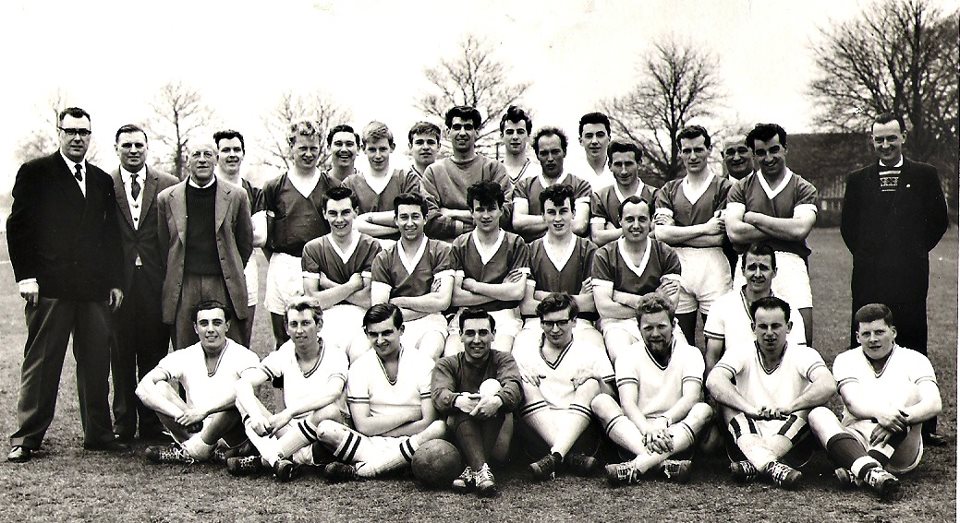
Moving down to Luton in 1960 to work for Hunting/British Aircraft Corporation then Vauxhall Motors, he played for a while  with Totternhoe FC. I believe this picture is of them, with my dad at the right end of back row.


Seemingly he also played cricket - this picture is of the Hunting/BAC cricket team in Luton, 1965, my dad in back row third from left. 


Of course I'm sad that my dad isn't around to know that I'm running the marathon, and since I've got more involved in the world of club running I've come to appreciate more the  work he put into youth football. The athletics clubhouses with their trophies and changing rooms remind me of the very similar football places I went to with him. Running and football, like most sports, are sustained by the efforts of countless volunteers like my dad who share their time, knowledge and skills without financial reward, just because they love it.

[last updated October 2025 with Islay United cuttings]