Showing posts with label Luton. Show all posts

Saturday, 25 March 2017

The Lark in the Morning - running over Blow's Downs in Dunstable

'In the golden lightning 
Of the sunken sun, 
O'er which clouds are bright'ning, 
Thou dost float and run; 
Like an unbodied joy whose race is just begun'

(To a Skylark by Percy Bysshe Shelley)


I went for a run last week at Blow's Downs nature reserve, a hilltop unimproved chalk grassland 'site of special scientific interest' overlooking Dunstable in Bedfordshire. I say overlooking but on this particular morning there was nothing to be seen in all directions but fog, making superfluous the sign at the top pointing out other landmark hills which are normally visible including Luton's Warden Hill (which I wrote about here previously).


If the town was invisible there was the odd trace of nearby urban reality as a reminder, like the carving on this fallen tree...


Blow's Down, at the northern end of the Chiltern Hills, is known for its wildlife with its information board mentioning ring ousels, redstarts and wheatears. I had hoped that I might see something interesting – the day before I had watched a red kite circling over nearby down Dunstable Downs. On this morning though the birds too were hidden in the mist.


But I could still hear their songs - one in particular as a skylark floated overhead uttering its 'silver chain of sound, Of many links without a break, in chirrup, whistle, slur and shake' (George Meredith, The Lark Ascending, 1881). Yes the skylark is the poet's favourite bird, and maybe every runner too aspires to 'float and run... like an unbodied joy' as Shelley puts it.  Though while running in limited visibility on uneven ground the runner must not lose themselves too much in ethereal thoughts - there is a steep quarry on the hill, and last year a dog walker broke his leg falling down the slope. 'The lark in the morning she rises from her nest', but s/he never loses sight of the ground.


'Alas! my journey, rugged and uneven,
Through prickly moors or dusty ways must wind;
But hearing thee, or others of thy kind,
As full of gladness and as free of heaven,
I, with my fate contented, will plod on,
And hope for higher raptures, when life’s day is done'
(To a Skylark by William Wordsworth)


The Luton - Dunstable busway runs along the bottom of the downs, a bus only route with a track alongside it that is great for runners and cyclists.


(The Lark in the Morning is of course an Irish folk song, I used to be part of a folk music session that performed it every Sunday afternoon in a pub near Elephant and Castle back in the 1990s)

Monday, 25 July 2016

Running up Warden Hill, Luton

Warden Hill, and the adjacent Galley Hill, are situated on the northern edge of Luton. They feature on both the recent Chiltern Way walking/running route and the ancient Icknield Way, and have been designated part of a Site of Special Scientific Interest as an example of chalk downland featuring some rare plants. Since 1993, they have been managed by Luton Borough Council as 'Galley Hill and Warden Hill Nature Reserve'.


They surely needed this protection as in the past 40 years the town has spread closer and closer to the hills with new housing developments replacing previous farmland. Yet immediately behind the houses on the local 'The Riddy Lane Trail' you are next to barley fields looking towards Warden Hill.
 
Riddy Lane Trail sign, located off Old Bedford Road near junction with Barnfield Avenue
 As a teenager I spent a lot of time on and around what we just called 'The Hill', as I lived nearby on one of the encroaching housing developments at the end of Old Bedford Road. And for a period when I was at Luton Sixth Form College me and my friend Nick ran up Warden Hill in the mornings. The healthy effect was perhaps slightly offset by stopping at the top of the hill each morning for Nick to have a roll up, but it was a good start to the day. 
 

I left Luton nearly 30 years ago, and my run up Warden Hill last week (in the course of an 8 mile run from Luton to Dunstable) was only the second time I've run up there since. Just as I remembered it, its trickiest feature is its false summit - running up the main pathway up you appear to be approaching the top but then find you are actually just at the start of the next section. Anyway it's quite runnable, maximum height  is 195m (there is a trig point on the top), and if you wish you can follow the path along the top of the hill and on to Galley Hill next door.


 From the top of the hill one direction faces over the town and the South Beds golf course  whereas the other way overlooks the open countryside towards the Bedfordshire/Hertfordshire border (as well as affording a view of the Stopsley hill that has figured in the town's cross country course, scene of national championships in the 1970s and 80s). Easy to imagine with your back to the town that you are in an ancient landscape. Neoltihic burials and the Drays ditches earthworks have been found in the vicinity, and Galley Hill apparently takes its name from Gallows that once stood on the hill top.


Amidst the wild flowers and bird life- swifts buzzing overhead, the song of yellowhammers - I was pleased to see evidence of modern teenage life, even if I wished that they had taken their rubbish home with them.  Schools had broken up for the summer a couple of days before, and burnt remains of exercise books scattered the hill top. But apart from a couple of dog walkers I passed on the way down I had the hill to myself.


'let them run riot and scream from the mountain tops'- creative writing burnt offering


Luton Wardown parkrun

While up in Luton at the weekend I also took part for the second time in Luton Wardown parkrun, which has now been running every Saturday since April 2015.  253 people took part this week, the highest number other than at their first birthday run in April. Great inclusive parkrun in a lovely park, this week it featured a group graduating from a Stopsley Striders beginners group to run their first 5k.


English National Cross Country Championships at Stopsley, Luton, 1975 -
won by Luton's Tony Simmons (founder of Stopsley Striders)

See previously:
 

Thursday, 12 May 2016

My (not so) brilliant junior career- 1970s Luton schools cross country

Among school reports and other memorabilia kept by my Mum I recently came across two stapled, duplicated sheets giving details of a cross country race I took part in way back in November 1975, when I was 12 years old.
 
The event was organised by Luton United Athletic Club at Stopsley, with a young boys race for the 'White Trophy', the 'Ninth annual colts cross country race' which I took part in over two miles, and the 'boys cross country relay race' (4 x 2 miles). Not sure of the age rages, the young boys is described as under 12s and I am guessing that the colts was 12-14s and the boys 14-16.
 
It seems to have been quite a big event. I ran for my school, Icknield High, but there were also clubs from across the country taking part such as Aldershot, Farnham & District AC,  Shaftesbury Harriers, Thames Valley Harriers, Hillingdon AC and Havering AC. Prizes were presented by Tony Simmons, the Luton runner who had won the 1975 National Cross Country Championships, also held in Luton at Stopsley, and was to go on the following summer to come 4th in the 10,000m at the 1976 Montreal Olympics (he now coaches the great Kate Avery).
 
'Betting in any form is strictly prohibited'


I've no idea how I did but I doubt if I set the town alight. In PE lessons I usually finished at or near the top in cross country runs around the playing fields and adjacent marshes - I like to think that this wasn't just due to not stopping for a smoke - and this led to me sometimes running for the school team. The only record I have of an actual result is from February 1977 when I wrote in my diary 'I ran in the Luton schools cross country championships at Stopsley. The snow covered course was 3 miles long. I came 79th out of 103, I was 4th out of 15 for our school'.  I also recorded that I had run the most laps for my class in 'a sponsored run for the school mini bus fund' doing '14 laps in 28.5 minutes', as well as coming to second to last in 800m on school sports day.
 
It was to be more than 30 years after leaving school before I took part in another race. I know some people who return to running in their middle age regret the lost years and wonder how well they could have done if they'd kept at it when they were younger. I've no doubt that if I'd trained as hard as I do now in my 20s and 30s I would have got some faster PBs than I am now ever likely to achieve, but in those days staying up dancing was my only endurance exercise.  My school record suggests in any case that I would probably have ended up at a similar level to where I am now. At school I was good enough to be picked for the team, but not good enough to finish near the front in competitive races. And today I am usually one of the first in age category at parkruns, but towards the back quarter in serious club competitions.  In fact I haven't made much progress since the mid-1970s - my 1500m PB when I was 14 was 5:52, last year I ran the slightly longer City of London Mile in 5:55. Perhaps I could just about take down my 14 year old self, but then again I am at least six inches taller!

(see previous post on Wardown parkrun and 140 years of Luton running history)

Update

Posted on 'I was, or am a runner!' group on facebook this is a  preview of the 1975 English National Cross Country Championships mentioned above, held at Stopsley in Luton: 'Runners who believe in real cross country should have no complaints about the course in Luton today... The three miles lap takes in a very steep hill and a long section of plough as well as grassland. Conditions will be muddy'. Luton's Tony Simmons ('The Man to Beat') won this race, while Steve Ovett (described here as 'dark horse') won the Junior race.


Sunday, 15 November 2015

River Runscapes

There's an interesting newish group on facebook called 'Our Runscapes' where people post photographs of where they run as part of 'an exploration of running and the landscape - where we choose to train and run'. 

Lately some of my favourite runscapes have involved meetings with remarkable rivers. When you turn up in a town that has a river running through it, you know there's a strong chance of a great run - after all there will probably be a flattish path alongside and not too many road crossings to worry about. But there's also something about the motion of a river, the steady but powerful flow onwards that every runner aspires too. Here's a few photos taken out running this year.

River Severn in  Shrewsbury


Shrewsbury is surrounded by a loop of the River Severn, with a wide tree lined path along much of its town-side bank. The suspension bridge (above) is by the Quarry, the main park in the town centre where Shrewsbury parkrun takes place every Saturday.


Statue of Hercules by the River Severn in Shrewsbury


River Cam


Staying in Cambridge for a wedding in July, I went out for a ten mile run on a Sunday morning. The River Cam has the added inspiration of serious rowing clubs out on the water from early in the morning. I ran along the south bank from Jesus Green out to Stourbridge Common, on the way back coming across people getting ready for Race for Life, where thousands of pink-clad runners traced a similar route as part of their 10k raising funds for cancer research.

ponies by the River Cam


River Lym

In Lyme Regis over the summer we were lucky to be staying in a house right next to the River Lym, and there is some great running to be had along the river and out of town to the old mill and beyond


River Ravensbourne

The River Ravensbourne runs through much of my South East London heartland, including close to my club's track, so I always seem to be running along or near to it. I will do it justice in a post of its own another time, but here it is glimpsed through the trees in Ladywell.


<


River Lea

The River Lea rises in Luton, where I was born and grew up. Earlier in the year on separate days I ran both its first few miles and its last, to where it joins the River Thames in East London.


The River Lea in Luton (stretch by Birdsfoot Lane)


River Thames

 Which brings us to the great River Thames itself. I guess most London runners have spent a lot of time running along, over and even under it - the latter through the Greenwich foot tunnel. The photo below was taken at the end of a long run to where the River Lea flows into the Thames by Trinity Buoy Wharf. Across the river where the cable car lands is where I ran  in the Assembly League on the Greenwich peninsula. A few miles to the West the Embankment where I ran along the river on in the closing miles of the London Marathon.  Many other memories floating off downstream.


Monday, 1 June 2015

Wardown parkrun... and 150 years of running in Luton

I grew up in Luton in Bedfordshire, so was delighted when I heard that a parkrun was starting in the town's Wardown Park in 2015. I went along for the first time in that May on only its sixth event and it  it already felt like a long established event, with nearly 200 people taking part and a friendly community emerging.

All parkruns have the same format, but they also reflect the unique character not only of their courses but of their local running communities. Wardown parkrun that weekend included nearly 50 runners from the main local clubs - Luton AC, Stopsley Striders and Dunstable Road Runners. A feature of the run too was a preponderance of strong young runners up front - five of the top ten finishers were under twenty years old, led by Rhys Lewis (Luton AC) in 17:40.


The start of Wardown parkrun, 30 May 2015

I have run there a few times since, and returned in May 2025 ten years after my first visit to find it still very much in good health.

The 5k course, mostly on tarmac, takes in three and a half laps of the lake in the park, along well-shaded tree-lined paths. No real hills, but a short slope near the finish that you come up four times. People meet up by the bandstand for the briefing, before walking down together to the start by the lake at the South West end of the park (New Bedford Road side).  The finish is up by the Museum.

A short history of running in Luton

Wardown parkrun is the latest development in a history of organised running in the town stretching back at least 150 years.

A Luton Athletic Society and Cricket Club was in existence by 1873, when the committee of the club announced that they had secured what was to become known as Dallow Road recreation ground for its use  (1). The club held an athletics meet there  in October 1873 with various track and field events (2). By the times of its 1888 athletic fete, cycling had been added to the programme (3).

Luton Times, 28 June 1873

There was also a 'Luton Hare and Hounds club', reported  in March 1875 to have run 'between 9 and 10 miles' cross country from Luton to Caddington and Kenworth and over Dunstable Downs (4).

Amateurism was a big deal in this period, with controversy over the extent of awarding prizes rather than cash to get around the rules prohibiting payment. It was presumably in this context that in 1892, Luton was expelled from the Amateur Athletics Association  'for not complying with an order re. under value prize' (5).

I assume relations must have been repaired, because in 1894 J. Daffern of the AAA was a handicapper at the club's Whit-Monday sports day. The Luton Times reported that  'The annual Athletic Sports of the Luton Athletic and Cycling Club, took place on the Dallow Lane ground, in the most delightful weather, on Monday afternoon. The many attractions offered drew together an enormous crowd numbering, it was estimated, at least five thousand persons, the largest number which has ever assembled to witness the sports of this club'. A mixture of running and cycling races drew competitors from around the country, and the event also featured a failed balloon launch and music from the Red Cross Band -  'In the evening the band played for dancing, which was largely indulged in by those present' (6).

The following Whit Monday (1895) the same event was held at Luton Town Football Ground, with a crowd of 3,000. This time the balloon ascent went smoothly.  There were Half Mile and One Mile races, the former won by C S Montague of Finchley Harriers (7). By 1899, however, the Whit Monday sports meeting had dwindled. 'Meager weather' may have been one factor in  the event at the football ground attracting less than 1,000, many of them children. The races failed to attract runners from outside the town, and the organisers made a financial loss (8).

There seems to have been a decline in athletics at this point, but a new Luton Athletic Club was launched at a meeting on 21 July 1908, held at the Central Cafe, in Cheapside: 'The need for a well-managed athletic club in the town has been keenly felt for years past. At last a move has been made (the suggestion coming principally from the employees of the Vauxhall and West Hydraulic Engineering Company)'. The club was offered the use of the Vauxhall ground in Kimpton Road. The meeting decided that  'The club is limited to amateurs, and the colours are the cardinal shirt and white knickers' (9).

A.J. Harman was elected captain at that first meeting and in the following year, in March 1909, he won what was said to be the first Marathon race in the town over 'a course of nearly 20 miles' which started in Park-square and proceeded 'via Dunstable, Houghton Regis, Sundon, Streatley and back along New Bedford Road' (at this time the Marathon distance hadn't been completely standardised). Ten of the twelve runners finished, greeted by 'a tremendous crowd' (10).

Shortly afterwards, the new club's first meet took place on a grass track laid out on People's Park, with races ranging from 100 yards to the mile. The crowd of up to 1500 in May 1909  'proved an exceedingly unwieldy handful for the perspiring committee of eight, with the assistance of one policeman' (11).

The club seems to have been renamed as Luton United Harriers and Cycling Club by the following year, perhaps as a result of a merger, with what was reported in July 1910 as  'the newly formed Luton United Harriers and Cycling Club' holding races at People's Park with 'Over 6,000 people... assembled round the track' (12). The club's Headquarters in this period were at All Saints Institute, Beech Hill, from where its cross country races sometimes started and finished (13).

People's Park is on a slope so less than ideal for athletics, and so Luton United Harriers explored other alternatives. In 1912, it  held a sports day at Stockwood Park, with running, cycling and some novelty events such as egg & spoon and sack races (14). The club also organised a one mile race at the town's American Skating Rink (15- not sure where this was in the town).

The club also lobbied the Council for the use of Wardown Park, a former private estate acquired by the Council in 1904 for development as a town centre park. After being refused permission to hold a sports day and gala  in 1911 (16) , the club applied again and a successful event was held at the Wardown Park cricket ground in May 1913 (17).

In the summer before the First World War, Luton United Harriers  (with Luton Town Football Supporters Club) held another  Whitsun Tuesday sports day in Wardown Park, where the competitors included Willie Applegarth who 'showed marvellous sprinting powers and he was warmly applauded for his success' (18). Applegarth, who ran for Polytechnic Harriers, was one of the world's fastest runners at this point having equalled the world 100m record and set the world 200 yards record.

The large industrial firms that were growing in the town in this period also entered into athletics, with their own sports clubs and grounds. In 1914 the sports day of Kent's Athletic Club included a mile relay race for local engineering firms with teams from Kent's, Vauxhall, Davis and Waterlow's ('Artisans' Athletics', Luton Times, 17 July 1914).

The war took its toll on the club, as with all parts of society. For instance, Private Alfred Smith (58 New Street), a moulder by trade and 'trainer of the Luton United Harriers', was shot dead in 1915 (19). Military personnel from all over the world were based in camps in the Luton area during the conflict, and the cricket ground in Wardown Park was used for Regimental Sports Days for the Royal Field Artillery based at Biscot. These were held in 19161917 and 1918 and races including other military units from the town, munitions workers and nurses. The 1916 event included a cross country race starting at Wardown and heading 'to the "Three Horseshoes" Leagrave, and then to Stopsley, returning by the same route. The distance was 8000 yards' (Luton News, 26 July 1916)

Regimental Sports at Wardown, 1918
(from Luton World War One- great war stories)
Athletics revived after the war and by the mid-1920s a permanent grass track had been provided at Wardown Park. The Midland Counties AAA championships were staged in 'the new sports ground at Wardown Park' in June 1928 (20). Luton United Harriers also acquired “Oxford Hall”, 2 Union Street as their headquarters in 1926 (21).

Bedfordshire Times, 15 June 1928
Women's athletics was taking off in this period. The club's first recorded female athlete, noted in 1925, was Ena Smith (Luton A.C. History).  The first ever women's national cross country championship was held at Luton Hoo Park in 1927 ('Modern Amazons Plucky Running', Western Daily Press, 14 February 1927). National cross country championships have taken place in Luton, usually at Stopsley, on a number of occasions since - including the first combined men's and women's champs in 1995. Paula Radcliffe, who  ran for Bedford and County AC, won the 1996 national students cross country champs in Luton.

By the mid-1930s, Luton United Harriers seemed to have been joined by another (new?) Luton Athletic Club. There was a Luton and District Athletic League, with four teams competing for the Walker Cup - Luton AC, Luton United Harriers, Bedford and County AC and RAF Cardington. The last match before the Second World War took place at Wardown in July 1939, with Luton AC winning the League (22). Another Luton team, Luton and District Athenians, is mentioned as competing against both in the 1934 Beds Cross Country Championship (23). The three Luton teams merged as Luton United Athletic Club in 1962/3 (24)

Wardown Park Sports Ground - where grass track was laid out in mid-1920s
(my school, Icknield High, held its sports days there in the 1970s, I believe I once ran the 800m there)

In 1952 the Bedfordshire County AAA Championships were held at Wardown, watched by '2000 people... basking in brilliant sunshine' (25). By this point though there was increasing discontent at the lack of an all-weather track in the town.  'No cinders yet for Luton's cinderella of sport', N.S. Paul noted in the Luton News on 1 July 1954, criticising the Council: 'it is a disgrace that Bedfordshre has no track or arena fit for international events...only a grass track in Wardown - when not debarred by other events going on there'.

In the post-Second World War period, Vauxhalls became increasingly important in athletics, as the company also dominated the town as its major employer. The 'first full-scale athletic meeting held at Vauxhall Motors' new ground' in 1953, included a crowd of 6,000 with a funfair and trick motor cycling as well as athletics. Teams competing in races included Vauxhall Motors Recreation Club, Luton United AC, Skefco AC (another local workplace team) and others from further afield (26).

Vauxhall sports  ground c.1980, with running track at top of picture
(my dad worked in the building at bottom when it was the engineering/design centre)

The annual Vauxhall sports day were largely based around athletics and and cycling in the 1950s but throughout the 1960s grew to a huge event, the Vauxhall Spectacular, with races supplemented with celebrity appearances, car shows, show jumping, fairground rides and more. I remember going to them as a kid, as my dad worked there. They came to an end in the mid-1980s, as the firm began to wind down its presence in the town - car production ceased in 2002. In 1998, the Vauxhall athletics club merged with Luton United to form the current Luton A.C. Some of the former Vauxhall Recreation facilities have survived as Venue 360. One of the last great triumphs of the Vauxhall Motors Athletic Club came in 1990 when a team broke the world record for a relay run from John O'Groats to Land's End.

Vauxhall Mirror, 21 June 1990
from Bedfordshire County Council Archives

An all weather track was opened at Stockwood Park in 1977, where it remains having been resurfaced a couple of times since. Luton AC's clubhouse is there too. In Luton's adjoining town, Dunstable Road Runners was formed in 1983. Another local club, Stopsley Striders, was formed in 1982 by Tony Simmons - a former Luton United runner who won a silver medal in the 10,000m in the 1974 European Championships, and set a world half marathon record  in Welwyn Garden City in 1978 of 62 minutes 47 seconds. 

Another Lutonian distance runner was Ian Thompson.  Born in Birkenhead, his family moved to Luton where he attended and ran for Luton Grammar School and Luton United. Thompson won Gold in the marathon at the 1974 Commonwealth Games, his time of 2:08:34 still being a championship record.
 
Thompson in the lead in a 1964 race at Luton Grammar School


No Luton running history is complete without mentioning its footnote in the history of the London Marathon. In the 1970s and 1980s, long distance running legend David Bedford owned the Mad Hatter nightclub in Luton (a place I sometimes frequented). As mentioned in the 2015 London Marathon magazine, 'On a Saturday night in 1981, future London Marathon race director and former 10,000m world record holder Dave Bedford was in the Mad Hatter, the nightclub he then owned in Luton. Several beers down, he accepted a bet of £250 that he could not complete the following morning’s inaugural London Marathon. Four piña coladas, a phone call to race co-founder Chris Brasher, a king prawn curry and another pint later, Bedford finally got to bed at 04:45. Just 75 minutes later he awoke and headed to the start. Despite being spotted on BBC TV looking less than his usual vigorous self, Bedford completed the race before falling asleep in a pub'.

And on 18 April 2015, parkrun came to Luton. Long may it last.

The finish line at Luton Wardown parkrun, 17 May 2025.

[post updated May 2025]

Sources:

(1) Luton Times, 28 June 1873.
(2) Luton Times, 11 October 1873.
(3) Bedfordshire Times, 4 August 1888.
(4) Luton Times, 20 March 1875.
(5) Manchester Courier, 19 December 1892.
(6) Luton Times and Advertiser, 18 May 1894.
(7) Bedfordshire Times, 7 June 1895.
(8) Bedfordshire Advertiser, 26 May 1899.
(9) Beds Advertiser 24 July 1908/
(10) Beds Advertiser, 19 March 1909.
(11) Beds Advertiser, 2 June 1909.
(12) Luton Times, 29 July 1910.
(13) Luton Times, 15 November 1912.
(14) Luton Times, 31 May 1912.
(15) Luton Times, 1 Nov 1912.
(16) Luton Times, 29 March 1912.
(17) Luton Times. 16 May 1913.
(18) Beds Advertiser,5 June 1914.
(19) Luton Times, 3 September 1915.
(20) Bedfordshire Times. 25 May 1928.
(21)  Luton Athletic Club History 
(22) Bedfordshire Times, 28 July 1939.
(23) Bedfordshire Times, 26 January 1934.
(24)   Luton Athletic Club History
(25) Bedfordshire Times, 23 May 1952.
(26) Luton News, 25 June 1953.

See also: 1970s Luton schools cross country at Stopsley, including programme for 1975 Luton United AC races.

Saturday, 14 March 2015

Remembering my dad Dugald Orr & running for stomach cancer research

I am lucky to have got a ballot place at next month's London Marathon, all I need to do is turn up and run, I don't have a fundraising target in return for a charity place. However when I do tell people I'm running they invariably ask what charity I am running for, so I have decided to create a low-key 'Just Giving' account so that friends and family can make donations if they wish. I have chosen to raise funds for Core: Fighting Gut and Liver Disease, a charity that funds research and provides information in relation to digestive disorders. My dad, Dugald Orr (1935-1997), died from stomach cancer and this is one of the diseases that Core focuses on.  

Dugald Orr - a sporting life

Me and my dad at St Joseph's in Luton

Of course there's lots I could say about my dad and his life, which started on the Isle of Islay and ended in Luton & Dunstable Hospital 62 years later. But as this is a running blog I will focus on sport, which some of my best memories of my dad are tied up with, football especially. We jumped for joy when we watched Luton Town beat Arsenal at Wembley in 1988, and didn't sing quite so loudly when we saw Scotland lose 5-1 to England at the same venue in 1975 (I was so small I had to stand on a stool on the terraces).  With his father, my grandad Neil Orr, we saw Luton beat Chelsea 4-0 (1976 - those days will come again!). and went to see Rangers play at Ibrox in 1977. The following year my dad took me to see Partick Thistle, the team he supported when he lived in Glasgow while doing his shipwright apprenticeship at Alexander Stephens shipyard on the Clyde. 

I remember watching him play football with his work colleagues at Vauxhall Sports Ground in Luton, but his main involvement with football while I was a child was as a coach in youth soccer. A qualified FA coach, he coached St Joseph's youth football team for six years in the 1970s, and then helped out with Meads United before going on to the committee of the Chiltern Youth League, the Bedfordshire under-18s league. When he died the Luton News described him as 'one of the most popular local soccer coaches in Luton' and 'one of the best loved characters in the local game' ('Sad loss of a coach who lived for youth soccer', February 19 1997).

St Josephs football club, Luton, 1970 - my dad at back in tracksuit, me as mascot to right of the ball. Other adults in this picture are Tony Coyne on the left - whose son Laurence Coyne (crouching  behind me) went on to play professional soccer in the US - and Bud Aherne (right), who played for Luton Town and Ireland.

Tom 'Bud' Aherne (1919-99)

Islay United

Earlier my dad had been a keen player himself. When my dad moved from Islay to Glasgow to work in the shipyards he played for 'Glasgow's only Island football team' Islay United who played in the Glasgow Welfare League. I was delighted to find a report in the Oban Times of him banging in four goals in a 7-1 win on Glasgow Green in 1958.


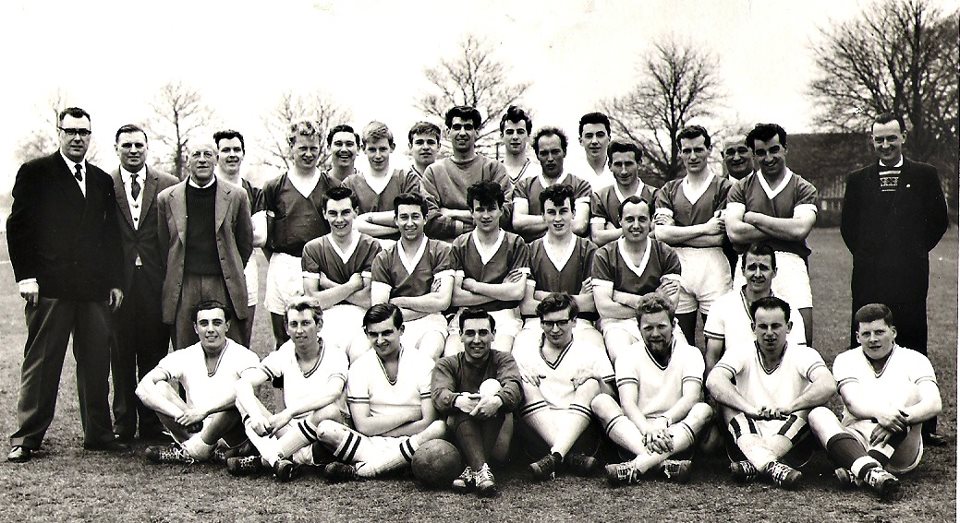
Moving down to Luton in 1960 to work for Hunting/British Aircraft Corporation then Vauxhall Motors, he played for a while  with Totternhoe FC. I believe this picture is of them, with my dad at the right end of back row.


Seemingly he also played cricket - this picture is of the Hunting/BAC cricket team in Luton, 1965, my dad in back row third from left. 


Of course I'm sad that my dad isn't around to know that I'm running the marathon, and since I've got more involved in the world of club running I've come to appreciate more the  work he put into youth football. The athletics clubhouses with their trophies and changing rooms remind me of the very similar football places I went to with him. Running and football, like most sports, are sustained by the efforts of countless volunteers like my dad who share their time, knowledge and skills without financial reward, just because they love it.

[last updated October 2025 with Islay United cuttings]

Friday, 11 April 2014

Friday photos (11): Running tracks from space

People have speculated for many years about the 'Nazca lines', a series of prehistoric geometrical figures in the Peruvian desert. Images of them taken from airplanes have been used to support various theories, most famously the claim by Eric von Daniken that they were messages meant for alien spaceships! I much prefer the explanation arrived at by one G.A.von Breunig that they were actually running tracks (there's apparently a 1980 article of his entitled 'Nazca: a pre-Columbian Olympic site' though I haven't been able to track it down).

Nazca lines
But what would space travellers or future archaeologists make of modern day running tracks? Thanks to Google Earth we can spend hours looking at satellite images of these mysterious ovals, overlaid with the strange markings of track and field. Here's a few examples I'm familiar with.

Icknield High School, Luton - I went to this school and remember running the 1500m around it. In fact I can still remember coming second with a time of 5:52 (quickly calculating that equates to about a 19:30 5k, about a minute faster than the taller, older me manages over that longer distance all these years later). The track is painted lines on grass, wonder how many times over the decades somebody has retraced the lines, and wonder too how many kids have run around it.  On this photograph you can make out the tiny dots of the runners, seemingly running a relay. Seems the picture was taken on the afternoon of Tuesday 30 June 2009, so if you had PE on that day it could be you! The overlapping oval of the cricket pitch can be seen too, with the wicket inside the running track.The marshy area at the top of the image was part of our cross country route:


Haberdashers Aske's playing fields, off St Asaphs Road,London SE4. My children had their primary school sports days there. Another grass track, with lots of other markings presumably related to javelin and shot put:


Ladywell Arena in Lewisham, home to Kent Athletics Club:


Southwark Park running track. The geometric design is some kind of temporary cover, the facility being currently  in poor condition and hardly used. Good news is that Southwark Council agreed last month to spend £2.6m to refurbish it:


Previously in the Friday Photos series:

Anita Neil - Britain's first female Black Olympian?

Thursday, 26 September 2013

Running London (5): Hackney Marshes 5k Your Way

The start - photo by Adnan Mohamedy (more at facebook)
Last week (18th September) I ran in '5k your way', an event on Hackney Marshes bringing together more than 800 council workers and other public sector employees to run, jog or walk for 5000m. Teams in colour coded t-shirts took part from London Boroughs including Bexley, Camden, Greenwich, Hackney, Haringey, Islington, Lambeth, Redbridge, Southwark, Tower Hamlets, Waltham Forest, as well as Leyton Sixth Form College and  'Central London Finest' with people from Westminster, Hammersmith & Fulham and Kensington & Chelsea.

Team Southwark, complete with British Heart Foundation mascot
 I was definitely in the running camp, and the front was fairly fast (too fast for me anyway). Glad to report that one of my work colleagues (David White from Southwark) came first with a chip time of 16:05; fastest woman was Claire Mcmahon from Islington in 19:05. I was pleased enough to get a 5k PB, and come 2nd in age category.


With the Marshes' wide open skies and green expanses (home to 82 football, rugby and cricket pitches), you feel like you're way out in Essex rather than in London. It makes for a good scenic run - nice and flat too - with changing rooms and a decent roof terrace bar at Hackney Marshes Centre (where we retired afterwards, walking back to the station under the full moon I half expected to bump into one of the Hackney Marshes 'bears' of urban folklore renown)

Of course you are in Iain Sinclair territory there, the writer even worked on the Marshes painting white lines at one point. In his book 'Ghost Milk' (2011) Sinclair mentions a 19th century running track nearby in Hackney Wick, started by one James Baum of the White Lion public house in 1857.  It was here that 'William "The Crow-catcher" Lang came down from Middlesbrough in 1865, to take the  world one-mile record with a time of four minutes seventeen and a half seconds. Not bad for an uneven track with an uphill section and a mob pressing tight to the verge. John "The Gateshead Clipper" White established a six-mile record that stood for sixty years, before it was broken by Paavo Nurmi, the legendary Finn, in 1921'. Thousands turned out here to watch 'Louis Bennett, a Native American known as Deerfoot'.

As Sinclair also notes, round there 'Everything begins with the fact of the river. the Lea and its tributaries. Like a wig of snakes. A dark stream sidling, fag in mouth, towards the Thames at Bow Creek; foam-flecked, coot-occupied, enduring its drench of industrial pollution'. Running alongside the River Lea was very evocative for me. I spent most of my childhood living by the river close to its source in Luton, playing football and cricket on the 'Riverside Walk' green by its Birdsfoot Lane banks, and more often than not arguing about who was going to fetch the ball out of the water (there was also the time I smashed my next door neighbour's glass door after whacking a golf ball with the cricket bat, but that's another story). Like the river, my journey brought me from there to London.


Something else got me musing about Luton on '5k your way', the experience of running in work teams reminding me of all the time I spent in the late 1960s/1970s hanging out at Vauxhall sports grounds, watching my dad play football or going to Vauxhall sports day, a big annual event with fair rides and games. In those days of one big company dominating a town (my dad worked for the car firm along with many others in Luton), there would often be sports clubs and facilities linked to it - Vauxhall in Luton even had its own running track up until the 1980s. I guess most of these facilities have vanished along with the manufacturing jobs that many assumed would be 'for life' - Vauxhall, which had once employed 30,000 people in Luton, ceased car production there in 2002. Still in a small way, 800 council workers on Hackney Marshes were still flying the flag for workplace-based sports and sociability last week!


You can run a 5k on Hackney Marshes every Saturday with the parkrun there, starting from Hackney Marshes Centre at 9 am. 

Terrain: mainly on tarmac paths, with some grass.

Getting there:  308, 276, 236 and W15 buses run close to the start of the course. The closest rail stations are Homerton and Hackney Wick.

Post-run refreshments: Hackney Marsh Centre has a cafe/bar.

Previously in the Running London series:


See also Run Don't Run's report of the Hackney Marshes 5k Your Way 2013