Showing posts with label Salford Harriers. Show all posts

Friday, 17 April 2015

Friday photos (22 ) - More 1890s English Athletes

I featured some photos a few weeks ago from an 1896 book entitled the 'Sportfolio: portraits and biographies of heroes and heroines of sports and pastimes'. I have never seen the actual book, but had found a few images from it on ebay. In response to that post, Jennifer Miller  (who runs with 'New Jersey's Best Running Club' Raritan Valley Road Runners) got in touch. Not only has she seen the whole book, but she has scanned all the pictures in of athletes - and kindly shared them to post here.

George Crossland, Salford Harriers:


E.C.Bredin, London Athletic Club:


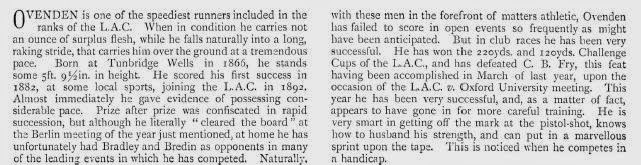
A. Ovenden, London Athletic Club:


Sid Thomas, Ranelagh Harriers, and later professional runner:


H.A. Munro, Lea Harriers:


J.E. Dixon (not stated in book, but he ran for Spartan Harriers):


E.J. WIlkins, London Athletic Club:


E.H. Pelling, Ranelagh Harriers


Some very well groomed gentlemen there, reminding me of  a comment about hair I read in an issue of the Ranelagh Harriers Gazette (no.167, May 2013) which I picked up in their clubhouse recently. It was a reprint of an article by 'Alsoran' from the Gazette a century ago (30 April 1914) describing the club's trip to Guildford for the Southern Cross Country Championships.The author writes: 'after the team had bathed themselves and got back to their right senses, besides bestowing very great care upon their hair - this being characteristic of all good-class runners - we got underweigh for The Three Pigeons... Things went quite in the ordinary way with each member of the team explaining how he beat old so-and-so, and gallantly passed five thousand men in the last quarter-of-a-mile, all for the honour of the Club, of course, and not for his own  special glorification'

Once again I am fascinated by the sophistication of running kit design at this period - note the thin white stripes on Salford Harriers shorts (not to mention Thomas's lederhosen!), and the specially-made shoes with spikes. They look quite similar to theses ones from the 1950s (photo from excellent I Was, or Am a Runner group on facebook):


Sunday, 13 October 2013

Running Books: The Ghost Runner - John Tarrant (1932-1975)

'The Ghost Runner: the Tragedy of the Man they Couldn't Stop' by Bill Jones (Mainstream Publishing, 2011) is the story of English runner John Tarrant.  Fundamentally it is the rather sad tale of a talented and (obsessively) committed long distance runner failing to achieve his potential, at least partly because of class, power and bureaucracy. But it is also about a refusal to submit to other people's rules and to keep on running - whatever the cost.

Tarrant, born in Camberwell in 1932, had a tough childhood marked by the death of his mother from TB and years in a brutal children's home during the Second World War. A spell as a teenage boxer in Derbyshire brought little success and a total of £17 prize money - but under the strict rules on amateurism enforced by the Amateur Athletics Association this was enough to prevent him taking part in any mainstream athletics events. These pernicious rules not only banned runners like Tarrant who had earned pocket money in unrelated events as a young person, but also enforced a boycott of people like him by other athletes. Athletes could lose their amateur status if they were found to have taken part in any competition with somebody who wasn't  an ameteur.

Banned from officially taking part in races, Tarrant started turning up anyway and running without a race number.  Gate crashing events like the 1956 Liverpool marathon and the following year's Doncaster-to-Sheffield Marathon led to him being nick-named 'The Ghost Runner' by the press. Official results left out his name -  the AAA didn't recognise him as a runner - but his cause generated lots of supportive publicity.

John Tarrant running without a number
After a couple of years the AAA appeared to back down and allowed him to run in its events - but his hopes of an international career were dashed when they later announced that he was still banned from taking part in events outside of the UK under IAAF rules. Taking up ultra-distance running, John Tarrant set world records at 40 miles (in 1966) and at 100 miles in 1969, running 400 laps of a track at Walton-on-Thames. Tarrant won the Exeter-to-Plymouth 44-mile-race five years in a row from 1965 to 1969, as well as the London-to-Brighton 54-mile race in 1967 and 1968 (running for Salford Harriers). He had expected that winning the latter would lead to him being sponsored to take part in the Comrades Marathon in South Africa,as had happened to previous winners), a 56-mile road race, but the IAAF ban excluded him from this. Tarrant resumed his ghost runner tactics and turned up anyway to run this 56-mile race between Pietermaritzburg and Durban in 1968. He came 4th but once again was expunged from the official record.

Taking part in this event had unexpected consequences. On the day he wasn't the only unofficial runner - there were several black and Indian runners who ran but who were also denied recognition - this was a Whites Only race at the height of Apartheid in South Africa.  Under the Separate Amenities Act, it was illegal for black and white athletes to even share changing rooms and other facilities.

A Natal Runners Association had been formed in the late 1960s to fight the racist exclusion of black athletes from the Comrades race. In 1970 they decided to put on a non-segregated 50 mile race of their own, and to make it a genuinely multi-racial event they needed to attract white runners. In the 1970 Comrades Marathon, 'scores of white runners had worn black armbands in support of the black athletes competing alongside them as numberless ghosts' (Jones), but only one white runner was prepared to actually run in the non-segregated Goldtop race in 1970 - John Tarrant, who finished first that year and the following year.

Tarrant continued running until his death from late-diagnosed cancer in 1975 at the age of 42.

Tarrant (left) after winning the 1968 London to Brighton run, with runner-up T.R.Baker
(see pathe news reel of this race)