Showing posts with label running history. Show all posts

Tuesday, 28 November 2017

Phyllis Green: 1920s Peckham athlete (plus some Peckham Rye running history)


I did Peckham Rye parkrun again at the weekend, with about  around 250 people doing a 5k in an area that  can claim to be one of the birth places of modern English athletics. Some of the runners were from established local running clubs like Kent AC or Dulwich Runners, some from informal local groups like Runhead AC (who run every Tuesday from the Beer Shop in Nunhead), many just enjoying being part of the parkrun crew. But it is two of the oldest established London clubs, no longer based in the area,  who trace their origins back to Peckham Rye:

'South London Harriers was formed on 27th December, 1871 at a meeting in the Vivian Hotel, at 34 Philip Road (now known as Philip Walk), Peckham Rye, SE15. There was a similar Club close by in Peckham Rye, which was founded at "The King's Arms", as Peckham Hare & Hounds in October 1869, before soon changing its name to Peckham Amateur Athletic Club (PAAC). It later moved to "The Rye House", and in July 1878 moved from the Peckham Rye area to become the Blackheath Harriers' (SLH: A Brief History)
Both clubs moved away from Peckham as it became more urbanised, but are still going strong elsewhere. SLH  has its  clubhouse in Coulsdon, while Blackheath & Bromley Harriers AC is  based at the Norman Road track in Bromley (and with a clubhouse in Hayes).

A notable Peckham athlete was a pioneer women's jumper and the first to clear five feet in the high jump. Phyllis Green (1908-99) was born at 12 Rye Lane where her father Henry Green managed the undertakers. He was a member of Peckham Harriers so no doubt encouraged his daughter who as a 17 year old at Peckham High School for Girls 'set her first world best of 1.51 metres at London's Stamford Bridge in June 1925, and equalled that mark in Brussels a month later. She raised it by half an inch when winning the WAAA title at Stamford Bridge on 11 July 1925, becoming the first woman to clear 5 feet (1.52 metres).  At another London venue, Chiswick, she improved her world best to 1.55 metres (5 ft 1 in) in 1926 and her highest ever jump was 1.58 metres (5 ft 2¼ in) at the 1927 WAAA championships off a grass take-off at Reading’ – the end of a short but successful competitive career . She also held the British long jump record for a while and her personal best of 5.52 metres in 1927 was only 5 cm short of the then world record.  She told a reporter in 1925 that ‘I have always jumped from the time I learned to walk…'I never went round an obstacle—I always jumped over it.' (source:  Mel Watman, Women athletes between the world wars, Oxford Dictionary of National Biography, 2012)
These were the early days of women’s athletics - the Women’s Amateur Athletics Association was only founded in 1922, and Phyllis Green belonged to the London Olympiades Athletics Club, the first women’s club, set up in 1921 in a period when many running clubs only admitted male members.
The only picture I have found of Phyllis Green is an etching by Percy Smith (1882-1948), held in the collection of the Birmingham Museum and Art Gallery

(see Running Past for details of the first WAAA championships, held at Downham in 1923)


Friday, 16 December 2016

South of the Thames Cross Country 1903

Looking forward to the South of the Thames Senior Cross Country race at Beckenham Place Park this weekend. My club, Kent AC,  won this race last year for the first time since 1907.  The club were a dominant force in cross country at the time, thanks in particular to their star runner Albert Aldridge. He won the South of the Thames in 1902 and 1903, with the club finishing in second place on both occasions. Here's a report and some pictures from the 1903 race, which was won by Herne Hill Harriers. A few points to note: cross country at this time still featured the old hare and hounds paperchase method of marking the course, with trail layers running ahead and scattering slips of paper for the runners to follow; courses often had hurdles such as fences to overcome (in this race, one runner was reported to have been severely injured on such a hurdle); and one lesson that still applies - make sure you get there on time.

'THE SOUTH OF THE THAMES AT BROMLEY COMMON. VICTORY OF THE HERNE HILL HARRIERS' (Illustrated Sporting and Dramatic News,14 February 1903)

'The ill-fortune which proverbially follows the Kent Athletic Club, at Championship time, pursued them hotly on Saturday. Scarcely had the team men recovered from the shock of hearing that H. W. Churchman was in hospital awaiting an operation, than they found themselves minus another good man in R. E. Guest. He arrived on the scene, at Oakley Park. Bromley too late to compete. Then, when the 175 runners, representing fifteen clubs, were well on their way, H. Stent injured himself so severely on a hurdle that he collapsed completely.

Finally, the Kent A.C. lost the Championship by 22 points. Last year they lost by 1 point only. They had the satisfaction, however, in both years of supplying in A. Aldridge the first man home. He beat the big field a bit more than comfortably in 41 mins. 52 3/5 secs- good running for seven and a half miles of varied going, with obstacles en route. Next to Aldridge came the Reading runner, D. G. Harris, who did wonderfully well for a man thirty-one years of age. He cut out the work for F. James, of the Herne Hill Harriers, with such determination that the latter's finishing powers were rendered less dangerous than usual. James came in third, and easily beat the Eastbourne athlete and Sussex ex-Champion, B. Sewell.

Team honours went to the Herne Hill Harriers, who were similarly successful two years ago. They ran well on Saturday to win, as they did, with their second best man, J. S. Raynor, dropping out from exhaustion, brought on by running several miles from the wrong station, at which he had alighted. F. Appleby, who has relinquished athletics, for a time, in favour of study, and A. B. Starck, who is far from well, were also absentees. The leading clubs and their points were Herne Hill, 115; Kent, 137; Reading, 142; Eastbourne, 210; Epsom, 212; and Morden, 215. The forward running of P. A. Casserley, of the last-named club, was a great surprise'.
The trail layers


Monday, 29 August 2016

Athletics in Beckenham, 1881

The last race of this year's Assembly League will be hosted as usual by Beckenham Running Club this week. While the 5k road race takes place on local streets, runners meet up and change at the cricket club ground on Foxgrove Road where the club is based, and most of the runners do a circuit or two of the cricket ground to warm up before racing.

Beckenham Cricket Club has been based at Foxgrove Road since 1867, and has been associated with other sports too since the early days. It gave birth to a tennis club in 1879, and judging by the following report, athletics was also part of its early activities.
 
In June 1881, Beckenham Cricket Club held its 'annual athletic meeting',  an event that featured both running and cycling races, as well as  entertainment from 'The band of the 11th Hussars (Prince Albert's Own'). The running races ranged from the 'hundred yards' to the Mile.


The 120 Yard Hurdles featured competitors from clubs including Beckenham Cricket Club, Private Banks Cricket Club, London Athletic Club, Arundel Athletic Club and Crystal Palace School of Engineering. Interesting that while clubs dedicated to particular sports existed by this time, the exclusive specialisation of athletes was not as developed as it later became - as is shown by a cricket club organising a running and cycling event, with cricket, football, running and cycling club members taking part.


The Mile Race (Open) featured 22 runners, with T. Shore of London Athletic Club acting as the Handicapper. Races were routinely handicapped in this period, with runners being given a head start according to their form and ability.  So the winner, J.E. Dixon (Spartan Harriers), had a 130 yard start while H.B. Burrows, South London Harriers was given a 50 yard start. It was 'A well contested-race, though the  winner led throughout, and won by ten yards'. Third placed H.D. Thomas (Blackheath Harriers) finished three  yards behind 2nd place, having  started at scratch (i.e with no head start). The winning time was given as 'four minutes, 24 and one-fifth seconds'.

The Challenge Cup 'was presented by His Highness the late Rajah of  Kolapore' to 'Mr A M Inglis, who had gained the highest number of marks in the club events', including winning the half-mile and the high jump. Other prizes were awarded by Lady Inglis (his mother) - Julia, Lady Inglis (born Julia Thesiger), lived in Beckenham after returning from India and wrote a book about her experiences in the Siege of Lucknow. Her son Alfred later played cricket for MCC and, on one occasion, Kent.

The cycling race included cyclists from clubs including Brixton Ramblers, LAC, Dewsbury BC, Crichton BC, London BC and Wanderers BC (in that period it seems that clubs were generally known as Bicycling Clubs - hence BC- rather than Cycling Clubs as they soon became known).

It was announced by Mr Percy Bicknell at the end that the rumour that  the club was about to give up the ground was untrue - in fact 'the ground had been secured for a period of 10 years'. Thanks to the efforts of these Victorian sporting pioneers, cricketers, footballers, tennis players, runners and others are still using these facilities more than a century later.


Source: The Beckenham Journal, 1st July 1881
(there are bound copies of this journal in Bromley reference library)

Monday, 21 December 2015

South of the Thames Cross Country Championships 2015: 7.5 miles at Somerhill

The 2015 South of the Thames Cross Country Championships took place on Saturday 19th December, hosted by Tonbridge Athletic Club in the grounds of the schools at Somerhill, outside of the town.

242 runners completed the tough 7.5 mile course, with the men's and women's races taking place together. The men's winner was Kent A.C.'s John Gilbert in 42:29. For much of the race he was neck and neck with Tonbridge's Max Nicholls, the 19-year-old Team GB junior mountain runner, but Gilbert pulled away on the last lap and Brighton and Hove's Stephen Ferroni squeezed past Nicholls on one of the final hills to take the silver ahead of Nicholls in third place.


Amy Clements (Kent AC) won the women's gold in 50:40, twenty seconds ahead of Nicole Taylor (Tonbridge AC), with Sammi Amend (Belgrave Harriers) in third. In the veterans categories Kent AC's Chris Greenwood and Cath Stibbs won the M40 and W40 medals, Tunbridge Wells Harriers' Alex Howey and Dulwich Runners' Clare Elms won the M50 and W50, with the M60 and W60 won by Michael Thompson (Tunbridge Wells Harriers) and Maggie Statham (Holland Sports AC) respectively.

In the men's team competition the big prize  - in every sense of the word  - was the Dewar Championship Shield for the six-to-score (i.e. team with the lowest combined points for their first six finishers wins, with one point for winner, 2 points for second place etc). Kent AC won by a six point margin from Tonbridge, with Belgrave Harriers in third. In the 12-to-score competition, positions were reversed with Tonbridge AC first, Kent AC second, and Brighton and Hove AC third.


Kent AC's winning men's team - Neil Phillips (8th place), Chris Greenwood (4th),  John Gilbert (1st), Ken Pike (manager/coach), Owen Hind (9th)m Ben Harding (18th) James Connor (12th).

Detail from the Dewar Challenge Shield, presented to the South of Thames Cross Country Association by whisky magnate and MP Thomas Dewar (1864-1930). Note the image of runners heading towards a gate.
The women's race was won by Dulwich Harriers, with Kent AC in second place and Belgrave Harriers in third position.

Kent AC women scorers  with their silver medals: Cath Stibbs (7th place), Amy Clements (1st) , Kate Williams (26th), Sarah Young (31st), Victoria Buck (20th), Teresa Murphy (14th).
The course

The map and the territory

The course, which had been very well laid out by Tonbridge AC, was essentially set on one side of a large hill in the grounds of Somerhill House. Built in the 17th century, the building and its estate have a rich history including a period as a World War Two prisoner of war camp and a link to the wonderful stained glass windows by Marc Chagall in the neighbouring village of Tudeley. Since the 1990s Somerhill has been the home to several independent schools.


Somerhill was painted by JMW Turner in 1811, and the hill shown in the painting was the one we ran up, down and across at the weekend, with three significant ascents on each of the three laps. The ground was soft, and fairly muddy/slippery in places. A few tumbled and most were fairly drained by the end - I know I was, coming down with a cold I considered getting round without stopping an achievement in itself.

I bet Turner didn't run up that hill nine times in an hour


History

Kent AC (my club) have been doing really well in cross country in recent years,  winning the men's Surrey League and men's and women's races at last month's South of the Thames Team Race (a shorter race previously known as the South of Thames Junior race).  But the club have not won the South of Thames Championship since 1907, when the team came first in the race held at Bromley. J. Keywood won the race for Kent AC that day, followed by R.H. Backshall (Eastbourne) and J.S. Satch (Kent AC) in third place.


Kent AC's Albert Aldridge, one of the country's top distance runners of the period, won the South of the Thames in 1902, though on that occasion the club finished second to Brighton and County Harriers. The location again was Bromley - 'Mr A C Norman's park' - which as today's Norman Park Recreation Ground hosts Bromley parkrun and the running track used by Blackheath and Bromley Harriers.


See also:

Friday, 9 October 2015

Wimbledon Common, Blackheath and the origins of cross country

This weekend sees the start of the cross country season and I hope to take part in the first race of the Surrey Cross Country League Division One,  running with last year's champions Kent Athletic Club. The men's race is on Wimbledon Common, an iconic location regarded by many as the birthplace of modern cross country racing.

'Modern athletics' by Henry Fazakerley Wilkinson, published in 1868, gives the background. Public schools such as Shrewsbury and Eton were holding steeplechase races by the mid-1840s, and there were also cross country hare and hounds races. Steeplechase of course took its name from the form of cross country horse racing where riders used church steeples as markers as they were visible over long distances. In athletics as in horse racing the event entails jumping over obstacles along the way, with the early steeplechase runs in effect being cross country runs with gates, ditches etc. to be overcome. The first Cambridge and Oxford University inter-collegiate athletics competition took place in 1864 at Christ Church Cricket Ground in Oxford and featured a two mile steeplechase race. In this context, the event was moving from a cross country run to a flat course with specially arranged obstacles, as in the modern track event.  For a while 'steeplechase' seems to have been used to refer to either an event of this kind or a cross country run with obstacles.

Although often overlooked in the orthodox public school/university-centred history of athletics (of which Wilkinson's account is a classic example), there was also a popular culture of organised running outside of the colleges long before this, with foot-matches between professional runners some of them on what would nowadays be regarded as cross country courses. But it seems to be true that before the late 1860s there were no cross country races between members of different clubs, as of course this was the period when clubs were first emerging. One of the earliest, Mincing Lane Athletic Club, was founded in 1863, renaming itself London Athletic Club in 1866. It was actually amongst rowing clubs that the club competitions developed, as Wilkinson describes:

'The initiative in London, with the exception of the Honourable Artillery Company's sports, was undoubtedly taken by the West London Rowing Club in the winter of 1861-62. This club instituted athletic meetings as a subsidiary sport during the rowing recess, at a time when such gatherings were quite unknown in the metropolis. It was said such meetings would never answer: that men who trained hard throughout the rowing season required to rest in the winter, and that incessant training all the year round was injurious. The first spectators came to jeer, but remained to applaud, and went away very strongly possessed in favour of athletics. These winter meetings have been held ever since with great success; and now there is no metropolitan rowing club of note which has not followed in the footsteps of the West London'.

Wimbledon Common

Wimbledon Common and its windmill pictured in 1880s
(from 'Greater London: a narrative of its history, its people and its places'  by Edward Walford, 1888)
On 7 December 1867 Thames Rowing Club (from which the still extant Thames Hare and Hounds running club developed) held a steeplechase race on Wimbledon Common, and it is this event that is often said to be 'the first cross country race' not because if was the first time people raced across fields but because it 'the first "open" cross country race' in which members of different clubs took part (Amby Burfoot, Common Ground, Runners World, July 2006).

Actually it wasn't strictly an open race, as Wilkinson's report makes clear, but it certainly included members of several different rowing and athletic clubs:

'A private handicap steeplechase, confined to members of the Thames Rowing Club and their friends, came off on December 7, when a dozen competitors started over about two and a half miles of Wimbledon Common and some adjacent ploughed fields, beginning in the dusk and
finishing in the dark, competitors having to find their own way to a great extent. The winner turned up in W. Cross of the Thames Rowing Club (20 seconds), who kept a capital course, and finished about 100 yards before C. Bainsford of the Middlesex A.C. (35 seconds), the latter just beating J. G. Webster of the Twickenham Rowing Club (30 seconds), neither of the two last knowing the way. W. Rye, London A.C, the scratchman, finished fifth. The course was fearfully heavy and wet, and falls were frequent and severe.'

Wilkinson also reports that a similar race was held there a couple of months later:

'After a long lull, metropolitan athletics were recommenced on February 1, 1868, by the Thames Rowing Club handicap steeplechase (No. II.), which was run over a different and more open part of Wimbledon Common than the first, and produced exactly double as many starters - 24 out of 55 entries coming to the post. W. Slater, West London R. C. (85 seconds) led for three quarters of the way, but fell into a deep and awkward ravine, and was passed by J. G. Webster, Twickenham R. C. (20 seconds), W. James, London A.C. (45 seconds), C. Chenery, Marlborough Grammar School (50 seconds), E. Hawtrey, Eton College (35 seconds), S. F. Smith, Blackheath (25 seconds), A. King, Thames R.C. (25 seconds), and F. Chappel, Kingston R.C. (50 seconds), who were all together a quarter of a mile from home. Hawtrey was thrown out of the front rank by a water jump, into which he went ; Chenery gave up dead beaten 100 yards further; and as James and Slater tailed soon after, the race was left to King and Webster, the former winning through sheer gameness by a yard and a half, Chappell just stalling off Hawtrey, who came with a great rush at the finish, securing third prize by a foot'.

With ravines, water jumps and severe falls, these Wimbledon Common cross country steeplechase runs were clearly very challenging as well as amongst the first of their kind. But were they the first?

Interestingly, Wilkinson records that in the 1867-68 season 'The first meeting of any consequence was that held at Blackheath on October 5 1867' and that at this the meet 'The mile handicap steeplechase was won by A. Maddock of Richmond, receiving 15 seconds from W.M. Chinnery, (London A.C.) the scratchman, who never got near the leaders. R.C. Hannis of the Eton Excelsior R.C., who had 8 seconds of the winner, ran him hard and showed fair form, but had not calibre enough to compete successfully with Maddock, who is thought by some to be the coming mile runner. Blackheath has ever been celebrated as producing celebrated runners, and this, the first meeting passed off most successfully. The times were good throughout, considering the length of the grass on which the course was laid out and the high wind'.

Perhaps the distance (one mile rather than two) and the possibly grassier conditions still support the claim that Wimbledon saw the first inter-club cross country race proper, although Blackheath - today of course the starting point for the London Marathon - should also be accorded its place as one of the origin points of modern athletics.

Wednesday, 7 October 2015

'Running naked in a publick Road' (1754)

'Last Saturday Afternoon a foot-match was run between two Coal-Heavers, from the Turnpike in Whitechapel-road to Bow and back again, for five Shillings - The indecent Appearance of Men running naked in a publick Road, and the Number of idle People which such an Occasion generally draws together, may not be unworthy the serious Consideration of those Persons in whose Power it is to prevent them' (Oxford Journal 18 May 1754).

A short report of a mid-18th century running race in East London with a lot of detail packed into it. Running of this kind was evidently popular, drawing a crowd deemed disespectable by some ('idle People'). The runners were 'naked', but in this period that did not necessarily mean nude, as in wearing no clothes at all, but rather not wearing the socially expected amount of clothing. On the other hand coal heavers probably didn't have an elaborate range of underwear/sportswear in this period, so they might not have been wearing very much at all.

Tuesday, 29 September 2015

Running Clapham Common: RunThrough 10k 2015 (and a 15 mile race in 1869)

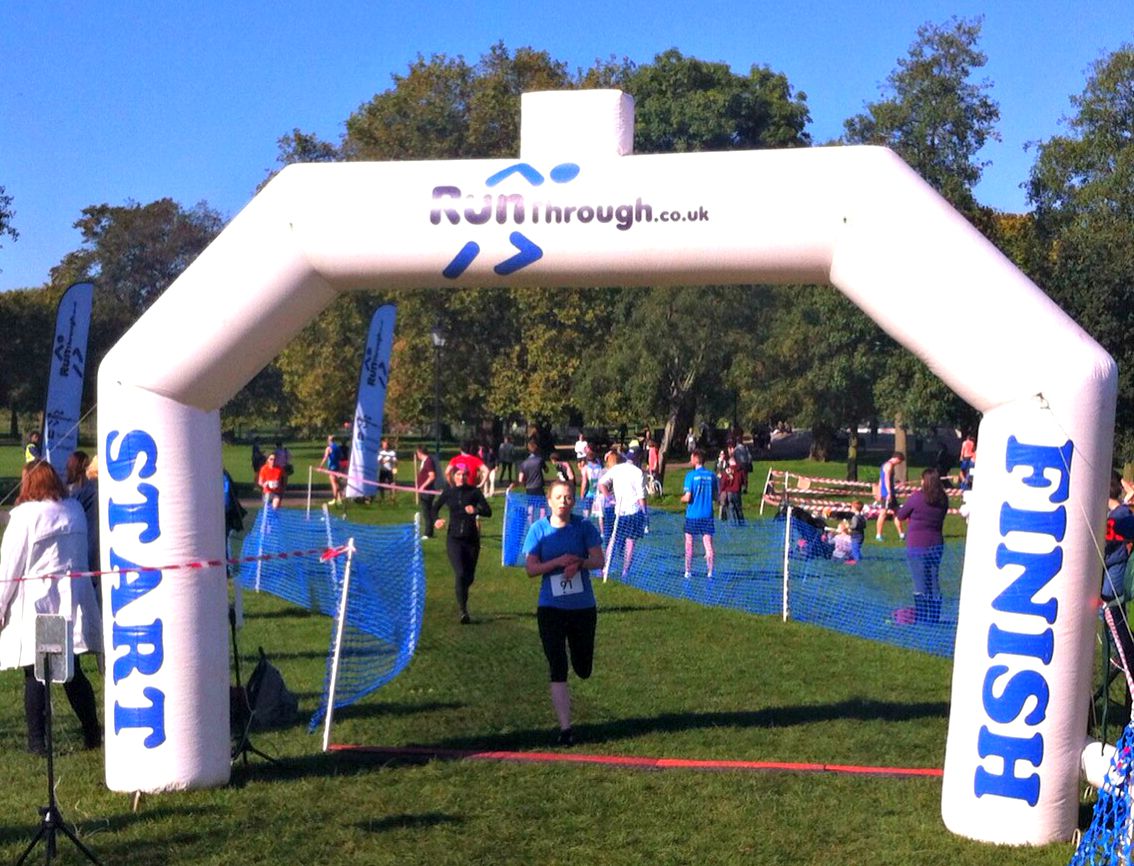
I enjoyed the Clapham Common 10k organised by RunThrough on Saturday, with nearly four hundred runners finishing a three lap course around this flat South London park. I suspect too that it will be my last race in sunglasses this year - a glorious sunny morning on this first weekend after the Autumn Equinox. Dan McGrath finished first in 33:50, first woman finisher was Imogen Aimsworth in 36:43 (full results here). I took a couple of minutes off my PB in my first 10k for two years, so was more than happy.

The start/finish was near to the park's grand Victorian bandstand, which along with the local underground station inspired the event's fine medal 


There's always people running round Clapham Common, and a number of local running groups/ clubs use the park regularly - including Clapham PioneersClapham Runners, Sweatshop's running group (from their shop just off Clapham High Street in Voltaire Road) and indeed RunThrough themselves who have a free Monday night session there. 


The Common doesn't seem to have quite the rich running history of other South West London parks such as Richmond and Wimbledon - where organised cross country running started out - but it was featuring in races even before it was drained and recreations grounds laid out in the 1870s. This report from 1869 is of a Hare and Hounds race organised by Brixton Football Club. Two 'Hares' - F. Bone and Harry Foster - laid a paper trail across nearly 15 miles of SW London in one hour 57 minutes for the 'hounds' to follow. As well as Clapham Common their run in a loop from Brixton took in Streatham, Tooting and Wandsworth Commons.

The Sportsman, 10 March 1869

Wednesday, 9 September 2015

Railway Jack & the Lewisham Pet: the Perch brothers & 19th century pedestrianism

Before the rise of athletics clubs in the second half of the nineteenth century, the main focus for organised running in England was on races between individual  runners. In a format not unlike boxing, runners with outlandish nicknames challenged each other through newspaper columns and large crowds turned up to watch and bet on the outcome. Newspapers including Bell's Life in London and The Sporting Life promoted the sport, making national celebrities of some runners, and many local pubs were also involved both in hosting events in their grounds (crowds meant drinkers) and as places where the competitors would lay down their respective stakes for prize money. Runners sometimes had backers who put up the stake money for them, in return taking their share of the winnings. The whole sport was known as 'pedestrianism', a term that covered all kinds of foot-races, including walking races, sprints and longer distance runs.

Two prominent pedestrians in the mid-19th century were brothers from Lewisham: John Perch (alias Railway Jack) and Thomas Perch (sometimes known as the Lewisham Pet).  This is where my club, Kent AC, is based - so as part of exploring its history I have been looking into the earlier world of pedestrianism in this part of South London.

The 1841 census shows the Perch  family living at No. 1, Gothic Cottages, Rushey Green – at the time John was 15 with another brother Richard of the same age (twins?), along with siblings including Thomas (13 - he was baptised in May 1829 at St Mary's Church, Lewisham) and Joseph (7). The Gothic Cottages seem to have been at 110 Rushey Green - an

The father’s occupation is given as castrator. Both Thomas and John were subsequently listed as having the same occupation in the 1851 and 1861 census respectively - in the latter John was living with his parents at 7 James Place, Lewisham with father and son both giving occupation as ‘castrator of stock’.  This is a reminder that at this point Lewisham in Kent had not yet been completely swallowed up by the expanding metropolis - there were still farms in the area.

Railway Jack

Not along after this, John Perch began to make a name for himself as a sprinter and hurdler. In January 1844 'Two very excellently contested foot-races took place... near the eighth mile-stone at Lewisham' with 'a very numerous assemblage of the patrons and admirers of pedestrian performances'. Goldsmiths of Greenwich beat Banks of the West-end over 250 yards and in the second match Perch beat Par over 150 yards (West Kent Guardian, 20 January 1844).

West Kent Guardian, 20 January 1844
Although this Perch is not specifically named, it seems most likely that it was John, as there are other reports from the same year that identify John Perch - or Railway Jack - as a runner, and none I have found at this stage that mention Thomas. We know of some of John Perch's races through contemporary reports, and others from newspaper listings of forthcoming events:

- in August 1844, he won a hurdle race over 350 yards at the Tiger's Head in Lee Green, Lewisham (see post on this race at Running Past);
- 'Perch of Lewisham (alias Railway Jack), and Naylor' were scheduled to 'run a match on Wednesday September 18 [1844] at the Beehive Cricket Ground, Walworth, distance 200 yards, and to leap 10 hurdles, 20 years apart, each hurdle to be 3 feet 4 inches high' (The Era, 8 September 1844);
-  In January 1845 'Railway Jack' - this time described as 'of Greenwich' beat George Parry ('alias Jim Crow') over 150 years at Southend, Lewisham (8 February 1845);
- Later that year he 'ran a quarter of mile race for £5 a side' against W. Berry of Lambeth, with Perch having a head start of ten yards in the race at South End, Lewisham: 'The start was a good one, both going away at a rattling pace. Perch however kept ahead throughout the distance, and went in an easy winner, Berry having given up some distance from the finish' (Bell's 14 Sept 1845)
- In November 1845 he was scheduled to run against Pearce Naylor, over 150 yards at the Tigers Head in Lee Green, Lewisham (The Era, 23 November 1845).

There are reports of challenges too: 'Edward Smith will accommodate Perch, alias Railway Jack, of Greenwich, with a match, and will give him two yards start in 150 for £5 or £10 a side, or he will run him  a quarter of a mile and leap 15 hurdles for £10 a side. The money will be ready at Mr Parr's, Green-street, Grosvenor Square, to-morrow' (Bell's, 4 Feb 1844).

John Perch '(alias Railway Jack) of Lewisham' won 'a silver stop watch' in a 150 yards race beating five others, at the Kings Head in Bexley Heath in November 1847. There was a dispute about whether he should have been allowed to receive the prize as the race was for runners 'who had never won more than £5 in any race', and Perch had  previously won a race against Berry of Lambeth advertised as being for a £10 prize. However the landlord of the Fisherman's Arms in Greenwich confirmed it was in fact only for £5. The landlord is described as the 'stakeholder for that race'- the origin of this term is the person who holds the stake put down for a wager (Bell's, 7 November 1847).

(Bell's Life in London, 7 November 1847)
Intriguingly in 1844, it was reported that 'Railway Jack's youth and S.Penny of Greenwich' will 'run tomorrow... at the Green Man, Southend, Lewisham' (Bell's 10 March 1844). Could this have been his younger brother? Certainly in the following year, both Perch brothers took part in a 350 yard hurdle race in a field by the Tigers Head, Lee along with James Kitchener (the Hampstead Stag) and Ned  Wild (Merrylegs) (Bell's 7 September 1845).

Thomas Perch, the Lewisham Pet

In September 1847, The Era reported 'fun and frolics' in a quarter of a mile race between two runners, 'one named Cross, and the other designated the Lewisham Pet' (The Era, 19 September 1847). The former won in a race in Charlton-lane, Blackheath, where both 'bounded like affrighted antelopes'. The identity of the Lewisham Pet isn't disclosed, but in the report of race in 1850, the same paper refers to Perch 'who revels in the sobriquet of the Lewisham Pet' (Era, 29 September 1850). This was Thomas Perch, though confusingly in this period there was also a boxer, 'Young Bostock' known as 'the Lewisham Pet' (Bell's 26 November 1848).

(The Era, 19 September 1847)
If Thomas Perch started off as John's lesser-known sibling with reports referring to him as 'brother to Railway Jack' (Bells, 28 January 1849) he soon seems to have established a reputation as a runner in his own right.

In January 1849 'nearly two thousand persons assembled' to watch him beat Joseph Judd of Westminster in a 120 yards race at Beddington Corner, Surrey for which 'both men had been in active training'. He was described on this occasion as 'about 5 feet 5 inches in height, and weighs about 8 stone; when stripped, his skin looks a nut brown, is well knit together, and all runners of his size will find him a troublesome character. He first showed in public a short time ago by beating Price of Mile End rather easy in a six score yard race' (Bell's, 28 January 1849).The latter race with William Price was over 130 yards in December 1848 (Bell's, 3 September 1848)

(Bell's Life in London, 28 January 1849)

In the following year he raced James Mayne of Mile End, for £25 a side, at the Flora Ground in Bayswater (Bell's Life in London, 29 September 1850). Once again the report emphasises the runners' preparation - this was a serious sport, not a casual contest between talented but unprepared athletes: 'Both had been actively trained for the event, Mayne under the charge of John Smith of Turnham Green, and Perch had the advice of his brother John at Charlton'. The result 'in one of the best contested races ever witnessed' was declared a dead heat.

(Bell's Life in London, 29 September 1850)

The rematch the following week saw Perch win 'after seven false starts', proving himself 'a very smart runner... a good starter, very quick in getting into full speed' against his 'remarkably game' competitor (Bells 6 October 1850).

Other Thomas Perch races reported as having taken place or being scheduled included the following:

- In April 1849 he was scheduled to race John Owen of Bermondsey at the Red Lion, Smitham Botton (Bell's 25 March 1849);
- In September 1849 he was due to race William Allen of Woolwich over 120 yards, with deposits at the Yorkshire Grey, Blackheath Hill (Bells,  16 September 1849);
- In November 1849 he was planning a 200 yards race with James Patterson (Bell's 21 October 1849);
- In December 1850, T.Perch of Lewisham and R. Marsh of Marylebone were due to run 250 yards at the Isle of Dogs, £10 a side (Bell's Life in London and Sporting Chronicle, 1 December 1850);
- In 1852 he was scheduled to race Isaac Howarth of Sheffield over quarter of a mile for £10 a side at Copenhagen grounds (Islington), with Perch 'to have four yards start' (Bell's 2 May 1852);
- In the following year he was due to run against H. Stevens of Eltham, the latter with a 'five yards start' with the stakes to be held at the Royal Oak, Greenwich (Bells 6 March 1853).

Perch both issued to challenges to other runners, and was in turn the subject of challenges to him. An example of the former from 1850 reads: 'Thomas Perch will run Jesse Smith, Dawkins, Connor, or Sillitoe a quarter of a mile, or Washington of Crayford three yards  start in 200 for £25 a side. A match can be made at Mr Clarke's, Yorkshire Grey, Blackheath-hill' (Bell's 8 Dec 1850).

Conversely, in April 1853, R.Elliot of Kings Cross challenged 'Perch of Lewisham, Stevens of Eltham' and a couple of other runners to race for '100 or 120 yards a side' (Bell's 17 April 1853). Acceptances of challenges were also published in the press. For instance, it was reported in 1850 that  'Perch of Lewisham will accept Newman's challenge to run 140 yards for £25 a side, and will meet him a the Yorkshire Grey, Blackheath Hill, tomorrow (Monday) night; to run in three weeks from the first deposit. The Editor of Bell's Life to be a stakeholder' (Bells Life, 17 February 1850).

In 1859 Thomas Perch repleid to a challenge from W. Price offering for a match to be made at the Duke of York in Greenwich (Bell's 27 Feb 1859). A race between the two did go ahead at the White Lion, Hackney Wick: Price 'won as he liked by a long distance; Perch being, apparently, anything but fit for a running match' (Sporting Life, 24 March 1859). Perch wasn't finished yet however.  He was nominated to take part in a 100 yards race at the same venue soon afterwards - 'the rendezous of all the Victoria Park pleasure seekers' - in the following month for a silver tankard prize (Sporting Life, 13 April 1859). And in 1860 he was still receiving public challenges: 'T. Schofield of Woolwich will run T.Perch of Lewisham, or Steven of Eltham... An answer to the Sporting Life will be attended to' (Sporting Life, 21 November 1860).

Cricket

I have also found reference to a couple of cricket matches featuring the Perch brothers. A match between  Lewisham St Germans Club  and Bexley Heath in July 1853 featured an R. Perch, J.Perch and a T. Perch (The Era, 17 July 1853). Another match,  between Lewisham St German's and the City Club at the Roebuck Ground in Lewisham featured a John Perch (who hit 'an immense score on such a ground') and and a R. Perch (The Era, 1 August 1852). In my family history search at ancestry I didn't find another Perch family in Lewisham with individuals with the right name and right age, so it seems almost certain that these were the same Perch brothers.


At some point the Perch brothers must have hung up their running and cricket shoes. In the 1871 census, Thomas was living with his wife at 8 Mercy Terrace, Lewisham – his job given as a labourer. Interestingly at that same address in 1881 were to be found the Brewers - one of several Lewisham families who went on to become important figures in the history of Essex County Cricket Club as groundsmen and players.

Aside from some local colour - nice to know that the Perch brothers both lived within a few minutes run of the Kent AC's current Ladywell track - what does all this tell us? Well in my reading about this period 'pedestrianism' is sometimes looked down upon as some kind of circus sideshow prior to the emergence of 'proper' running under the aegis of running clubs and the Amateur Athletics Association. From my research into the Perch brothers it is clear that they were dedicated runners - training hard and sustaining careers over a number of years as part of a national circuit of like-minded athletes. And judging by their involvement in cricket, they were not separate from the emerging world of organised sports clubs, but at its heart.

Friday, 7 August 2015

Catford Cycling Club and its athletics origins

My running club, Kent Athletic Club, traces its origins back to an earlier club in this part of South East London - Lewisham Hare and Hounds, which merged with West Kent Harriers to form Kent AC in 1898. Lewisham Hare and Hounds also helped spawn another sporting body that exists to this day - Catford Cycling Club.

The story of this episode is told in the book 'The first 50 years of the Catford Cycling Club' by E.J. Southcott, published in 1939.


A key driver of the formation of the cycling club was Charles Percival Sisley, an 18 year old who lived with his parents in Morley Road, Lewisham. He had been been a member of a small local club, Mount Pleasant Cycling Club, based around Mount Pleasant Road in Lewisham.

His plan to create a wider Catford Cycling Club was not universally popular. The Brockley BC complained that 'there were enough clubs already in the SE of London' (there were also Lewisham and Sydenham clubs). But Sisley's plans did find support from 'an athletic club called the Lewisham Hare and Hounds' which 'was also considering the formation of a cycling club'. The club's secretary Ernest G. Brabrook talked to Sisley and the outcome was the inaugural meeting of the cycling club at the Hither Green Hall - HQ of Lewisham Hare and Hounds - on 12 April 1886.


In the Chair was the Reverend W. Hook Longsdon, a keen cyclist, goalkeeper for Colfe’s Grammar School's football team and later curate at St. Mary’s Lewisham.  The meeting agreed a set of rules and that 'All Club runs shall start from the Black Horse, Catford'. The club's first inter-club race in June 1887 was with St Peters Bicycle Club and headed to the ''Salt Box' at Cudham, a popular resort for cyclists for many a year'.


Geraldine Biddle-Perry has explored the history of CCC  further in an excellent article in The London Journal,  Fashioning Suburban Aspiration:Awheel with the Catford Cycling Club,1886–1900 (Vol. 39 No. 3, November, 2014, 187–204).

The author has made good use of material held in Lewisham archives to analyse the membership of the cycling club: 'Using Cross-referencing CCC membership lists between 1886 and 1900 with 1891 Census data reveal a social constituency drawn from a cross-section of middle- and lower-middle-class British suburban society at the turn of the twentieth century. Members were predominantly unmarried young men in their late teens and twenties living with their parents (or boarding) in larger villas and neat terraced houses, sometimes in the same roads in Lewisham, or in neighbouring South London boroughs. Most members were employed as mercantile, commercial and stockbrokers’ clerks, but there are also draughtsmen, commercial artists, travellers and agents, managers, journalists and engineers'. I would imagine that the associated athletic club had a similar membership.

While membership was not explicitly socially exclusive, there were financial barriers to joining it, including the cost of the club's uniform 'consisting of a grey check tunic and breeches in a cloth... this could be made by Messrs Clare & Son, of French Street London, priced at 42/- with an extra 2/- for the addition of a fleece lining.The suit would be worn with black stockings and a black cricket cap adorned with the Club badge (a wheel with the word ‘Catford’ inscribed across it)'.

CCC was ambitious to be much more than just a local club and to make its wider mark in the world of cycling: 'in its first season Catford held the first ‘open’ public road race—over 25 miles on a circuitous route (kept secret until the start of the event) around the adjacent Kentish countryside—a practice the National Cyclist Union described as ‘illegal, illegal as prize-fighting, cocking or any other tabooed sport’'. While the cycling world, like the Athletics world, agonised about the vagaries of amateurism, CCC members made  their living from the sport in various ways. Club founder Sisley became editor of the popular  magazine 'Cycling', while another member, 'T.C. Pullinger started a small manufacturing workshop in New Cross producing his own version of the new safety bicycle, ‘The Parade’. Other members belonging to the Argus Bicycle Club in neighbouring Brockley included a cycle salesman for Stanley bicycles, a self-employed cycle manufacturer producing their own machine ‘The Austen’, a cycle engineer and repairer, as well as a tailor and outfitter selling ‘Cycling, Cricketing and Tennis Suits made to order’. 

 A race at Catford in the 1890s
In 1894/95, the club - nicknamed the Kittens- was involved in the development of the first cycling track with banking in England. The Catford stadium also hosted athletics events before it was sold off to property developers in 1900 (see details at Running Past)

CCC is still going strong today, though focusing on the Bromley and Sevenoaks area rather than its former Lewisham heartland.

[post updated April 2018 with details from '50 years of the Catford Cycling Club']

Sunday, 7 June 2015

All over Battersea, some hope and some despair - Assembly League Race 3

The third of this season's Assembly League races was held in London's Battersea Park last Thursday (4th June 2015), hosted by Serpentine Running Club. 318 runners from 13 clubs took part on one of the hottest days of the year so far - with heat, pollen and London air quality there were plenty of dry throats and coughs by the end.

Johh Franklin (Serpentine) was first in 15:24, followed by Chris Greenwood (Kent AC - 15:29) and Richard Kowenicki (London Stock Exchange - 15:30). Amy Clements (Kent AC) was the women's winner in 17:07- making it three out of three for her this season - with Martha Lloyd second (Victoria Park Harriers, 17:47)  and Clare Elms (Dulwich Runners, 17:58) in third place. In the club placings, Serpentine came first in both  men's A-team and B-team, while Kent AC  cleaned up in women's A-team and B-team. A-team scores are based on positions of each club's first four finishers (so Serpentine runners finished in 1st, 4th, 6th and 10th place = 21 points) with the club with lowest points winning. B-team is the same, but for the next four finishers from each club. Final results are now available here  (see also the Assembly League facebook group).

With three races still to go - Greenwich peninsula, Victoria Park, Beckenham - Lewisham's Kent AC are still ahead in all team competitions but by no means secure. Plenty still to run for.


Runners gather at the bandstand last week
The 5k course started at the bandstand in the centre of the park, before heading on a circuit and half of the park. There aren't many parks in this country where a run takes you past a Buddhist peace pagoda, but of course Battersea has one, built by monks, nuns and followers of the Japanese Nipponzan Myohoji Buddhist Order as part of the 1984 Greater London Council (GLC) Peace Year - shortly before the GLC was abolished and the park handed over to be run by Wandsworth Council. In fact I saw The Pogues play in the park in July 1985 in one of the great farewell free festivals organised in the last days of the GLC.


Battersea Park was opened next to the River Thames in 1858 and has a long sporting pedigree. The first football match played under Football Association rules took place there in January 1864. The park was regularly used by London Olympiades Athletics Club, one of the first women's athletics clubs in Britain (founded in 1921). In fact the first women's mile race in the UK was organised by Olympiades in Battersea Park in 1932 (source), in a period when many athletics officials thought women weren't capable of running such long distances!

Margery Bennett throws the discus in a London Olympiades meeting in Battersea Park, August 1939, with a barrage balloon in the background (Leeds Mercury 15 August 1939)

The women pictured below were taking part in a May 1931 trial in the park to select athletes to run in Florence later that year.


Today the park hosts the Battersea Park Millennium Arena, with its eight lane running track, as well as other sporting facilities.

(the title of this post - 'All over Battersea, some hope and some despair' is a line from Morrissey's 1992 song, 'You're the One for Me Fatty', the video for which was filmed in the park).

Obligatory picture of some of the Kent AC runners in Battersea Park last week

Monday, 1 June 2015

Wardown parkrun... and 150 years of running in Luton

I grew up in Luton in Bedfordshire, so was delighted when I heard that a parkrun was starting in the town's Wardown Park in 2015. I went along for the first time in that May on only its sixth event and it  it already felt like a long established event, with nearly 200 people taking part and a friendly community emerging.

All parkruns have the same format, but they also reflect the unique character not only of their courses but of their local running communities. Wardown parkrun that weekend included nearly 50 runners from the main local clubs - Luton AC, Stopsley Striders and Dunstable Road Runners. A feature of the run too was a preponderance of strong young runners up front - five of the top ten finishers were under twenty years old, led by Rhys Lewis (Luton AC) in 17:40.


The start of Wardown parkrun, 30 May 2015

I have run there a few times since, and returned in May 2025 ten years after my first visit to find it still very much in good health.

The 5k course, mostly on tarmac, takes in three and a half laps of the lake in the park, along well-shaded tree-lined paths. No real hills, but a short slope near the finish that you come up four times. People meet up by the bandstand for the briefing, before walking down together to the start by the lake at the South West end of the park (New Bedford Road side).  The finish is up by the Museum.

A short history of running in Luton

Wardown parkrun is the latest development in a history of organised running in the town stretching back at least 150 years.

A Luton Athletic Society and Cricket Club was in existence by 1873, when the committee of the club announced that they had secured what was to become known as Dallow Road recreation ground for its use  (1). The club held an athletics meet there  in October 1873 with various track and field events (2). By the times of its 1888 athletic fete, cycling had been added to the programme (3).

Luton Times, 28 June 1873

There was also a 'Luton Hare and Hounds club', reported  in March 1875 to have run 'between 9 and 10 miles' cross country from Luton to Caddington and Kenworth and over Dunstable Downs (4).

Amateurism was a big deal in this period, with controversy over the extent of awarding prizes rather than cash to get around the rules prohibiting payment. It was presumably in this context that in 1892, Luton was expelled from the Amateur Athletics Association  'for not complying with an order re. under value prize' (5).

I assume relations must have been repaired, because in 1894 J. Daffern of the AAA was a handicapper at the club's Whit-Monday sports day. The Luton Times reported that  'The annual Athletic Sports of the Luton Athletic and Cycling Club, took place on the Dallow Lane ground, in the most delightful weather, on Monday afternoon. The many attractions offered drew together an enormous crowd numbering, it was estimated, at least five thousand persons, the largest number which has ever assembled to witness the sports of this club'. A mixture of running and cycling races drew competitors from around the country, and the event also featured a failed balloon launch and music from the Red Cross Band -  'In the evening the band played for dancing, which was largely indulged in by those present' (6).

The following Whit Monday (1895) the same event was held at Luton Town Football Ground, with a crowd of 3,000. This time the balloon ascent went smoothly.  There were Half Mile and One Mile races, the former won by C S Montague of Finchley Harriers (7). By 1899, however, the Whit Monday sports meeting had dwindled. 'Meager weather' may have been one factor in  the event at the football ground attracting less than 1,000, many of them children. The races failed to attract runners from outside the town, and the organisers made a financial loss (8).

There seems to have been a decline in athletics at this point, but a new Luton Athletic Club was launched at a meeting on 21 July 1908, held at the Central Cafe, in Cheapside: 'The need for a well-managed athletic club in the town has been keenly felt for years past. At last a move has been made (the suggestion coming principally from the employees of the Vauxhall and West Hydraulic Engineering Company)'. The club was offered the use of the Vauxhall ground in Kimpton Road. The meeting decided that  'The club is limited to amateurs, and the colours are the cardinal shirt and white knickers' (9).

A.J. Harman was elected captain at that first meeting and in the following year, in March 1909, he won what was said to be the first Marathon race in the town over 'a course of nearly 20 miles' which started in Park-square and proceeded 'via Dunstable, Houghton Regis, Sundon, Streatley and back along New Bedford Road' (at this time the Marathon distance hadn't been completely standardised). Ten of the twelve runners finished, greeted by 'a tremendous crowd' (10).

Shortly afterwards, the new club's first meet took place on a grass track laid out on People's Park, with races ranging from 100 yards to the mile. The crowd of up to 1500 in May 1909  'proved an exceedingly unwieldy handful for the perspiring committee of eight, with the assistance of one policeman' (11).

The club seems to have been renamed as Luton United Harriers and Cycling Club by the following year, perhaps as a result of a merger, with what was reported in July 1910 as  'the newly formed Luton United Harriers and Cycling Club' holding races at People's Park with 'Over 6,000 people... assembled round the track' (12). The club's Headquarters in this period were at All Saints Institute, Beech Hill, from where its cross country races sometimes started and finished (13).

People's Park is on a slope so less than ideal for athletics, and so Luton United Harriers explored other alternatives. In 1912, it  held a sports day at Stockwood Park, with running, cycling and some novelty events such as egg & spoon and sack races (14). The club also organised a one mile race at the town's American Skating Rink (15- not sure where this was in the town).

The club also lobbied the Council for the use of Wardown Park, a former private estate acquired by the Council in 1904 for development as a town centre park. After being refused permission to hold a sports day and gala  in 1911 (16) , the club applied again and a successful event was held at the Wardown Park cricket ground in May 1913 (17).

In the summer before the First World War, Luton United Harriers  (with Luton Town Football Supporters Club) held another  Whitsun Tuesday sports day in Wardown Park, where the competitors included Willie Applegarth who 'showed marvellous sprinting powers and he was warmly applauded for his success' (18). Applegarth, who ran for Polytechnic Harriers, was one of the world's fastest runners at this point having equalled the world 100m record and set the world 200 yards record.

The large industrial firms that were growing in the town in this period also entered into athletics, with their own sports clubs and grounds. In 1914 the sports day of Kent's Athletic Club included a mile relay race for local engineering firms with teams from Kent's, Vauxhall, Davis and Waterlow's ('Artisans' Athletics', Luton Times, 17 July 1914).

The war took its toll on the club, as with all parts of society. For instance, Private Alfred Smith (58 New Street), a moulder by trade and 'trainer of the Luton United Harriers', was shot dead in 1915 (19). Military personnel from all over the world were based in camps in the Luton area during the conflict, and the cricket ground in Wardown Park was used for Regimental Sports Days for the Royal Field Artillery based at Biscot. These were held in 19161917 and 1918 and races including other military units from the town, munitions workers and nurses. The 1916 event included a cross country race starting at Wardown and heading 'to the "Three Horseshoes" Leagrave, and then to Stopsley, returning by the same route. The distance was 8000 yards' (Luton News, 26 July 1916)

Regimental Sports at Wardown, 1918
(from Luton World War One- great war stories)
Athletics revived after the war and by the mid-1920s a permanent grass track had been provided at Wardown Park. The Midland Counties AAA championships were staged in 'the new sports ground at Wardown Park' in June 1928 (20). Luton United Harriers also acquired “Oxford Hall”, 2 Union Street as their headquarters in 1926 (21).

Bedfordshire Times, 15 June 1928
Women's athletics was taking off in this period. The club's first recorded female athlete, noted in 1925, was Ena Smith (Luton A.C. History).  The first ever women's national cross country championship was held at Luton Hoo Park in 1927 ('Modern Amazons Plucky Running', Western Daily Press, 14 February 1927). National cross country championships have taken place in Luton, usually at Stopsley, on a number of occasions since - including the first combined men's and women's champs in 1995. Paula Radcliffe, who  ran for Bedford and County AC, won the 1996 national students cross country champs in Luton.

By the mid-1930s, Luton United Harriers seemed to have been joined by another (new?) Luton Athletic Club. There was a Luton and District Athletic League, with four teams competing for the Walker Cup - Luton AC, Luton United Harriers, Bedford and County AC and RAF Cardington. The last match before the Second World War took place at Wardown in July 1939, with Luton AC winning the League (22). Another Luton team, Luton and District Athenians, is mentioned as competing against both in the 1934 Beds Cross Country Championship (23). The three Luton teams merged as Luton United Athletic Club in 1962/3 (24)

Wardown Park Sports Ground - where grass track was laid out in mid-1920s
(my school, Icknield High, held its sports days there in the 1970s, I believe I once ran the 800m there)

In 1952 the Bedfordshire County AAA Championships were held at Wardown, watched by '2000 people... basking in brilliant sunshine' (25). By this point though there was increasing discontent at the lack of an all-weather track in the town.  'No cinders yet for Luton's cinderella of sport', N.S. Paul noted in the Luton News on 1 July 1954, criticising the Council: 'it is a disgrace that Bedfordshre has no track or arena fit for international events...only a grass track in Wardown - when not debarred by other events going on there'.

In the post-Second World War period, Vauxhalls became increasingly important in athletics, as the company also dominated the town as its major employer. The 'first full-scale athletic meeting held at Vauxhall Motors' new ground' in 1953, included a crowd of 6,000 with a funfair and trick motor cycling as well as athletics. Teams competing in races included Vauxhall Motors Recreation Club, Luton United AC, Skefco AC (another local workplace team) and others from further afield (26).

Vauxhall sports  ground c.1980, with running track at top of picture
(my dad worked in the building at bottom when it was the engineering/design centre)

The annual Vauxhall sports day were largely based around athletics and and cycling in the 1950s but throughout the 1960s grew to a huge event, the Vauxhall Spectacular, with races supplemented with celebrity appearances, car shows, show jumping, fairground rides and more. I remember going to them as a kid, as my dad worked there. They came to an end in the mid-1980s, as the firm began to wind down its presence in the town - car production ceased in 2002. In 1998, the Vauxhall athletics club merged with Luton United to form the current Luton A.C. Some of the former Vauxhall Recreation facilities have survived as Venue 360. One of the last great triumphs of the Vauxhall Motors Athletic Club came in 1990 when a team broke the world record for a relay run from John O'Groats to Land's End.

Vauxhall Mirror, 21 June 1990
from Bedfordshire County Council Archives

An all weather track was opened at Stockwood Park in 1977, where it remains having been resurfaced a couple of times since. Luton AC's clubhouse is there too. In Luton's adjoining town, Dunstable Road Runners was formed in 1983. Another local club, Stopsley Striders, was formed in 1982 by Tony Simmons - a former Luton United runner who won a silver medal in the 10,000m in the 1974 European Championships, and set a world half marathon record  in Welwyn Garden City in 1978 of 62 minutes 47 seconds. 

Another Lutonian distance runner was Ian Thompson.  Born in Birkenhead, his family moved to Luton where he attended and ran for Luton Grammar School and Luton United. Thompson won Gold in the marathon at the 1974 Commonwealth Games, his time of 2:08:34 still being a championship record.
 
Thompson in the lead in a 1964 race at Luton Grammar School


No Luton running history is complete without mentioning its footnote in the history of the London Marathon. In the 1970s and 1980s, long distance running legend David Bedford owned the Mad Hatter nightclub in Luton (a place I sometimes frequented). As mentioned in the 2015 London Marathon magazine, 'On a Saturday night in 1981, future London Marathon race director and former 10,000m world record holder Dave Bedford was in the Mad Hatter, the nightclub he then owned in Luton. Several beers down, he accepted a bet of £250 that he could not complete the following morning’s inaugural London Marathon. Four piña coladas, a phone call to race co-founder Chris Brasher, a king prawn curry and another pint later, Bedford finally got to bed at 04:45. Just 75 minutes later he awoke and headed to the start. Despite being spotted on BBC TV looking less than his usual vigorous self, Bedford completed the race before falling asleep in a pub'.

And on 18 April 2015, parkrun came to Luton. Long may it last.

The finish line at Luton Wardown parkrun, 17 May 2025.

[post updated May 2025]

Sources:

(1) Luton Times, 28 June 1873.
(2) Luton Times, 11 October 1873.
(3) Bedfordshire Times, 4 August 1888.
(4) Luton Times, 20 March 1875.
(5) Manchester Courier, 19 December 1892.
(6) Luton Times and Advertiser, 18 May 1894.
(7) Bedfordshire Times, 7 June 1895.
(8) Bedfordshire Advertiser, 26 May 1899.
(9) Beds Advertiser 24 July 1908/
(10) Beds Advertiser, 19 March 1909.
(11) Beds Advertiser, 2 June 1909.
(12) Luton Times, 29 July 1910.
(13) Luton Times, 15 November 1912.
(14) Luton Times, 31 May 1912.
(15) Luton Times, 1 Nov 1912.
(16) Luton Times, 29 March 1912.
(17) Luton Times. 16 May 1913.
(18) Beds Advertiser,5 June 1914.
(19) Luton Times, 3 September 1915.
(20) Bedfordshire Times. 25 May 1928.
(21)  Luton Athletic Club History 
(22) Bedfordshire Times, 28 July 1939.
(23) Bedfordshire Times, 26 January 1934.
(24)   Luton Athletic Club History
(25) Bedfordshire Times, 23 May 1952.
(26) Luton News, 25 June 1953.

See also: 1970s Luton schools cross country at Stopsley, including programme for 1975 Luton United AC races.