Showing posts with label 1890s. Show all posts

Friday, 7 August 2015

Catford Cycling Club and its athletics origins

My running club, Kent Athletic Club, traces its origins back to an earlier club in this part of South East London - Lewisham Hare and Hounds, which merged with West Kent Harriers to form Kent AC in 1898. Lewisham Hare and Hounds also helped spawn another sporting body that exists to this day - Catford Cycling Club.

The story of this episode is told in the book 'The first 50 years of the Catford Cycling Club' by E.J. Southcott, published in 1939.


A key driver of the formation of the cycling club was Charles Percival Sisley, an 18 year old who lived with his parents in Morley Road, Lewisham. He had been been a member of a small local club, Mount Pleasant Cycling Club, based around Mount Pleasant Road in Lewisham.

His plan to create a wider Catford Cycling Club was not universally popular. The Brockley BC complained that 'there were enough clubs already in the SE of London' (there were also Lewisham and Sydenham clubs). But Sisley's plans did find support from 'an athletic club called the Lewisham Hare and Hounds' which 'was also considering the formation of a cycling club'. The club's secretary Ernest G. Brabrook talked to Sisley and the outcome was the inaugural meeting of the cycling club at the Hither Green Hall - HQ of Lewisham Hare and Hounds - on 12 April 1886.


In the Chair was the Reverend W. Hook Longsdon, a keen cyclist, goalkeeper for Colfe’s Grammar School's football team and later curate at St. Mary’s Lewisham.  The meeting agreed a set of rules and that 'All Club runs shall start from the Black Horse, Catford'. The club's first inter-club race in June 1887 was with St Peters Bicycle Club and headed to the ''Salt Box' at Cudham, a popular resort for cyclists for many a year'.


Geraldine Biddle-Perry has explored the history of CCC  further in an excellent article in The London Journal,  Fashioning Suburban Aspiration:Awheel with the Catford Cycling Club,1886–1900 (Vol. 39 No. 3, November, 2014, 187–204).

The author has made good use of material held in Lewisham archives to analyse the membership of the cycling club: 'Using Cross-referencing CCC membership lists between 1886 and 1900 with 1891 Census data reveal a social constituency drawn from a cross-section of middle- and lower-middle-class British suburban society at the turn of the twentieth century. Members were predominantly unmarried young men in their late teens and twenties living with their parents (or boarding) in larger villas and neat terraced houses, sometimes in the same roads in Lewisham, or in neighbouring South London boroughs. Most members were employed as mercantile, commercial and stockbrokers’ clerks, but there are also draughtsmen, commercial artists, travellers and agents, managers, journalists and engineers'. I would imagine that the associated athletic club had a similar membership.

While membership was not explicitly socially exclusive, there were financial barriers to joining it, including the cost of the club's uniform 'consisting of a grey check tunic and breeches in a cloth... this could be made by Messrs Clare & Son, of French Street London, priced at 42/- with an extra 2/- for the addition of a fleece lining.The suit would be worn with black stockings and a black cricket cap adorned with the Club badge (a wheel with the word ‘Catford’ inscribed across it)'.

CCC was ambitious to be much more than just a local club and to make its wider mark in the world of cycling: 'in its first season Catford held the first ‘open’ public road race—over 25 miles on a circuitous route (kept secret until the start of the event) around the adjacent Kentish countryside—a practice the National Cyclist Union described as ‘illegal, illegal as prize-fighting, cocking or any other tabooed sport’'. While the cycling world, like the Athletics world, agonised about the vagaries of amateurism, CCC members made  their living from the sport in various ways. Club founder Sisley became editor of the popular  magazine 'Cycling', while another member, 'T.C. Pullinger started a small manufacturing workshop in New Cross producing his own version of the new safety bicycle, ‘The Parade’. Other members belonging to the Argus Bicycle Club in neighbouring Brockley included a cycle salesman for Stanley bicycles, a self-employed cycle manufacturer producing their own machine ‘The Austen’, a cycle engineer and repairer, as well as a tailor and outfitter selling ‘Cycling, Cricketing and Tennis Suits made to order’. 

 A race at Catford in the 1890s
In 1894/95, the club - nicknamed the Kittens- was involved in the development of the first cycling track with banking in England. The Catford stadium also hosted athletics events before it was sold off to property developers in 1900 (see details at Running Past)

CCC is still going strong today, though focusing on the Bromley and Sevenoaks area rather than its former Lewisham heartland.

[post updated April 2018 with details from '50 years of the Catford Cycling Club']

Thursday, 30 April 2015

Alec Nelson from 1890s Goldsmiths to Olympic Coach

I am currently a part time student at Goldsmiths College (University of London) in New Cross. Goldsmiths doesn't have an active athletics club at the moment - keen runners there tend to gravitate instead to the local Kent Athletic Club- but it does have a long history of athletics involvement.

What was originally Goldsmiths' Technical and Recreative Institute was founded by the Worshipful Company of Goldsmiths (one of the City of London's livery companies) in 1896 for 'the promotion of technical skill, knowledge, health and general well-being among men and women of the industrial, working and artisan classes'. In 1903 it was transferred to the management of the University of London.

There seems to have been an athletics club from early on, and one of its first prominent runners was Alec Nelson (1871-1944). A report of an 1897 1,000 yards race, organised by Finchley Harriers, records that 'A. Nelson, of the Goldsmiths Institute Athletic Club, rushed to the front. Travelling at a great rate he gained a lead of eight yards in the first furlong' but having 'misjudged the pace... was done with a hundred and fifty yards from home' (1).

(Pall Mall Gazette, 6 September 1897)
The following year 'The South London Harriers held their Autumn meeting at the Oval on September 17th, when there was an attendance of about 3000. The 1000 yards Invitation Scratch Race brought out a field of thirteen, and A. Nelson, Goldsmiths' Institute, won easily from J. Binks of Wandle, C. Pearce of Northampton, being third. Time, 2 min 15 sec, which is claimed to be a grass record for the distance' (2). 

Nelson went on to become a professional runner from, winning a professional half-mile championship in 1905 (3). An article from this period bemoaning the dearth of professional athletes in England, mentions  'Another candidate is Alec Nelson, the old Goldsmiths' Institute runner, but he has no pretensions to be regarded as a distance champion, a mile being almost his limit as a class man' (4).

When his own running career came to an end, Nelson took up coaching. He was a professional coach at Cambridge University 1908-1913, and also coached British athletes for the 1912 Olympics in Stockholm (5). 

In the First World War he served in the Friends Ambulance Unit in Italy and France - this was a voluntary service founded by Quakers and mostly staffed by conscientious objectors. Nelson worked alongside FAU founder Philip Noel-Baker (6), later Labour MP and disarmament campaigner. Baker had been President of the Cambridge University Athletic Club from 1910 to 1912 (7), which is presumably how the two first met. As Ian Stone (8) has demonstrated, the long term friendship with Baker was an important factor in Nelson’s career. After the war both became involved again in athletics. Baker was captain of the British track team for the 1920 Summer Olympics in Antwerp and won silver medal in the 1500m (9), while Nelson returned to coaching at Cambridge. .

Nelson was well known enough by 1919 to be mentioned in an article in the Times arguing for more 'Money and Trainers' to improve Britain's prospects at the following year's Olympics. 'The Olympic Games: British Need of Organization' by Lieut. Col. A.N.S. Strode-Jackson (winner of the 1500m at Stockholm Olympics) 'We want immediately a fund of £100,000... With this money we could engage a supervising trainer of the stamp of Alfred Shrub and Alec Nelson for athletics' (10).

As well as coaching Cambridge University Athletics Club athletics coach from 1920 to 1939, Nelson coached the Achilles Club (11), founded for ex-Cambridge and Oxford athletes. Another engagement, in 1928, was in the capital: 'Alec Nelson the well known trainer for the Cambridge University A.C. has been appointed by the University of London Athletic Union as coach of the athletic team' (12) .

As well as Philip Noel-Baker, Nelson is known (13) to have coached athletes including Harold Abrahams of Chariots of Fire fame (winner of the 100m at 1924 Paris Olympics), Douglas Lowe (winner of 800m at Paris and in 1928 in Amsterdam), Henry Stallard, Lord Burghley, and G.M. Butler. He also coached Irish athletes Patrick O'Callaghan, Bob Tisdall and Eamon Fitzgerald to prepare for the 1932 Olympics in Los Angeles (14) – O’Callaghan went on to win gold in the hammer throw (15), Tisdall gold the 400m hurdles (16) while the injured Fitzgerald narrowly missed out on a medal in the triple jump (17).

Nelson was the author of an influential textbook, Practical Athletics, first published in 1924 with a  2nd edition in 1930. Copies of these appear on ebay from time to time.


Nelson's death in 1944 was marked by a short obituary in The Times:

Times, 12 January 1944

Bibliography/Sources:

1. Pall Mall Gazette, 6 September 1897
2. The Press (NZ) 16 November 1898.
3. The Times, 12 January 1944.
4. Sydney Sportsman, 2 May 1906.
5. The Times, 12 January 1944;  Day, D. (2011), 'Massaging the Amateur Ethos: Professional coaches at Stockholm 1912', a presentation given at the 'Sports and Coaching: Pasts and Futures' conference. Manchester Metropolitan Universty, June 2011. http://www.ipr.mmu.ac.uk/conference/podcast-presentations/Dave_Day_Professional_Coaches_at_Stockholm_in_1912.pdf
6. Stone, I. (2010), 'Alec Nelson: professional runner and athletics coach', a presentation given at the ‘Sporting Lives’ Symposium, Wychwood Park, Cheshire, December 2010. http://www.ipr.mmu.ac.uk/conference/.../Ian-Stone-on-Alec-Nelson.pptx
7. http://en.wikipedia.org/wiki/Philip_Noel-Baker,_Baron_Noel-Baker
8. Stone, I. (2010), 'Alec Nelson: professional runner and athletics coach', a presentation given at the ‘Sporting Lives’ Symposium, Wychwood Park, Cheshire, 4th December, 2010.
9. http://en.wikipedia.org/wiki/Philip_Noel-Baker,_Baron_Noel-Baker
10. The Times, 29 Sept. 1919.
11. The Times, 12 January 1944.
12. The Times 19 March 1928.
13. The Times, 12 January 1944.
14. http://www.achilles.org/ftp/annual/2002-4.pdf
15. http://en.wikipedia.org/wiki/Pat_O%27Callaghan
16. http://en.wikipedia.org/wiki/Bob_Tisdall
17. http://www.independent.ie/regionals/kerryman/sport/other-sports/remembering-a-true-olympian-27366907.htm

Ian Stone of Durham University is researching Stone's career. His powerpoint presentation (see ref. 6 above) is available online and includes photographs of Nelson.  I believe that there is also an article based on this but I have not yet seen it: Stone, I. (2012). Alec Nelson: Professional Runner, Athletics Coach and Entrepreneur-Client. In Sporting Lives, special issue of ‘Sport in History'. Day, D. Routledge. 103-133).

Friday, 17 April 2015

Friday photos (22 ) - More 1890s English Athletes

I featured some photos a few weeks ago from an 1896 book entitled the 'Sportfolio: portraits and biographies of heroes and heroines of sports and pastimes'. I have never seen the actual book, but had found a few images from it on ebay. In response to that post, Jennifer Miller  (who runs with 'New Jersey's Best Running Club' Raritan Valley Road Runners) got in touch. Not only has she seen the whole book, but she has scanned all the pictures in of athletes - and kindly shared them to post here.

George Crossland, Salford Harriers:


E.C.Bredin, London Athletic Club:


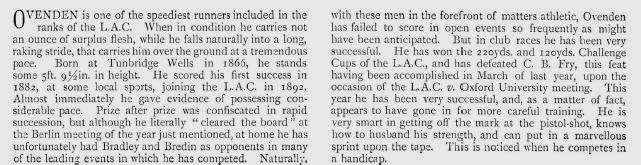
A. Ovenden, London Athletic Club:


Sid Thomas, Ranelagh Harriers, and later professional runner:


H.A. Munro, Lea Harriers:


J.E. Dixon (not stated in book, but he ran for Spartan Harriers):


E.J. WIlkins, London Athletic Club:


E.H. Pelling, Ranelagh Harriers


Some very well groomed gentlemen there, reminding me of  a comment about hair I read in an issue of the Ranelagh Harriers Gazette (no.167, May 2013) which I picked up in their clubhouse recently. It was a reprint of an article by 'Alsoran' from the Gazette a century ago (30 April 1914) describing the club's trip to Guildford for the Southern Cross Country Championships.The author writes: 'after the team had bathed themselves and got back to their right senses, besides bestowing very great care upon their hair - this being characteristic of all good-class runners - we got underweigh for The Three Pigeons... Things went quite in the ordinary way with each member of the team explaining how he beat old so-and-so, and gallantly passed five thousand men in the last quarter-of-a-mile, all for the honour of the Club, of course, and not for his own  special glorification'

Once again I am fascinated by the sophistication of running kit design at this period - note the thin white stripes on Salford Harriers shorts (not to mention Thomas's lederhosen!), and the specially-made shoes with spikes. They look quite similar to theses ones from the 1950s (photo from excellent I Was, or Am a Runner group on facebook):


Friday, 3 April 2015

Friday photos (21): 1890s English Athletes (and their shorts)

Here's some English runners photographed in the 1890s. Aside from recalling their achievements (one of them was a three mile world record holder, another the first London to Brighton winner), I was struck by their running kits, in particular their lengthy and high-waisted shorts. All of the ones here have different coloured piping on the shorts, I wonder who made them? There was no mass manufacture of sports wear by this time, as far as I know, but there must presumably have been some specialist clothing retailers. The shoes too - which as a friend pointed out on twitter look almost like moccasins - must have been specially made.

James Kibblewhite, Spartan Harriers & Essex Beagles

The first photograph is entitled 'Runner James Kibble, 1891' and is from the National Archives collection. 


The name is an error though and it is actually James Kibblewhite, also shown in this photo from Wiltshire Historic Photographs with the caption 'James Kibblewhite, athlete, of Spartan Cottages, Purton, Wiltshire, running for Spartan Harriers in the two mile N.C.A.A. Championship, Manchester, July 1890':


According the Newham and Essex Beagles History, Kibblewhite went on to run for Essex Beagles in 1892-3: 'The programme of races at the 1892 meeting featured a two miles match where Beagles' new recruit James Kibblewhite was forced to concede defeat to Heath of the South London Harriers. But Kibblewhite made no mistake in the AAA championship four miles race two months later, winning in a fast time of 19 minutes 50.6 seconds. While this was the first championship success for a member of the Essex club, for Kibblewhite it was a sixth (and final) AAA title, following on from his hat-trick of victories in 1890 when he lifted the one, four and ten mile prizes, and his other mile wins both in 1889 and 1891.

James Kibblewhite, Wiltshire born in 1866, started a career spanning 10 seasons in 1884 - the last year as an amateur of his fellow Wiltshire athlete, Walter George, whose feats must have attracted the young Kibblewhite's attention. Kibblewhite burst on the scene in 1889 in the black vest of Spartan Harriers and on 31 August that year, running from scratch in a three miles handicap race at Stamford Bridge, he slashed 10 seconds off George's five-year old world best, coming home in 14 mins 29.6 seconds. Swindon based - where he worked at the Great Western Railway works - Kibblewhite reached the top by "persistent practice". During his long career he won prizes valued at £1200 and probably also pocketed a tidy sum in appearance money: there were few meetings where the star names were not paid the standard £5. Kibblewhite retired three years before the AAA's crackdown on his contemporaries in 1896, so he was able to end his career untainted by the tag 'professional''.

F.D. Randall, Finchley Harriers

The second athlete featured here is F.D. Randall, 'born in Enfield, on February 5th, 1864. He enjoys the reputation of being the best cross-country runner included in the ranks of the Finchley Harriers' coming second in both the Southern and National Cross Country Championships in 1892 behind H.A.Heath. We are told that the Finchley Harriers were 'the Black and Pinks' so we can easily colour his running kit in our imagination.


Randall went on to be the first winner of a London to Brighton race, organised by South London Harriers in 1899. He completed the fifty miles in 6 Hours 58 minutes 18 seconds. On the strength of this he was selected to run the Marathon for Great Britain in the 1900 Paris Olympics, though he was one of 6 out of 13 runners who did not finish due to the heat.

The image comes from an 1896 book entitled the 'Sportfolio: portraits and biographies of heroes and heroines of sports and pastimes' (on sale on ebay). From the same book, here's another Finchley Harrier - W.J. Fowler, one of whose claims to fame according to this book is that he once beat Kibblewhite.


(Finchley Harriers merged with two other clubs to form Hillingdon AC in 1966)

See also:

More 1890s English Athletes


Saturday, 7 February 2015

Herbert Cowper Scard (1865-1931): Lewisham and Blackheath Cross Country Champion

Today sees the final races of the 2014-15 Surrey Cross Country League, sore foot permitting I hope to run at Richmond Park in a Kent A.C. vest later. So as part of my continuing research into the history of running in my part of South London, I thought I would write about a previous cross country champion and founder of my club - Herbert Cowper Scard. An obituary notice from 1931 sets the scene:

'Sportsman Solicitor: Death of Former Athletic Champion

Mr Herbert Cowper Scard, a solicitor who had practiced at Greenwich and Woolwich police courts for many years, died at the age of 65. In the late eighties and nineties Mr Scard was regarded as one of the finest cross-country runners of his day. He was champion of the Lewisham Hare and Hounds in 1888-89-90-92-95, and 96, and also held the Order of Merit of the Blackheath Harriers as their champion in 1889, and possessed scores of other trophies. Mr Scard was also associated with the Kent Athletic Club' (Straits Times, Singapore, 29 May 1931)

According to geni.com, Scard was born on July 8 1865 in Enfield and died April 9 1931 at 23 Blackheath Road, Greenwich.

Scard seems to have started out running for Blackheath Harriers. In 1888, he 'ran grandly and did the fastest time' in the club's Four and Three-Quarter Miles Members' Race at Blackheath (Lloyd's Weekly Newspaper, 18 November 1888), and he ran for the club in the National Cross Country Championship at Kempton Park Racecourse in 1889 (Manchester Courier, 4 March 1889).  Between 1888 and 1892 he won the Blackheath Harriers Cross-Country Challenge Cup four times.

In 1892, 'A Members' Two Mile Handicap produced a splendid struggle between two men, H C Scard 50 yds start, beating F Stephens 230 yds, by half a yard in 9 min 53 1/5 sec' at Blackheath Harriers' annual athletic meeting. This took place at Catford Bridge with 'a large and fashionable attendance' (York Herald, 18 July 1892). The following year he is reported to have run for Blackheath Harriers in the One Mile handicap in the the Spartan Harriers athletics and cycling meeting at Invicta Athletic grounds, Plumstead: 


Scard also seems to have run with Lewisham Hare and Hounds from its foundation, judging by the obituary reference to him being their champion in 1888, the year the club was founded. In 1895 he came joint first in a Lewisham Hare and Hounds 'paper-chase over eight miles of stiff country' with 30 other runners: 

See also mention of London races organised by Southwark Harriers (at Wimbledon), Allenbury's A.C. (at Lower Clapton), Polytechnic Harriers (at Pinner), Earlsfield Harriers, Columbia Harriers (at Walthamstow) and Herne Hill Harriers (at Streatham).

I have come across reports of Scard winning the One Mile Handicap at Colfe's Grammar School Sports in Catford (Lloyds Weekly Newspaper, 19 April 1896), and the same distance race at Stamford Bridge at a London Athletic Club event (London Daily News, 13 April 1896). Shortly after, in another London Athletic Club Spring Meeting at Stamford Bridge, he came second in the 1.5 Miles handicap. He was listed as running for 'Lewisham H.H', showing that the latter was not just a cross country club but was now taking part in track athletics events (Sheffield Daily Telegraph, 18 May 1896). In 1897, he ran in the first Inter-County Cross Country race at Wembley Park: 


Scard was also for a time Vice-Captain of the Goldsmiths Institute Athletic Club. He is listed as such as in 'A Handbook to the Goldsmiths Company's Technical and Recreative Institute 1896-87',  with the team Captain being Alec Nelson - later a notable athletics coach as discussed here previously.

In 1898, Scard won the Lewisham Hare and Hounds Four and a Quarter Miles handicap at Ladywell, followed by W.W.Lamb and H. Larkins (Lloyds Weekly Newspaper, 27 February 1898). Later that same year, Lewisham Hare and Hounds merged with West Kent Harriers to form Kent Athletic Club, which remains based in the Lewisham area at Ladywell track to this day. Scard must have been actively involved in the merger, as according to club historian Len Reilly, he was Kent A.C.'s first treasurer. 

In 1900, Scard ran for Kent A.C. in the Printing and Allied Trade Sports meeting 'held at Herne Hill grounds in the presence of about 3,000 spectators'.This was at what is now known as the Herne Hill Velodrome - as was often in the case at that period, cycling and running races were held as part of the same event. Scard came 2nd in the One Mile Handicap behind A.H. Lye (Herne Hill Harriers) and ahead of Kent A.C.'s A.E. Godsall:


Scard continued to be involved in the club after he had passed his peak as a runner. A 1908 notice for Kent Athletic Club advises that:

'The next evening meeting will be held at the Ladywell recreation grounds on Tuesday next, 26th inst., commencing 7.30 p m. The following events are down for decision - 109-yards and 1 mile handicaps and entries with fees, close on Saturday next... Members may train any evening at above grounds... and intending members may obtain full particulars from Mr. H. C. Scard, 30, Blackheath road, and Mr. A.J. Jennings, 19, Blythe vale, Catford who attend at Ladywell on Tuesday and Thursday evenings' (Kentish Mail Greenwich And Deptford Observer, 22 May 1908).

Over a hundred years later, Kent A.C. are still to be found at Ladywell on Tuesday nights, and not doing too badly in cross country either.

[updated 19 June 2015, with information about Goldsmiths link]

Wednesday, 17 September 2014

'A delightful spin': Cycling and Running in Herne Hill & Blackheath 1893

From the South Wales Daily Post, 3 August 1893, an interesting account of a combined cycling and athletics event at Herne Hill stadium ('the famous South London track') organised by the Blackheath Club. These were big spectator sports at the time, as shown by the fact that a crowd of 1500 was described as a 'poor attendance' and 'a modest array of spectators'


London Polytechnic seem to have done well in the cycling, including their A.J. Watson who won the half-mile scratch event. Winners in the running events, which included a 300 yards and one mile handicaps, came from Goldsmiths Institute (H.C. Hart) and Highgate Harriers (A. Grubb). Putney AC and Spartan Harriers are also mentioned.


The fact that cycling and running events featured in one programme reflected the fact that some of the clubs also combined both sports. Blackheath was both a cycling and athletics club, not to mention rowing, swimming and water polo. The article mentions that 'the Heathens' were also prominent in cross country: 'it is a gladdening sight to stand outside the Green Man hotel at Blackheath when the members of the Southern pack are just starting for a delightful spin o'er field and fallow'. I believe this is a reference to the Blackheath Harriers, founded in 1869 as Peckham Hare and Hounds, and who changed their name when they moved to the Green Man in Blackheath in 1878. The club continues today as Blackheath and Bromley Athletic Club

A.J. Watson, mentioned above, photographed c.1900

The article mentions that 'At one time the famous W.G. George held the [Blackheath] club's 4¾-mile challenge cup'. Walter George (1858-1943) set a record for the mile of 4:12¾ in 1886, which remained the world's fastest recorded time until 1915 (when the USA's Norman Taber ran 4:12 3⁄5 at Harvard).