Tuesday, 11 July 2017

The Outrun - Amy Liptrot


Amy Liptrot's The Outrun (2015) is partly another fine example of the new nature writing - urban dweller rediscovers connection with the wild between nicely illustrated covers, in this case through returning to her native Orkney where, among other things, she helps her farmer father in the lambing season and gets a job tracking corncrakes. The Outrun of the title 'is a stretch of coastland at the top of the farm where the grass is always short, pummelled by wind and sea spray year-round... where the ewes and the lambs graze in summer'. That aspect has a not entirely unromantic appeal to me, with my fond memories of my shepherd grandfather in the Hebrides.

But the book is also a memoir of addiction, to alcohol in particular, and the author's struggle to recover after some very messy years in London. Her relationship with the landscape is part of this process. Struggling to believe in 'a power greater than ourselves' as envisaged in the Alcoholics Anonymous 12 step programme, she thinks 'about the forces that I have experienced living on the islands: The wind and the sea. I think of erosion and corrosion… I think of the power of animal instinct, guiding the corncrakes to Africa and me to my lover's house, dead drunk, late at night… I decide that I can accept the existence of some "powers greater than myself" – not God, just the things I've always known, the forces I've grown up with, strong enough to smash up ships and carve islands'.

She walks all over Papay, one of the smaller islands where she lives for a while, including circumnavigating St Tredwell's Loch where once pilgrims seeking relief for eye troubles came to visit the chapel dedicated to a saint who legend claims gouged her own eyes out.

She joins the Orkney Polar Bears who go swimming every Saturday morning in the sea and manages to find through this the beginnings of new compulsions: 'Once after being out all night at a party in a squatted East London warehouse, Gloria and I decided, high and wide eyed, that what we needed was a dawn swim in Hampstead Heath ladies pond. We had grimy rave skin and sleep deprivation and thought the cold water would provide refreshment and even salvation... In the past when I was under stress, my first impulse was to drink… Now, sometimes, I'm not just fighting against these urges but have developed new ones. Even back in the summer, set free after a frustrating day in the RSPB office, my first thought was sometimes not a pint but "get in the sea". Swimming shakes out my tension and provides refreshment and change... The motivation is the same but my methods of dealing with the way I feel are changing. I used to confuse my neurotransmitters on a Friday night in a hot nightclub. Now I shock my senses on a Saturday morning in the biting sea, plunging warm skin into cold water, forcing a rush of sensation, cleansed'.

Interesting how culturally embedded this idea of water as medium of baptism and rebirth is, to swim in the sea or even the Hampstead ponds is to literally plunge into the landscape (or waterscape) and perhaps to emerge with a sense of being somehow cleansed or transformed.

The Outrun is certainly not another rehab through fitness memoir, but the author recognises that part of her recovery is also about a new relationship to her body in movement, including through walking, swimming and scuba diving: 'When I am in motion I am at ease, able to move forward mentally as well as physically. I use walking and swimming to calm my churning thoughts. My sea swims are increasingly important in relieving the non-specific low-level anxiety I often feel. The cold water shocks out any mental stress – my body suddenly has something more immediate to deal with'.

Sunday, 9 July 2017

Bewl15 2017: 15 very hot miles

Last weekend - Sunday 2 July 2017 - I  took part in a 15 mile race on the Kent/Sussex borders. My clubmates who had run it before told me that the Bewl15 was a great race, and they weren't wrong....

Everybody said it was well organised, and Wadhurst Runners did a great job, seemingly supported by signficant parts of the local community. Plenty of car parking and good facilities at the Uplands Sports Centre, sufficient toilets, water stations throughout and lucozade at two points on the course.


Everybody said it was a friendly and fun event - and yes, there was a piper to lead people to the start, free beer and cake at the end - not to mention a brass band  and a technical t-shirt and medal. The race was started by Olympic legend Dame Kelly Holmes too. She let everybody start and then joined in, swiftly moving through the field - she passed me at about mile three.
Kelly Holmes and piper

Everybody said it was an amazing course -  and yes we warmed up in a field with sheep bahing across the way, always good for us townies. After a start downhill along a country lane the course made its way around Bewl Water, the largest inland water in the South East of England (its actually a reservoir created by the flooding of a valley in the 1970s). The course, at least for the first ten miles, alternated between sections of shaded woodland and trails  on the shores of the reservoir, where boats sailed in the sunshine. There were horses.

Photo by Mark Reese of Hastings Runners - @the_real_reesey

All very good but I must admit by the end I was reminded of that 1980s anti-drugs advert -  'when they told me how good Bewl15 would make me feel they didn't tell me how bad it would make me feel'.

Entirely my own fault of course.  I headed off close to the front at a cracking pace that I knew I couldn't sustain, but I wanted to avoid a bottleneck in the first mile where the field has to file through a narrow gate - and where last year people further back had had to stop and walk. The heat was tough - I didn't put sun protection on and really should have, as I ended up with sunburnt neck and shoulders. I found myself slowing and then, at about ten miles in, the hills reared up. There are three significant ascents in the last 5 miles, including running back up the hill you run down at the start, all the way up to the finish line.


In the last couple of miles I got full on cramps in my quads, and while I was determined not to walk, I did have to stop a couple of times as first one leg then the other stopped working.  I finished in  2:25:34 behind 458 others - many of whom streamed past me in the last third of the race. There were 835 finishers in total.

The finish line


Bottom line is I failed to respect the distance, not for the first time. I only entered a few days before and had to google whether it was 15k or 15 miles - believe me it's the latter. I figured I still had the fitness from my London Marathon training but that was two months ago and though I'd run plenty since I hadn't done any long runs at any kind of pace.


Congratulations to Danny Kendall (Cambridge Harriers) who won the men's competition in 1:27:37, and to Tina Oldershaw (Paddock Wood AC), first woman in 1:44:46. Tina is a W50, so can't really blame my woeful run on my age category! Some great runs from my Kent AC clubmates, including medals for Che Compton (5th place overall and first male vet) and Zuzana Nemeckova (2nd female vet).

So yes, I strongly  recommend Bewl15 but do some training - and wear sunscreen!


Hard earned medal and t-shirt


Thursday, 22 June 2017

Art of Athletics (9): 'Catch Me' by Royalle Niambura

The Turner Contemporary gallery in Margate currently features work from the MASK PRIZE, an annual arts competition for young people under the age of 25 living in Africa and people of African origin living outside the continent, set up by the charity MASK (Mobile Art School in Kenya).

It includes this striking running image, 'Catch Me',  by Royalle Niambura from the Riara Springs Academy in Nairobi, Kenya. This was the winner of the Visual Arts Under 13 prize.


Monday, 19 June 2017

Running on Screen (19): The Handmaid's Tale


Episode 3 of The Handmaid's Tale (the excellent new TV adaption of Margaret Atwood's dystopian novel), features a scene with June, played by Elisabeth Moss, out for a run with her friend Moira, played by Samira Wiley. The soundtrack is Peaches' F*ck the Pain Away, expressing the kind of assertive women's subjectivity that is soon to be suppressed. The carefree freedom to run is remembered in flashback from a world where women's public presence is rigidly policed under a religious fundamentalist regime, and where fertile women live as slaves to breed children for their masters.


The point of this episode is to show the transition to the new repressive regime. The uncovered flesh of the runners receives a disapproving stare from a passer-by, and when the runners stop for a coffee afterwards they find that women's bank accounts have been frozen and women banned from the workplace as a menacing militia takes to the streets.

June - rechristened as Offred as she is now 'Of Fred', her commamder -  reflects: 'Now I'm awake to the world. I was asleep before. That's how we let it happen. When they slaughtered Congress, we didn't wake up. When they blamed terrorists and suspended the Consitution, we didn't wake up then, either. Nothing changes instantaneously. In a gradually heating bathtub, you'd be boiled to death before you knew it'.

The quote from Atwood's 1985 novel goes:

'Is that how we lived then? But we lived as usual. Everyone does, most of the time. Whatever is going on is as usual. Even this is as usual, now. We lived, as usual, by ignoring. Ignoring isn't the same as ignorance, you have to work at it.

Nothing changes instantaneously: in a gradually heating bathtub, you'd be boiled to death before you knew it. There were stories in the newspapers, of course, corpses in ditches or the woods, bludgeoned to death or mutilated, interfered with, as they used to say, but they were about other women, and the men who did such things were other men. None of them were the men we knew. The newspaper stories were like dreams to us, bad dreams dreamt by others. How awful, we would say, and they were, but they were awful without being believable. There were too melodramatic, they had a dimension that was not the dimension of our lives. We were the people who were not in the papers. We lived in the blank white spaces at the edges of print. It gave us more freedom.'


In the new world women must be covered up, and Offred recalls as she walks 'I'm remembering my feet on the sidewalks, in the time before, and what I used to wear on them. Sometimes it was shoes for running, with cushioned soles and breathing holes, and stars of fluorescent fabric that reflected light in the darkness'.


Previously in the Running on Screen series:


Sunday, 4 June 2017

New Burgess parkrun route

Southwark's Burgess Park hosts one of my favourite parkruns, scene of my PB and recognised as being one of the flatter and faster courses in the London area. I've written about it here before, but recently there has been a change to the course. I went along and ran it yesterday, chasing my second sub-20 5k in three days after a good outing in the Assembly League race in Battersea Park on the preceding Thursday. I didn't make it, but can confirm this is still a good course if you are looking for a fast 5k time.
 
 
As before the course starts at the far west of the park near the Camberwell Road entrance, and heads off for a long straight before taking a turn and looping around the Burgess Park lake. The main change is that the old course used to go twice round the lake- nice and picturesque (what with its herons and all), but sometimes resulting in congestion as there would be a lot of lapping around the lake.  The new course only goes round the lake once before heading up to the far east of the park by the Trafalgar Avenue entrance.
 
runners on the home stretch with the Aylesbury Estate in the background
There is a slowing hairpin turn there,  but once negotiated it's a long straight run (I think about 1.2k) from one end of the park to the other. Mentally it's quite tough, as it does seem quite a stretch, but there is nothing to slow momentum other than going down then up through the underpass that takes the path under the road at Wells Way.
 
 
At the very end there is a sharp left turn towards the finish funnel on the grass, other than that it's tarmac all the way. The finishing line is actually within the funnel by the flag, so as the sign says make sure you 'run all the all way to the flag'. Friendly crowd and team as always, they have fresh fruit at the end for a donation.
 
 
 Kent AC's Gareth Anderson was first man home yesterday in 16:48,  Amy Cook first woman in 21:04, with a total of 286 finishers.


Sunday, 28 May 2017

Running London: Brockley and Nunhead Five Peaks (10k route)

Last summer's 'Lewisham 3 Peaks Challenge' was a successful charity walk linking three South East London hill tops with fine views across the capital - Hilly Fields, Blythe Hill Fields and One Tree Hill in Honor Oak. An excellent map  with lots of interesting historical detail has been produced, designed by Linda Durrant (Full Circle Design), to promote this as an ongoing walking route.


Detail of Brockley Three Peaks Walk, showing Ladywell Arena athletics track

 
I picked up a copy in the Hilly Fields café after parkrun there and thought I would give it a go as a run, but to mix it up a bit and increase the distance I added in a couple more hills - Telegraph Hill and the hill in Nunhead Cemetery historically known as Nunhead Hill.
 
It is a good run, just over 10k in total, with plenty of up and down hill stretches of course. Toughest part is the steep stairs to the top of One Tree Hill, but as with all the hills there is the reward of the view from the top. An added advantage is that for several sections of the run it is possible to run on grass.

View from Hilly Fields with Crystal Palace TV transmitter on the horizon
and Blythe Hill Fields also visible above the tree line

View from Blythe Hill Fields with Canary Wharf on the horizon
 

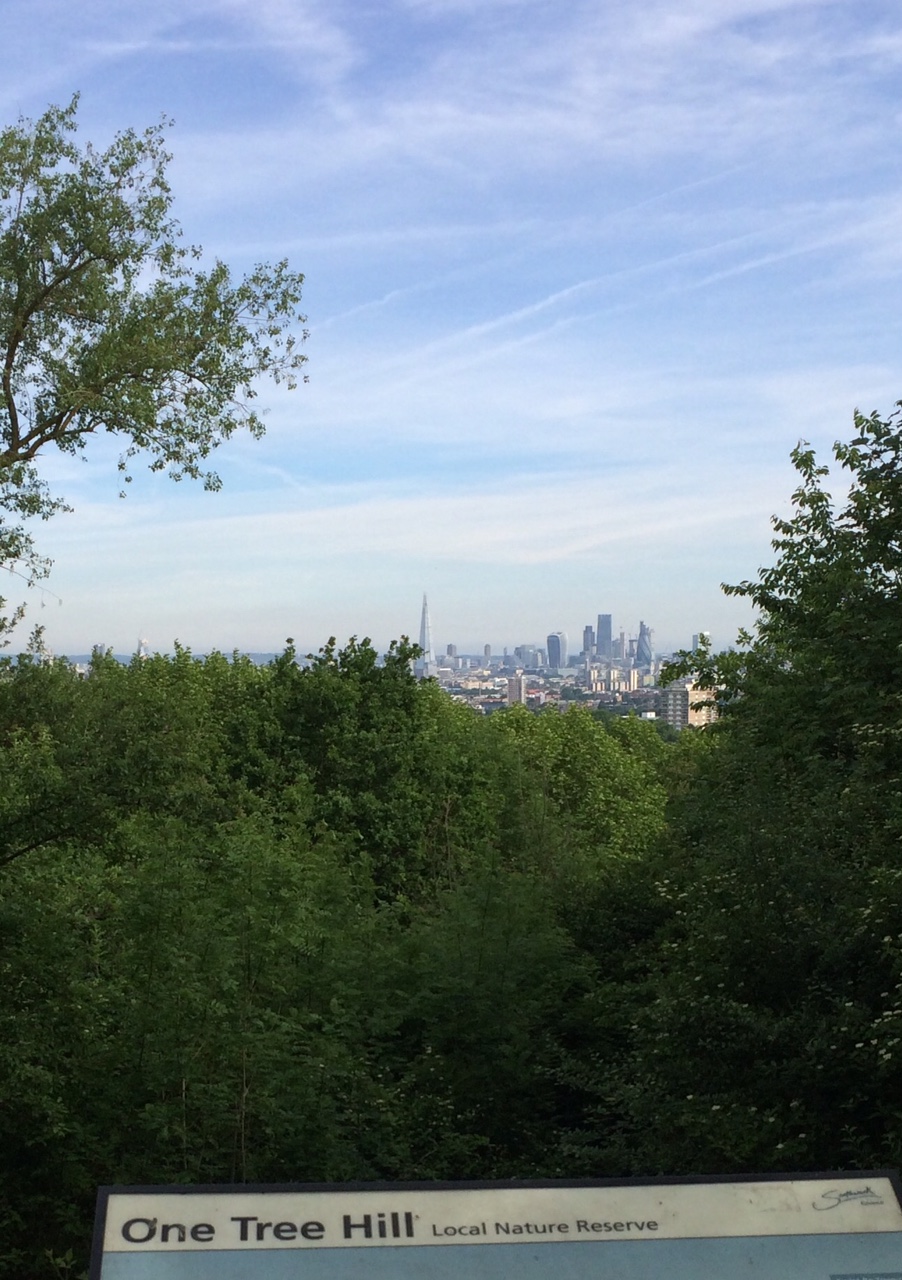
The Shard and the City of London visible from top of One Tree Hill

View from top of Nunhead Cemetery - St Pauls Cathedral is visible through the gap in the trees (though not very clear in this photo). The artists JMW Turner sketched St Pauls from near this spot

London skyline from Telegraph Hill upper park


Sunday, 14 May 2017

Once a Runner - it's about time

'Once a runner' by John L Parker Jr is a novel first self-published by the author in 1978 and subsequently re-issued with some success in 2009, having established something of a cult reputation as a runners novel about running.


Set in the world of American college athletics - apparently at a fictionalised University of Florida - it inevitably reflects the period that it was written in. The Vietnam war is a reference point and there are battles between the students and the college authorities about the permitted length of hair for men. But much of the book is about the timeless, single-minded pursuit of success on the track at the elite end of athletics.


For me some of the more interesting passages are where the authtor reflects on how the runners' notion of time differs from the everyday world: he describes well the specific temporality of speed and endurance.


There is a cyclical time of seasons, of cross country and track, within a longer four year cycle of the Olympic games. But there is also an obsessive focus on the tiny passages of time that make the difference between winning and losing, between reaching or just missing a PB or record: "The Games were over for this time around. He knew quite well that for him they were over for good. Four years is a very long time in some circles; in actual time – real-world time, as that of shopkeepers, insurance sellers, compounders of interest, and so on – it is perhaps not long at all. But in his own mind Time reposed in peculiar receptacles; to him the passing of one minute took on all manner of rare meaning. A minute was one fourth of a four minute mile, a coffee spoon of his days and ways'.

Elsewhere he characterises the running world as a place where 'the jettisoning of but a single second is announced like a birth in the family'.


In some circumstances running seems to have a 'timewarp' dimension that stretches time: 'In the mind's special processes, a 10 mile run takes far longer than the 60 minutes reported by a grandfather clock. Such time, in fact, hardly exists at all in the real world; it is all out on the trail somewhere, and you only go back to it when you're out there'.
 

Waiting for the gun at the start of a race, there is 'that one instant there would be a kind of calm in the midst of all that pounding, roaring furor, a moment of serene calm before an unholy storm. There would be a single instant of near disbelief that it would finally be happening in a fraction of a second; finally happening after the months, the miles, the misty mornings'.


The main protaganist, Quenton Cassidy is 'not interested in the perspective of the fringe runners, the philosopher runners, the training rats; those who sat around reading abtruse and meaningless articles in Runners world, coining yet more phrases to describe the indescribable, waxing mystical over the various states of euphoria that the anointed were allegedly privy to... Cassidy sought no euphoric interludes. They came, when they did, quite naturally and he was content to enjoy them privately. He ran not for crypto- religious reasons, but to win races, to cover ground fast. Not only to be better than his fellows, but better than himself. To be faster by a 10th of a second, by an inch, by 2 feet or 2 yards, than he had been the week or year before. He sought to conquer the physical limitations placed upon him by a three-dimensional world (and if Time is the fourth dimension, that too was his province)'.