Showing posts with label South London. Show all posts

Sunday, 28 May 2017

Running London: Brockley and Nunhead Five Peaks (10k route)

Last summer's 'Lewisham 3 Peaks Challenge' was a successful charity walk linking three South East London hill tops with fine views across the capital - Hilly Fields, Blythe Hill Fields and One Tree Hill in Honor Oak. An excellent map  with lots of interesting historical detail has been produced, designed by Linda Durrant (Full Circle Design), to promote this as an ongoing walking route.


Detail of Brockley Three Peaks Walk, showing Ladywell Arena athletics track

 
I picked up a copy in the Hilly Fields café after parkrun there and thought I would give it a go as a run, but to mix it up a bit and increase the distance I added in a couple more hills - Telegraph Hill and the hill in Nunhead Cemetery historically known as Nunhead Hill.
 
It is a good run, just over 10k in total, with plenty of up and down hill stretches of course. Toughest part is the steep stairs to the top of One Tree Hill, but as with all the hills there is the reward of the view from the top. An added advantage is that for several sections of the run it is possible to run on grass.

View from Hilly Fields with Crystal Palace TV transmitter on the horizon
and Blythe Hill Fields also visible above the tree line

View from Blythe Hill Fields with Canary Wharf on the horizon
 

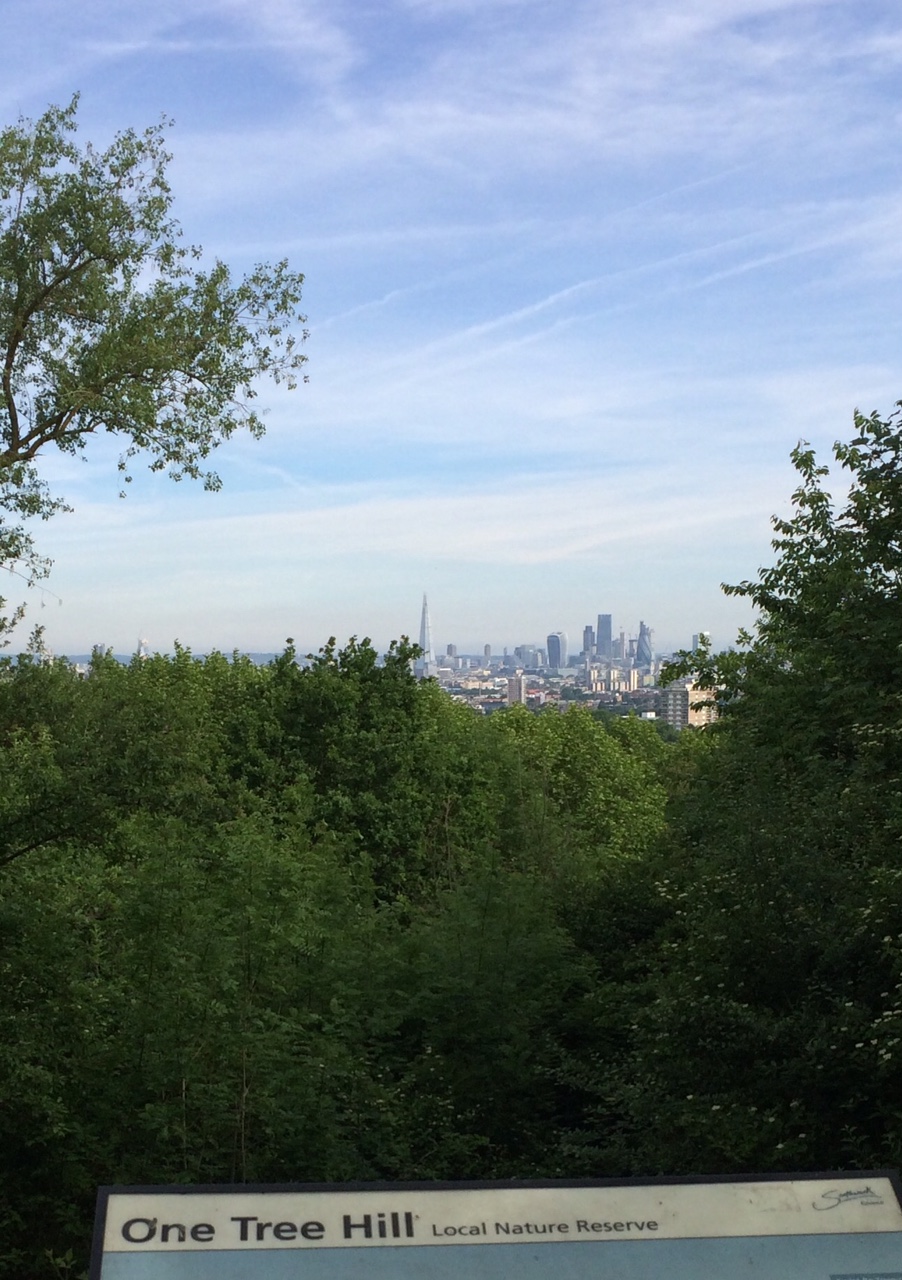
The Shard and the City of London visible from top of One Tree Hill

View from top of Nunhead Cemetery - St Pauls Cathedral is visible through the gap in the trees (though not very clear in this photo). The artists JMW Turner sketched St Pauls from near this spot

London skyline from Telegraph Hill upper park


Wednesday, 22 February 2017

Running London: South London Windmill Run

The few remaining windmills in the London area are a reminder of the capital's history of absorbing formerly separate rural villages into the expanding city's urban fabric. With a 17 mile long run target as part of my London marathon training I decided to set off last weekend on a windmill-themed run across South London, taking in Peckham, Brixton, Clapham and Wimbledon.

In Peckham, on the corner of Choumert and Bellenden roads, there is a 2014 mural featuring a windmill landscape. It does not, as I first thought, represent an image of Peckham past. In fact I have found no evidence of there ever having been a windmill in Peckham, though there were a number at different times in the Camberwell area. The local connection to this mural is rather more obscure - it was painted by Walter Kershaw as one of a number of works inspired by paintings in the Dulwich Picture Gallery collection.  The windmills are in fact reproduced from a John Constable painting at DPG, which is in itself a copy of 'Landscape with Windmills near Haarlem’ by Jacob Van Ruisdael (1650).


Heading on to Brixton we find a fine windmill at the end of Blenheim Gardens, off Brixton Hill. The Ashby Mill was built in 1816 and remained a working mill until 1935. It has been restored as a result of the efforts of the Friends of Windmill Gardens and others, and was officially reopened in 2011.


The windmill has its own mural nearby in Lyham Road. The lettering at the bottom reads ''The Windmill revamped by community love, will hold us together if push comes to shove'.


The nearby pub, The Windmill, is one of South London's great music venues. Have had some excellent nights there, folk sessions, punk gigs and alt country events. Particularly recall People's Republic of Disco club nights, seeing Art Brut when they were just breaking (Geoff Travis of Rough Trade was in the crowd, think he had just signed them or was about to), and Pine Valley Cosmonauts. 


On Clapham Common there is another landmark pub with the same name.


As the sign outside says, there has been a Windmill pub in that location since at least 1665. Clearly there must originally have been a windmill there too, but it doesn't seem to have lasted  too long as 'milling must have become less important, and beer selling more important'.


Running on to Wimbledon Common I passed near to the remains of another windmill on Wandsworth Common, but confess I didn't actually see it.

The mill on Wimbledon Common, at the end of Windmill Lane of course, is in good condition. It may not have its own pub, but it does have The Windmill tearooms next door.


A sign above the entrance to the windmill states that Baden-Powel wrote part of his book 'Scouting for Boys' (1908) in the mill house.


According to the information sign at the site, it was built by local carpenter Charles March in 1817 and remained open until 1864 when the Lord of the Manor, the fifth Earl Spencer proposed to enclose Wimbledon Common 'and build himself a new Manor House just south of the windmill'. Fortunately this scheme was successfully opposed by local residents, leading  to 'the Commons being protected by the Wimbledon and Putney Commons Act 1971'.

As a result of these endeavours, the common remains open for all and among the many sporting associations using it are the Wimbledon Windmilers running club - I saw a group of them meeting up at the Windmill for a run on Sunday. 

Only the week before (11 February 2017) several hundred of us ran over the Common in the final race of the 2016-17 Surrey League men's cross country competition - did I mention that my club, South London's finest Kent AC, won the competition for the 5th year in a row?!


Start of the Surrey League finale on Wimbledon Common, 11 February 2017

My windmill route, which included exploring other parts of Wimbledon on the way back, and getting lost in Tooting, is on Strava.


Other Running London posts:


Tuesday, 27 December 2016

Peckham Street Art Run

Ten miles on a frosty morning, out and about in South London before the shops opened.

RIP George Michael, outside John the Unicorn pub, Rye Lane, SE15
(I was listening to George Michael's 'Listen without prejudice' LP while running)

This one, and the one below, from the courtyard outside the Bussey building, Rye Lane, SE15


Copeland Park, SE15

Prime Minister Theresa May as Star Wars villain, by Artful Dodger, outside Peckhamplex cinema

by Peckham car park

'Stay wild, stay true', on  old Surrey canal path

Monday, 29 August 2016

Athletics in Beckenham, 1881

The last race of this year's Assembly League will be hosted as usual by Beckenham Running Club this week. While the 5k road race takes place on local streets, runners meet up and change at the cricket club ground on Foxgrove Road where the club is based, and most of the runners do a circuit or two of the cricket ground to warm up before racing.

Beckenham Cricket Club has been based at Foxgrove Road since 1867, and has been associated with other sports too since the early days. It gave birth to a tennis club in 1879, and judging by the following report, athletics was also part of its early activities.
 
In June 1881, Beckenham Cricket Club held its 'annual athletic meeting',  an event that featured both running and cycling races, as well as  entertainment from 'The band of the 11th Hussars (Prince Albert's Own'). The running races ranged from the 'hundred yards' to the Mile.


The 120 Yard Hurdles featured competitors from clubs including Beckenham Cricket Club, Private Banks Cricket Club, London Athletic Club, Arundel Athletic Club and Crystal Palace School of Engineering. Interesting that while clubs dedicated to particular sports existed by this time, the exclusive specialisation of athletes was not as developed as it later became - as is shown by a cricket club organising a running and cycling event, with cricket, football, running and cycling club members taking part.


The Mile Race (Open) featured 22 runners, with T. Shore of London Athletic Club acting as the Handicapper. Races were routinely handicapped in this period, with runners being given a head start according to their form and ability.  So the winner, J.E. Dixon (Spartan Harriers), had a 130 yard start while H.B. Burrows, South London Harriers was given a 50 yard start. It was 'A well contested-race, though the  winner led throughout, and won by ten yards'. Third placed H.D. Thomas (Blackheath Harriers) finished three  yards behind 2nd place, having  started at scratch (i.e with no head start). The winning time was given as 'four minutes, 24 and one-fifth seconds'.

The Challenge Cup 'was presented by His Highness the late Rajah of  Kolapore' to 'Mr A M Inglis, who had gained the highest number of marks in the club events', including winning the half-mile and the high jump. Other prizes were awarded by Lady Inglis (his mother) - Julia, Lady Inglis (born Julia Thesiger), lived in Beckenham after returning from India and wrote a book about her experiences in the Siege of Lucknow. Her son Alfred later played cricket for MCC and, on one occasion, Kent.

The cycling race included cyclists from clubs including Brixton Ramblers, LAC, Dewsbury BC, Crichton BC, London BC and Wanderers BC (in that period it seems that clubs were generally known as Bicycling Clubs - hence BC- rather than Cycling Clubs as they soon became known).

It was announced by Mr Percy Bicknell at the end that the rumour that  the club was about to give up the ground was untrue - in fact 'the ground had been secured for a period of 10 years'. Thanks to the efforts of these Victorian sporting pioneers, cricketers, footballers, tennis players, runners and others are still using these facilities more than a century later.


Source: The Beckenham Journal, 1st July 1881
(there are bound copies of this journal in Bromley reference library)

Wednesday, 20 April 2016

Running with bluebells and other fat burning adventures

I have been doing some very slow running recently, experimenting with running at 'fat burning threshold' using  Phil Maffetone's '180 formula' to calculate optimal heart rate to promote the body's use of fat for fuel. Basically having established this heart rate you use a heart rate monitor and try and keep within it. If your heart rate exceeds this threshold you're supposed to slow down to bring it back down.  Painfully slow, I ended up on something like 12 minute miles. Not totally convinced of the benefits, but interesting running to heart rate rather than the clock.

One advantage is that you have plenty of time to admire the scenery, which at this time means bluebells. Bluebells in Dulwich Wood, which I took in during a run that also included Belair Park and Dulwich Park:

Dulwich Wood bluebells
Bluebells in Nunhead Cemetery (see previous post on running there):

Of the thousands of graves there only a handful have bluebells growing on them, one of life's mysteries... must be something to do with the bluebell fairies!
One of the numerous flower fairies painted by Cicely Mary Baker
- she lived in Croydon incidentally so maybe this is also a South London bluebell!

Bluebells in Kent, in Scathes Wood at Ightam Mote near Sevenoaks (OK I was actually walking there rather than running).

Tuesday, 22 December 2015

Winter Solstice 2015: running in with the sun

In London the sun rose at 8:04 am this morning on the Winter Solstice, marking the turning point in the year when the days start getting longer. I marked this seasonal festival with a run at a stone circle in Hilly Fields, a South East London park I have run round hundreds of times during Hilly Fields parkrun and training sessions.


The monument, made up of 12 boulders, a central flatstone, and two standing stones forming a gate outside the circle, is not as ancient as it looks. In fact it was built in 2000, with the grantite boulders being transported to the site from Mount Struie in the Caledonian Mountains, and the other stones being quarried at Weydale, Caithness at the north east tip of Scotland.


But the relationship between stone, soil, grass, tree and sky is as real there as at any ancient megalithic monument, and people have been gathering there to mark the seasons since it opened. This morning there were a couple of drummers welcoming the sun and a handful of other sunrise watchers. I did a clockwise circuit of the park (about 3k), starting and finishing in the middle of the circle, and coming back in via the stone pillar gate which faces east towards the sunrise. If I was running in with the sun it didn't actually show its face on this cloudy morning, though the sky did brighten shortly afterwards.

It was noted that the gps map of my run generated the shape of a mushroom [insert dubious theory about Hilly Fields as cult centre of fly agaric chomping shamans!]


See previously:


Monday, 9 November 2015

'I enjoy running, jumping, shouting'


In Fordham Park, New Cross there's a long steel plaque on the ground with some words on it from children at the local Childeric Primary School. The full text is 'I enjoy running, jumping, shouting and singing in an open space'. I do too! I've often run round or through that park. I may have sang in several nearby pubs, but not in the park itself, though I have certainly danced there in some of the wild ravey free festivals there in the 1990s.

When I first moved round here nearly 20 years ago there was actually a (now vanished) running track at the edge of the park. Anyone remember it?

Friday, 6 November 2015

Friday photos: Kent AC and other 1960s athletics

Following the photo I posted earlier this week of a group of Kent AC athletes from the 1950s, Roy Candy (who ran for the Lewisham-based club from 1960 to 1966) has been in touch and sent through some great photographs from the 1960s.

The group photo was taken at a training weekend at Timsbury Manor, Hampshire in 1965. It features members of Kent AC (back left row), Cambridge Harriers and London Olympiades, including for the latter the great Lilian Board and Mary Bignal Rand. Kent AC runners featured include Tina Ash (nee Darby), Nigel Porter, Cheryl Miller, Beverley Franklin (nee Panter), Dave Franklin, and Roy himself.


The next couple of pictures are from the Eton Manor to Southend Road Relay (c.1964) and show Kent AC runners Peter Brenchley, Roy Candy and John Oliver.


At Kent AC's Ladywell track in 1965, Lewisham Half-Mile Champs won by Roy Candy in 2m 1.4s from Mike Field and Richard Selby.

Another training weekend, possibly Camber Sands 1963. Among those featured are Avril Usher (later Avril Bowring), who ran for Kent AC at the time and later competed in the 1970 Commonwealth Games in the 400m.


As always, any more names or memories very welcome in comments.

Tuesday, 29 September 2015

Running Clapham Common: RunThrough 10k 2015 (and a 15 mile race in 1869)

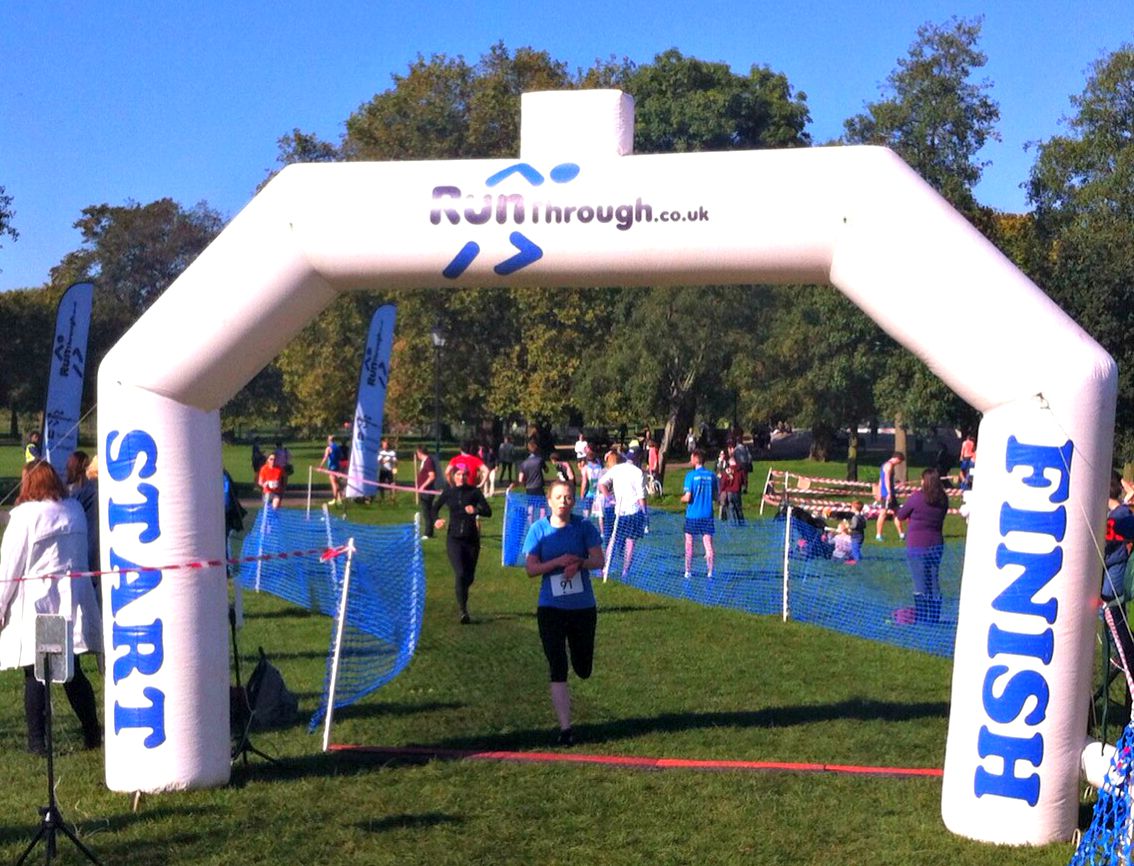
I enjoyed the Clapham Common 10k organised by RunThrough on Saturday, with nearly four hundred runners finishing a three lap course around this flat South London park. I suspect too that it will be my last race in sunglasses this year - a glorious sunny morning on this first weekend after the Autumn Equinox. Dan McGrath finished first in 33:50, first woman finisher was Imogen Aimsworth in 36:43 (full results here). I took a couple of minutes off my PB in my first 10k for two years, so was more than happy.

The start/finish was near to the park's grand Victorian bandstand, which along with the local underground station inspired the event's fine medal 


There's always people running round Clapham Common, and a number of local running groups/ clubs use the park regularly - including Clapham PioneersClapham Runners, Sweatshop's running group (from their shop just off Clapham High Street in Voltaire Road) and indeed RunThrough themselves who have a free Monday night session there. 


The Common doesn't seem to have quite the rich running history of other South West London parks such as Richmond and Wimbledon - where organised cross country running started out - but it was featuring in races even before it was drained and recreations grounds laid out in the 1870s. This report from 1869 is of a Hare and Hounds race organised by Brixton Football Club. Two 'Hares' - F. Bone and Harry Foster - laid a paper trail across nearly 15 miles of SW London in one hour 57 minutes for the 'hounds' to follow. As well as Clapham Common their run in a loop from Brixton took in Streatham, Tooting and Wandsworth Commons.

The Sportsman, 10 March 1869

Friday, 7 August 2015

Catford Cycling Club and its athletics origins

My running club, Kent Athletic Club, traces its origins back to an earlier club in this part of South East London - Lewisham Hare and Hounds, which merged with West Kent Harriers to form Kent AC in 1898. Lewisham Hare and Hounds also helped spawn another sporting body that exists to this day - Catford Cycling Club.

The story of this episode is told in the book 'The first 50 years of the Catford Cycling Club' by E.J. Southcott, published in 1939.


A key driver of the formation of the cycling club was Charles Percival Sisley, an 18 year old who lived with his parents in Morley Road, Lewisham. He had been been a member of a small local club, Mount Pleasant Cycling Club, based around Mount Pleasant Road in Lewisham.

His plan to create a wider Catford Cycling Club was not universally popular. The Brockley BC complained that 'there were enough clubs already in the SE of London' (there were also Lewisham and Sydenham clubs). But Sisley's plans did find support from 'an athletic club called the Lewisham Hare and Hounds' which 'was also considering the formation of a cycling club'. The club's secretary Ernest G. Brabrook talked to Sisley and the outcome was the inaugural meeting of the cycling club at the Hither Green Hall - HQ of Lewisham Hare and Hounds - on 12 April 1886.


In the Chair was the Reverend W. Hook Longsdon, a keen cyclist, goalkeeper for Colfe’s Grammar School's football team and later curate at St. Mary’s Lewisham.  The meeting agreed a set of rules and that 'All Club runs shall start from the Black Horse, Catford'. The club's first inter-club race in June 1887 was with St Peters Bicycle Club and headed to the ''Salt Box' at Cudham, a popular resort for cyclists for many a year'.


Geraldine Biddle-Perry has explored the history of CCC  further in an excellent article in The London Journal,  Fashioning Suburban Aspiration:Awheel with the Catford Cycling Club,1886–1900 (Vol. 39 No. 3, November, 2014, 187–204).

The author has made good use of material held in Lewisham archives to analyse the membership of the cycling club: 'Using Cross-referencing CCC membership lists between 1886 and 1900 with 1891 Census data reveal a social constituency drawn from a cross-section of middle- and lower-middle-class British suburban society at the turn of the twentieth century. Members were predominantly unmarried young men in their late teens and twenties living with their parents (or boarding) in larger villas and neat terraced houses, sometimes in the same roads in Lewisham, or in neighbouring South London boroughs. Most members were employed as mercantile, commercial and stockbrokers’ clerks, but there are also draughtsmen, commercial artists, travellers and agents, managers, journalists and engineers'. I would imagine that the associated athletic club had a similar membership.

While membership was not explicitly socially exclusive, there were financial barriers to joining it, including the cost of the club's uniform 'consisting of a grey check tunic and breeches in a cloth... this could be made by Messrs Clare & Son, of French Street London, priced at 42/- with an extra 2/- for the addition of a fleece lining.The suit would be worn with black stockings and a black cricket cap adorned with the Club badge (a wheel with the word ‘Catford’ inscribed across it)'.

CCC was ambitious to be much more than just a local club and to make its wider mark in the world of cycling: 'in its first season Catford held the first ‘open’ public road race—over 25 miles on a circuitous route (kept secret until the start of the event) around the adjacent Kentish countryside—a practice the National Cyclist Union described as ‘illegal, illegal as prize-fighting, cocking or any other tabooed sport’'. While the cycling world, like the Athletics world, agonised about the vagaries of amateurism, CCC members made  their living from the sport in various ways. Club founder Sisley became editor of the popular  magazine 'Cycling', while another member, 'T.C. Pullinger started a small manufacturing workshop in New Cross producing his own version of the new safety bicycle, ‘The Parade’. Other members belonging to the Argus Bicycle Club in neighbouring Brockley included a cycle salesman for Stanley bicycles, a self-employed cycle manufacturer producing their own machine ‘The Austen’, a cycle engineer and repairer, as well as a tailor and outfitter selling ‘Cycling, Cricketing and Tennis Suits made to order’. 

 A race at Catford in the 1890s
In 1894/95, the club - nicknamed the Kittens- was involved in the development of the first cycling track with banking in England. The Catford stadium also hosted athletics events before it was sold off to property developers in 1900 (see details at Running Past)

CCC is still going strong today, though focusing on the Bromley and Sevenoaks area rather than its former Lewisham heartland.

[post updated April 2018 with details from '50 years of the Catford Cycling Club']