Showing posts with label birds. Show all posts

Monday, 16 September 2019

Let's go to Dungeness


 Dungeness on the Kent coast has a famously bleak beauty, a shingle headland between Romney marsh and the Channel. Taking advantage of the September sunshine, we went down at the weekend.  A couple of intrepid members of our party swam in the sea but I contented myself with a run around the area - flat for miles around with the only real hazard apart from the occasional car  being stretches of running on pebbles. 


Other than than the nuclear power station there is a stretch of mainly wooden low houses in unfenced plots facing the sea, two lighthouses and a couple of pubs.  It is very much a working stretch of coast, with fishing boats pulled up on the shore as well as the decaying remains of previous seaside industry. Sea anglers certainly outunumber sunbathers, in fact I didn't see any of the latter.


We had a drink at the Britannia Inn, and food from the Fish Hut Snack Shack which is just what it sounds like. Freshly caught fish served up with salads, rolls and wraps with a vegan alternative for those so inclined. We also popped into the End of the Line cafe, located at the local train station at the end of the Romney, Hythe and Dymchurch light railway (where there are clean public toilets incidentally).


Dungeness has its own micro-climate with lots of wildlife. I saw a couple of black redstarts which are fairly rare.

Prospect Cottage, pictured below, was the home of film maker Derek Jarman (1942-1994) in the later period of his life. His Dungeness garden, built around driftwood and other beach finds, became quite celebrated and still attracts visitors.  


Jarman was one of the most outspoken public figures talking about living with HIV in the early 1990s, a period when I was working in the AIDS sector. I like the fact that a plaque was recently placed to mark the 25th anniversary of his death at another place he lived, Butlers Wharf by Tower Bridge (close to my work and which I often run past)

Derek Jarman plaque at Butlers Wharf  'film-maker, artist and gay rights activist'

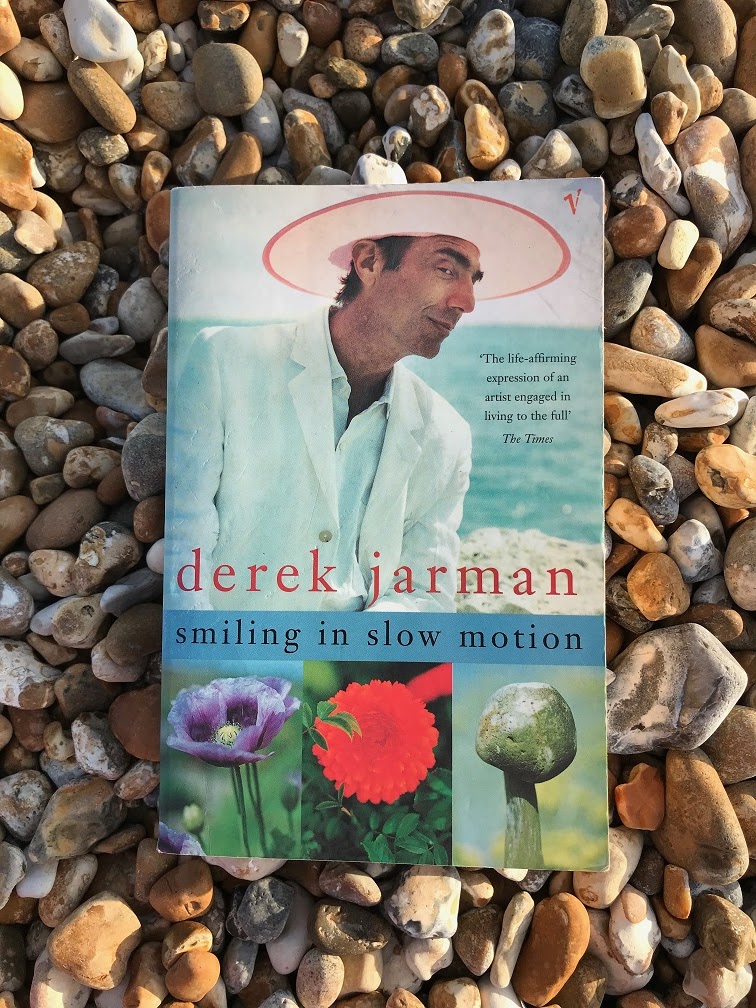
I looked back at his Dungeness diary from September 1992 (published in 'Dancing in Slow Motion') - 'Swallows swoop low around the house... The garden has never looked better'. He mentions a visit by the Sisters of Perpetual Indulgence (drag nun AIDS activists) who had annointed him a queer saint -'we all walked to the sea where the most intrepid paddled in the waves' with 'nuns changing in the loos of the Britannia Inn'


'here comes another winter of long shadows and high hopes'


Dungeness has featured in numerous films, videos and photoshoots because there is nowhere else quite like it. The Prodigy  (Indvaders must die) and Nicki Minaj (there's a funny film of her being carried down the boardwalk while making Freedom video) have shot there, while Athlete and Trembling Bells are amongst those namechecking it in songs. I particularly like the fact that the cover of joyous noughties album ‘So much for the City’ by The Thrills was apparently shot there. The album is essentially a fantasy of West Coast USA as imagined from Ireland. The band even got to appear in the OC - let’s just say that Dungeness is a long way from the Orange County.


Sunday, 21 July 2019

The View from a Hill - getting lost in the Sierra Cabrera


I recently had a family holiday in the semi-desert landscape of Almeria in Spain - an area where many classic 'western' films were made, such as Sergio Leone's 'The Good, the Bad and the Ugly' and 'Once upon a time in the West'. We stayed in Los Matreros, a tiny village on the edge of the Sierra Cabrera mountains, with lots of great running trails if you don't mind hills... and more hills stretching in all directions.


The best feature of where we were staying was a swimming pool where we all spent lots of time. In the evening swallows would dive around it - one flew in to the house and got trapped there (eventually it got tired and I was able to gently cover it in a sheet then released it outside).

The pool was oriented towards a striking hill on the other side of a dried up river valley so I was determined to run up it. It seemed easy enough, I could see that there was a track that wound around and up the lower part of it at least.


So I set off one morning, following the track as it headed behind the hill and then clambering up towards the top - my legs getting scratched by bushes as I did so. Of course I wanted to look back at where we were staying and I could see the small village of white buildings nestled into the hills opposite. But I could not see our house at all and it should have been easy to spot as it was next to the only high trees in the village. There was no sign of the trees or the house.

After a while I concluded that I must have been looking at a different village altogether but I couldn't work out how it could be in apparently the same place. If I was standing on top of this hill surely I must be able to see the house as from the house there was such a clear view of the hill. I had a spooky sensation that brought to mind M R James' classic ghost story 'A View from a Hill' (1925). 


James sets up the story by making it clear that a traveller is heading into unknown (to him) and sparsely populated territory: 'How pleasant it can be, alone in a first-class railway carriage, on the first day of a holiday that is to be fairly long, to dawdle through a bit of English country that is unfamiliar, stopping at every station. You have a map open on your knee, and you pick out the villages that lie to right and left by their church towers. You marvel at the complete stillness that attends your stoppage at the stations, broken only by a footstep crunching the gravel...He was in the depths of the country. I need not particularise further than to say that if you divided the map of England into four quarters, he would have been found in the south-western of them'

Stopping at his destination, the local Squire accompanies him on a walk - 'it was hot, climbing a slippery grass slope that evening.... A small clump of old Scotch firs crowned the top of the hill; and, at the edge of it, commanding the cream of the view, was a wide and solid seat, on which the two disposed themselves, and wiped their brows, and regained breath. ‘Now, then,’ said the Squire, as soon as he was in a condition to talk connectedly, ‘this is where your glasses come in. But you’d better take a general look round first. My word! I’ve never seen the view look better.’

Looking through the binoculars that he has been lent, the protagonist spots buildings in the distance that he cannot see with the naked eye and which his companion cannot see either. There is a gallows and a large church. The explanation in this case is that the binoculars have been manufactured with some act of sorcery that enables people using them to see what was there in the past.

In my case the explanation was more prosaic - it dawned on me that I must in fact be on a different hill to the one I thought I was on. I ran down and up the similar shaped adjacent hill and yes there was our village and house, with my son waving at me from by the pool. 

It was a reminder to me of just how quickly and easily you can become lost and disorientated in hills. You take a wrong path, imagine you are somewhere when in fact you are somewhere else, and if you continue you could find yourself in trouble in some circumstances.   When I hear about people doing solo running feats in hills and mountains  I am impressed by the endurance of endless ascent and descent but most of all I am impressed by how people can navigate in such landscapes, often in dark and/or harsh weather conditions. The potential dangers are the reason, for instance, why the Bob Graham club discourage unaccompanied solo attempts to run the famous round of Lake District mountains in 24 hours. 

My little run in Spain was certainly no Bob Graham round and I was not in any danger but it was a reminder not to take the lonely hills lightly. 


The sun rises over the hills while running on the Summer Solstice 2019

Monday, 30 October 2017

The Running Sky - of birds, books & runners in rotation

In Nottingham's Wollaton Park after this year's English National Cross Country Championships, there was a moment as the sun was going down when a large number of crows (yes I know the collective noun is 'A Murder') began circling above the hill where shortly before thousands of runners had circled on the last lap of their races. It felt like they were echoing the cross country race itself, though presumably they do it all year round, the park being home to 'a large corvid roost made up of rook, jackdaw, and carrion crow' (wikipedia)

It reminded me of a passage I'd read earlier that  day in Tim Dee's The Running Sky: A Birdwatching Life, describing not crows but a similar flight of seabirds:

'To see vast numbers of birds in silent movement is beautifully strange. In this crowd of so many moving things, the eye leaps constantly from individuals to the whole event. These are not flocks but countless single birds caught in a storm of life. Individuals fly fast but the ensemble seems to be moving at dream speed. The rush of the single bird somehow slows in the crowd. I cannot focus for long on a puffin with its hurrying wings in the wheeling cloud; instead I see a tumbleweed of birds rolling out from their grassed lawns and terraces over a gulf of air, a slow motion collective rotation'.

I’d been reading this book on the journey up to Nottingham – with a title like the Running Sky it got some curious looks on a train full of runners. But of course it is not a running book but a reflection on the author's lifetime fascination with birds.


While I have never been a fully fledged adult birdwatcher, I was and am interested in them as I have mentioned before. At primary school an enthusiastic teacher enrolled me in the Royal Society for the Protection of Birds' Young Ornithologists Club, something I recalled recently when I went to a bird themed art exhibition at the old library building on Walworth Road, near the Elephant and Castle (the building, which housed the Newington library and Cuming Museum has been closed following a fire, hopefully it will fully reopen permanently in the not too distant future).

From 'Natural Selection', Andy Holden and Peter Holden

Natural Selection combines the scientific perspective of Peter Holden, sometime national organiser of the Young Ornithologists Club, and the work of his artist son Andy Holden who is as interested in the aesthetic properties of birds, their nests and indeed the illicitly curated hordes assembled by illegal egg collectors.  Without undue anthropomorphism he wonders whether in some circumstances individual birds make choices about their use and display of materials in a way that can be regarded as akin to artistic activity. 


The display includes a case of birds nests arranged on piles of books - the importance of which cannot be overestimated. A recent thread on Twitter started by nature writer Robert Macfarlane asked people to share which bird, animal and plant books they had learnt from as children. It reminded me of how much those of us with childhoods before the Internet or even widespread colour TV relied upon books like the Observer's Book of Birds and the various Ladybird bird books among others. In fact it was in some ways the colourful plenitude of these lavishly illustrated volumes that made bird life seem so appealing, even if most of us would only get to see a handful of the species in the feather and flesh. I was particularly taken by a series of early 1970s 'Hamlyn All Colour Paperbacks' illustrated by Ken Lilly, I still have my copies of Seabirds and Birds of Prey, though along the way have lost my Tropical Birds.


In the wild, birds are rarely to be viewed in fine detail up close and still, but as we catch glimpses we fill in the gaps in our visual perception with the mental images we have stored from drawings and photographs. But no bird book can really capture the social phenomenon of flocks of birds in 'slow motion collective rotation', like runners racing around a field. And what does the birds eye make of the crowd of humans down below as they jostle for position, each dwelling in their individual exertions and largely oblivious to the pattern they create as they weave in and out of each other, moving together and separately at the same time. 

(The Running Sky takes its title from a Philip Larkin poem, which rather gloomily asserts the pointlessness of dreaming of flying or running as loss and loneliness are all that await...

'If hands could free you, heart,
Where would you fly?
Far, beyond every part
Of earth this running sky
Makes desolate? Would you cross
City and hill and sea,
If hands could set you free?

I would not lift the latch;
For I could run
Through fields, pit-valleys, catch
All beauty under the sun—
Still end in loss:
I should find no bent arm, no bed
To rest my head'.

Natural Selection continues until 26 November 2017, I strongly recommend going to see it (visitor details here) 

On a similar theme to ‘Natural Selection’ here's the wonderful Band of Holy Joy with the Observer's Book of Birds Eggs:
'it was the first book I ever owned, the Observer's book of birds eggs, fully illustrated and described in natural colours, and yay it was mine. I devoured every page from the hooded crow to the ptarmigan' (incidentally lead singer Johny Brown ran the Royal Parks Half last month after doing the Great North Run last year).


Saturday, 25 March 2017

The Lark in the Morning - running over Blow's Downs in Dunstable

'In the golden lightning 
Of the sunken sun, 
O'er which clouds are bright'ning, 
Thou dost float and run; 
Like an unbodied joy whose race is just begun'

(To a Skylark by Percy Bysshe Shelley)


I went for a run last week at Blow's Downs nature reserve, a hilltop unimproved chalk grassland 'site of special scientific interest' overlooking Dunstable in Bedfordshire. I say overlooking but on this particular morning there was nothing to be seen in all directions but fog, making superfluous the sign at the top pointing out other landmark hills which are normally visible including Luton's Warden Hill (which I wrote about here previously).


If the town was invisible there was the odd trace of nearby urban reality as a reminder, like the carving on this fallen tree...


Blow's Down, at the northern end of the Chiltern Hills, is known for its wildlife with its information board mentioning ring ousels, redstarts and wheatears. I had hoped that I might see something interesting – the day before I had watched a red kite circling over nearby down Dunstable Downs. On this morning though the birds too were hidden in the mist.


But I could still hear their songs - one in particular as a skylark floated overhead uttering its 'silver chain of sound, Of many links without a break, in chirrup, whistle, slur and shake' (George Meredith, The Lark Ascending, 1881). Yes the skylark is the poet's favourite bird, and maybe every runner too aspires to 'float and run... like an unbodied joy' as Shelley puts it.  Though while running in limited visibility on uneven ground the runner must not lose themselves too much in ethereal thoughts - there is a steep quarry on the hill, and last year a dog walker broke his leg falling down the slope. 'The lark in the morning she rises from her nest', but s/he never loses sight of the ground.


'Alas! my journey, rugged and uneven,
Through prickly moors or dusty ways must wind;
But hearing thee, or others of thy kind,
As full of gladness and as free of heaven,
I, with my fate contented, will plod on,
And hope for higher raptures, when life’s day is done'
(To a Skylark by William Wordsworth)


The Luton - Dunstable busway runs along the bottom of the downs, a bus only route with a track alongside it that is great for runners and cyclists.


(The Lark in the Morning is of course an Irish folk song, I used to be part of a folk music session that performed it every Sunday afternoon in a pub near Elephant and Castle back in the 1990s)

Sunday, 29 May 2016

Southwark Park 10k, May 2016

267 of us took part in a 10k in Southwark Park on 14th May,  organised by PB Race Events. The park hosts a weekly 5k parkrun on Saturday mornings,  on this occasion it was cancelled but many of the regulars stepped up to race the longer distance. 


As discussed here before, Southwark Park has a long athletics history  - including being the birth place of Cambridge Harriers. I can't say my own performance was particularly historic in the recent race, I started at PB pace but soon fizzled out. The course, while flat, wasn't particularly PB friendly as there were two hairpin bends to negotiate on each of the three laps. But I don't think I can really blame my sluggish second half on that - it didn't stop others.


The race was won by David Henderson of Inverclyde AC, with Tilly Snow of Stragglers running club the first female finisher (full results here)

The finish line of a well organised race


Some of my fellow Hilly Fields parkrun and Kent AC regulars at Southwark Park 10k

I wandered over to nearby Canada Water afterwards, a watery remnant of the old Canada Dock which now has a Decathlon sports store next to it and waterfowl nesting on it, including this lovely swans nest.


Monday, 3 August 2015

Running with Herons

My pleasant London Sunday long run yesterday included heading up to the Tower of London to watch cyclists go by in their thousands in the RideLondon-Surrey 100 mile event. As well as enjoying the spectacle, associated road closures meant that Tower Bridge was devoid of traffic and I was able to run across it in the middle of the road like it was mile 12  of the London Marathon all over again.


Heading home I passed through Burgess Park, where by the lake a grey heron was casually strolling along the path not in the slightest bit bothered by runners heading past. As the lake is on the Saturday parkrun route I can only assume that the wildlife there has grown accustomed to the sight of legs and Lycra! 

Heron on Burgess Park lake

On another run last week from St Katherine's Dock to Shadwell Basin I also saw a couple of herons calmly wading in the water as frantic humans packed a few km into their lunch breaks. I can't help thinking that they are conveying some taoist message about effortless grace.

Sunday, 21 July 2013

Birdwatching and running

Assuming you don't only run on a treadmill or track, running means spending a lot of time in the great outdoors. And that means that in your running you will encounter many birds, whether in city parks or rural wilderness. Of course you might not notice them as you focus on the ground in front of you, your time, your pain, or whatever you are listening to on your headphones, but they are there nonetheless.

I have never been a proper twitcher, but a time in the RSPB Young Ornithologists Club at primary school set me up for a lifetime appreciation of birdlife. And I think that does enrich my experience of being out and about running. In my regular parkrun in Hilly Fields I see the bright green ring-necked parakeets and, at this time of year, the swifts on summer holiday in South London from Africa (OK I tend to notice them more in the post-run state of mild euphoria than when I am chasing a 5k PB). I was delighted to see a beautiful goldfinch as I was on my way to the run last week.

Goldfinch

Running around Rotherhithe I see the waterfowl that live in the stretches of water that remain from the long-closed Surrey Docks - there are swans, ducks, coots, moorhen, and, on the nearby Thames, cormorants. I once saw a kingfisher by Surrey Docks Farm.

Running on holiday in Portugal I kept coming across a species of bird that is only found there and in Spain - the Iberian Azure-Winged Magpie. They fly and behave just like the magpies we see in this country, but as they look different I managed to break the lifetime habit of counting them ('One for sorrow, two for joy, three for a girl, and a four for a boy, five for silver, six for gold, seven for a secret never to be told').

Azure-winged magpie

Of course some birds are pretty good runners themselves. The roadrunner, found in the southern United States and Mexico, isn't quite as fast as its cartoon representation but can clock up speeds of 20 miles per hour. And if you should happen to come across an ostrich while running (unlikely in South London) don't bother trying to keep up. The fastest bird on land can reach speeds of up to 43 mph (70 km/h) - is using them as pacemakers the  secret of Kenyan running?!

Roadrunner


Update, 24 July 2013:  a 10k run this week taking in Dulwich Wood/Sydenham Hill Wood, a paradise of robins, blackbirds, wrens, great tits and best of all on my run a Lesser Spotted Woodpecker. Also saw a heron amongst the dragonflies on  a run along the canal between St Katharines Dock and Shadwell Basin.

11 August 2013: saw a Green Woodpecker while warming up for Richmond Park 10k today. 

26 August 2013 : running by the Thames at Purley, a flight of Canada geese alongside me just above the water

22 August 2014: I was buzzed by terns running near their nests of the Isle of Islay

26 October 2014: saw two Green Woodpeckers while running over Farthing Downs near Coulsdon.