Showing posts with label history. Show all posts

Thursday, 27 September 2018

When Kent AC were based at the Brockley Jack (1900s)

Like most sporting bodies, my running club Kent AC has an association with certain watering holes. We have our annual general meeting at the Blythe Hill Tavern in Catford, we gather each year after the London Marathon at the Chandos by Trafalgar Square, and lately we've had social events at The Station Hotel in Hither Green and the Blackheath Wanderers club house on Eltham Road.

Still in the old days Kent AC, like many clubs, not only gathered in pubs but had their headquarters there. This headed paper is from the 1900s (it is from the club's archives held at Lewisham Local Studies Centre) and shows that the club's headquarters at that point were at the 'The Brockley Jack Hotel, Crofton Park'.


The Brockley Jack had just been rebuilt at this point, the current building from 1898 replacing an older inn once known as The Castle on the same site (see history at Transpontine).  Writing in the 1890s, Walter Besant claimed rather dubiously that  'It was named after Jack Cade and was formerly frequented by Dick Turpin and other highwaymen' (London South of the Thames).

The Brockley Jack in 1905, looking much the same as it does now
The Jack on Brockley Road is no longer a club HQ, but it is still very much in Kent AC's London Borough of Lewisham heartland, just a mile or so away from our track at Ladywell Arena. Interestingly Kent AC's headed paper from this period also mentions somewhere further away - 'Country Quarters' at 'The Tiger's Head, Bromley'.

With Lewisham becoming increasingly urbanised by the 1900s, the club no doubt had to go further out for cross country races, hence a Bromley HQ perhaps. Not sure what pub this refers to though. There is a still standing Tigers Head on Masons Hill BR2 in Bromley proper, but there was also a now demolished pub of this name on the Bromley Road, Bellingham which would have been closer to to Kent AC territory.

Still have a plan for a run between pubs associated with the club at some point, would be good to find out more about this and the people mentioned - the honorary secretary is named as Carl Wallace, 94 Lewisham Road, with his deputy 'F. Till, 10 Chesterfield Grove, East Dulwich'.

Thursday, 9 February 2017

Running London: tracking the city's first railway journey

As somebody reminded me on twitter, yesterday was the anniversary of the birth of the London railways. On 8 February 1836, the first section of the London and Greenwich Railway was opened, with trains between Deptford and Spa Road in Bermondsey - the first passenger steam trains in the capital. Over the next few years the line was extended to reach London Bridge at one end and Greenwich at the other.

Today I decided to retrace that first train journey, running as near as I could the track from Deptford to Spa Road and indeed beyond to Druid Street then Tooley Street.


The railway not only transformed transport but the architecture of the city. To avoid the need for lots of level crossings, the railway was elevated above street level on a viaduct with hundreds of brick arches. 

Arches in Deptford

The site of the original Spa Road station is marked by a plaque commemorating 'London's first railway terminus, opened 1836'.


There is also a large photo on display of the old station.


The bridge where the railway crosses Spa Road is a grand structure supported on pillars.


As I ran alongside the railway I reflected on all the ever changing uses of these railway arches, home over the decades to countless stables, workshops, scrap metal yards, churches, gyms, boxing clubs, nightclubs, studios and in their latest incarnation offices like the Neal's Yard Dairy HQ on Druid Street.  I thought of great nights out in railway arches like the Cross club at Kings Cross, Shunt at London Bridge or various arches in 1990s Brixton.  It's been a similar picture in other cities, such as Glasgow, where of course one of the most iconic clubs until it closed in 2015 was The Arches. As urban property has become more valuable and tightly policed, railway arches in some areas are losing their cheap/marginal/semi-outlaw status, but the history of these places isn't played out yet.

Many of these arches have their own distinct stories, some glorious, some tragic. In the latter category, a plaque on Druid Street recalls the Druid Street Arch Bombing when on 25 October 1940 a Nazi bomb killed 77 people sheltering in a railway arch. 


site of the Druid arch bomb, October 1940
(I ran alongside the track for about 3 miles, for most of it close to the line though there were a couple of points where it's not possible to do so - see run details on strava)


Saturday, 21 January 2017

Kent AC women in the 1950s

My club, Kent Athletic Club, was formed in 1898 and has therefore nearly 120 years of running and other athletics behind it, sustained through the years by the efforts of countless volunteers in South East London. Former club coach Larry Garnham is currently finalising a history of the club, and has gathered together a treasure horde of photographs and documents dating back to the club's origins. Some of these have already been deposited in Lewisham Archives, and others will be shortly. 

Here's some great photos from the 1950s of the club's 'Ladies Section'. Prior to the Second World War the club was just for men but this was all to change.

The first photograph is captioned 'KAC Ladies Section - Winter training 1950-51, Ladywell Track' (where the club still trains today). The caption also lists the women - presumably left to right  - as Joyce Lane, Audrey Bell, Beryl Lane, Maureen Theakstone, Shirley Marlow, Olive Hynes, Edna Wittey and Audrey Homewood.


The second photo was also taken at Ladywell in 1950-51 - possibly even in the same session.


I don't have a caption or date for the final team photo but it is evidently from broadly the same period.


See previous posts on Kent AC and its history:


 Always interested to find out more, if you have any club photos or memorabilia lying around do get in touch.

Wednesday, 18 May 2016

Ladywell track: Spike Milligan and some more vintage photos

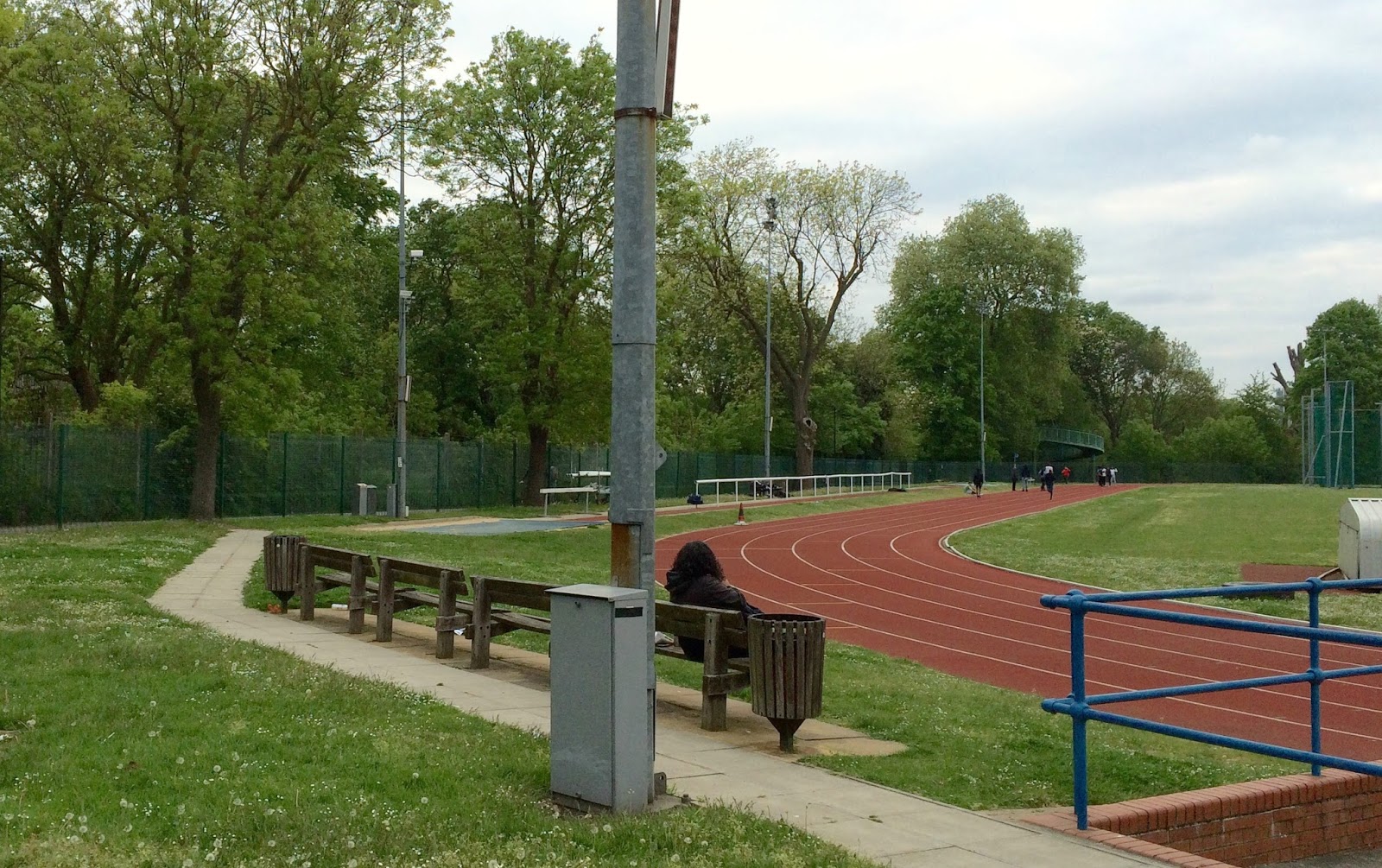
Some more old photographs of the track at Ladywell Arena in Lewisham, home of Kent Athletic Club.

First picture was sent to me by club member Paul Crompton.  The track looks much as now, but without the high fence surrounding it or the floodlighting. The photo is is undated,  but I am guessing  some time in the 1970s. In the background you can see the old iron railway bridge for pedestrians crossing the track, which has been replaced with a concrete structure.


Similar view today


This Getty Image is captioned 'Cubs from the 23rd Lewisham North Pack in London train at Ladywell Park for their athletes Proficiency Badge' and is dated December 1955.


This newspaper clipping popped up on ebay, only information is that it's from 1955. Headlined 'Off to the track' it reads ' Dorothy Lamb, a Suffolk County sprint champion carries her starting blocks to the track ready for a spell of training at Ladywell Park'. I haven't found a Ladywell Park anywhere on google, nor is there another Ladywell track past or present listed at the UK running track directory - so assume this must be at our Ladywell track in Lewisham.


Here's a picture of the comedian Spike Milligan, who grew up in Lewisham.I can't find one of him at Ladywell unfortunately but he also used to hang out at the track.


'Prior to the war, I was a keep-fit addict. Every morning you could see people counting the bones in my skinny body at Ladywell Recreation Track, as I lifted barbells. Sometimes we were watched by admiring girls from Catford Labour Exchange'
('Adolf Hilter: my part in his downfall' by Spike Milligan, 1971)

See also:
  

Friday, 6 November 2015

Friday photos: Kent AC and other 1960s athletics

Following the photo I posted earlier this week of a group of Kent AC athletes from the 1950s, Roy Candy (who ran for the Lewisham-based club from 1960 to 1966) has been in touch and sent through some great photographs from the 1960s.

The group photo was taken at a training weekend at Timsbury Manor, Hampshire in 1965. It features members of Kent AC (back left row), Cambridge Harriers and London Olympiades, including for the latter the great Lilian Board and Mary Bignal Rand. Kent AC runners featured include Tina Ash (nee Darby), Nigel Porter, Cheryl Miller, Beverley Franklin (nee Panter), Dave Franklin, and Roy himself.


The next couple of pictures are from the Eton Manor to Southend Road Relay (c.1964) and show Kent AC runners Peter Brenchley, Roy Candy and John Oliver.


At Kent AC's Ladywell track in 1965, Lewisham Half-Mile Champs won by Roy Candy in 2m 1.4s from Mike Field and Richard Selby.

Another training weekend, possibly Camber Sands 1963. Among those featured are Avril Usher (later Avril Bowring), who ran for Kent AC at the time and later competed in the 1970 Commonwealth Games in the 400m.


As always, any more names or memories very welcome in comments.

Wednesday, 4 November 2015

Kent Athletic Club: 1950s Photo

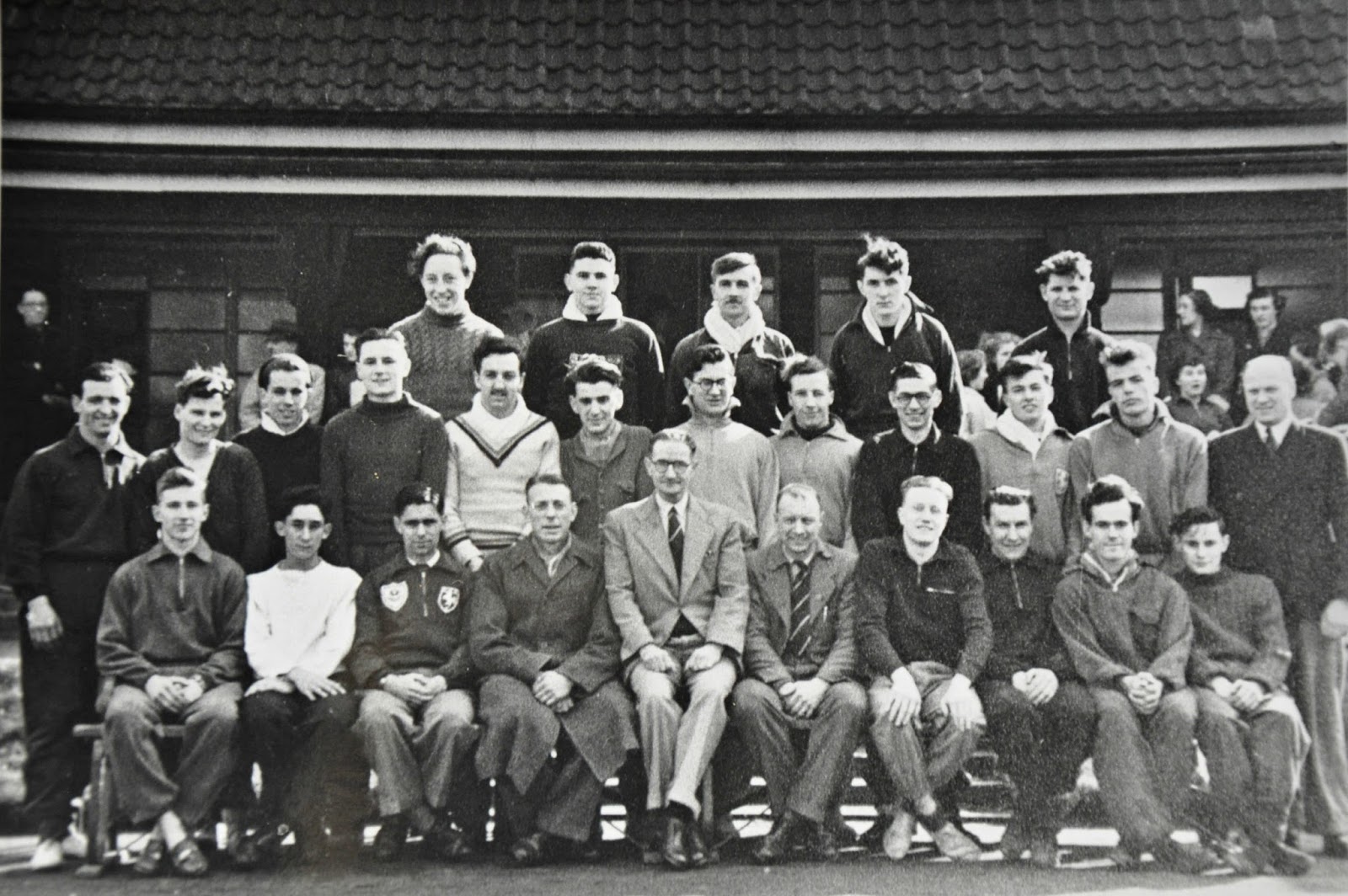
One of the threads at this blog is the history of athletics in South East London, including my club the Lewisham-based Kent Athletic Club. Larry Garnham, who is researching Kent AC history, has found this club photo from the 1950s. He has provisionally identified many of the faces, but has quite a few unknowns.

If you recognise any of the faces, or have any memories of the club and its runners in this period (or at other times), do let us know in the comments and we will pass on to Larry.


Back Row: JIM SAMPSON (Thrower), PAT JAMES, PETER MACDONALD, UNKNOWN. RALPH DODKIN (400 hurdles).

Middle Row: UNKNOWN, NORMAN FOX, UNKNOWN, JOHN WHALL (Jumper), UNKNOWN, BRIAN LINES, LES WITTEY,  DENNIS MILLGATE (Sprinter), UNKNOWN, ALAN DARVILLE (High Jumper), JOHN COOKE, JIM TREGUNNO (Treasurer)

Front Row: UNKNOWN, UNKNOWN, ARTHUR WHIFFEN, TOM WALKER, FRED LANE (President), FRED TREGUNNO (Secretary), UNKNOWN, EDDIE BABBS, DEREK WALLS, UNKNOWN.

(Dennis Millgate, in the middle row, went on to be Secretary of Kent County Athletics Association from 1965-1974 and 1978 to 1985).

(John Whall, born 25/6/1934 is on the UK all-time lists for a 7:52 long jump at Erith in April 1960; he also won the triple jump at the 1959 AAA British Athletics Championships)

(Fred Lane features in another 1950s photo featured here previously, acting as a starter at Kent AC's Ladywell track, see: http://go-feet.blogspot.co.uk/2014/11/friday-photos-16-ladywell-running-track.html)

See previously on Kent AC history:

Herbert Cowper Scard (1865-1931): Lewisham and Blackheath Cross Country Champion

Notes on the history of Kent Athletics (1908) 


AJ Lock, 1920s Kent AC Miler 

Tuesday, 1 September 2015

Haunts of the Black Masseur

'Haunts of the Black Masseur: the Swimmer as Hero' (1992) is a cultural/literary history of swimming by Charles Sprawson. Its main focus is on writers as swimmers, from the classical period onwards.

For the Romantic poets and those influenced by them, swimming was an embrace of the sublime. Byron considered swimming across the Hellespont in 1810 to be one of his life's greatest achievements, and Edgar Allen Poe was similarly proud of having once swum up the James river against the current. Sprawson compares the Romantic delight in swimming with their fondness for opium,  offering 'self-encapsulation in an isolated world, a morbid self-admiration, an absorption in fantasy':

'The passion for bathing really began with the Romantic generation and 'swim' was a word that particularly appealed to poets… The word suggests a state of suspension, a trance-like condition . .. Like the opium addicts of the nineteenth century analysed by Alathea Hayter, these swimmers felt themselves to be pariahs, elect outcasts, insulated from their fellow men. They too often  experienced through their swims the classic constituents of an opium dream: "the feeling of blissful buoyancy, the extension of time, contrasts of temperature, the bliss of the outcast."  .. Swimming, like opium, can cause a sense of detachment from ordinary life. Memories, especially those of childhood, can be evoked with startling strength and in vivid and precise detail'.

There was also a sexual element - Paul Valery referred to swimming as 'fornication avec l'onde' and wrote: 'I discover and recognise myself when I return to this universal element. My body becomes the direct instrument of my mind, the author of its ideas. To plunge into water, to move one's whole body, from head to toe, in its wild and graceful beauty; to twist about in its pure depths, this is for me a delight only comparable to love'.


Sprawson provides some useful social history too, reminding us that while there may always have been people who swam, swimming as a sport with its own dedicated spaces is a more recent development. The rise  in  popular swimming in Britain was linked with the fashion for bathing at sea resorts from late 18th century, with the first organised races seemingly organised in the 1830s. The first indoor public pools to be built in Britain since Roman times were likewise built in the 19th century.

Styles of swimming have also changed over time. The breaststroke was dominant in English swimming in the first half of the 19th century and Sprawson tells us that  'Frogs were kept in tubs by the sides of pools as a means of instruction'.  The later rise of overarm swimming was influenced by Native American swimming styles, through the medium of such swimmers as Flying Gull and Tobacco who raced the English swimming champion Kenworthy in 1845 'and amazed Londoners with their over-arm windmill stroke'.

Sunday, 19 July 2015

'Sporting Requisites of the Highest Class': Pre-First World War Sports Shops in London

I recently came across a couple of adverts from 1913 for sports shops in London - they appear in issues of Chin Wag, magazine of the Eton Manor Boys' Club which the Bishopsgate Institute has digitised.

F.H. Ayes Ltd was based at 111 Aldersgate Street (near to where the Barbican is now), and were 'manufacturers of every requisite for... lawn tennis, golf, football' etc.  The advert states that the firm was established as early as 1810. As well as sports equipment, they  manufactured board games and indeed wooden rocking horses. In the late nineteenth century they also installed 'removable grandstands for the Centre Court at Wimbledon' (John Lowerson,Sport and the English Middle Classes, 1870-1914, Manchester University Press, 1995).


Spalding's described itself as 'the great London House for Sporting Requisites of the highest class'. In this period they had two London stores - at 317/18 High Holborn and 78 Cheapside.  They also had shops in Birmingham, Manchester, Liverpool, Edinburgh and Paris. But their home was in the United States where Albert Goodwill Spalding (1849-1915)  was an influential figure in the history of baseball- in an attempt to popularise the game in England he helped arrange a tour of baseball clubs in 1889, including a game at Kennington Oval (Mark Lamster, Spalding's World Tour: The Epic Adventure that Took Baseball Around the Globe, 2007). He opened his first shop in New York in 1885, and the company is still a big player in US sports. Interesting that global sports brands were already in existence, and present in city centres, more than a hundred years ago.


'For all sports, come to Spalding's'


Friday, 26 June 2015

'Running Race for Young Ladies' (1828)

'Running Race for Young Ladies at Tenterden' by Robert Cruickshank is an 1828 illustration from Pierce Egan's 'Life in London or, the Day and Night Scenes of Jerry Hawthorn, esq., and his elegant friend, Corinthian Tom, accompanied by Bob Logic, the Oxonian, in their rambles and sprees through the Metropolis'. This fictional account of London adventures was first published as a monthly serial from 1821. 

In reality races involving women would have been a rarity in this period, though not unknown. I don't know whether Cruickshank based his illustration on any real event, but it would have been hard going too far or fast in dresses like these!