Wednesday, 26 August 2015

Athletics at the Museum of the History of Immigration in Paris

The Musée de l’histoire de l’immigration (Museum of the History of Immigration) was officially opened last year in Paris after several years in development. It is housed in a magnificent building near to the Bois de Vincennes that was originally built for the 1931 Colonial Exhibition. The space once used to glorify the French empire is now being used to tell a different story of the migrants who have settled in France over the past 200 years or more- many of them of course from parts of the world which France once invaded and ruled by force (as with British immigration, part of the story is that 'they' are here because 'we' were there).

Swimming statue outside the Musée de l’histoire de l’immigration

Part of the mission of the museum is to celebrate the contribution of immigrants to French society - did you know, for instance, that the creator of Asterix was born to Ukrainian-Polish Jewish parents and grew up in Argentina? 

As with Britain an immediately visible contribution has been in sports and entertainment, a double edged position since that very success is arguably a measure of the exclusion of migrants and their descendants from other spheres. But nevertheless the museum is right to highlight the important role sports has played in the lives of migrants to France. Here's a few images from the museum:

Algerian-born Ahmed Bouguera El Ouafi (1899-1959) - left in the photo - won the Olympic Marathon in Amsterdam in 1928. In the lead up to the competition he worked in a Renault factory in France - hence the caption 'le champion ouvrier' (the workers' champion)

Algerian-born Alain Mimoun pictured after winning the Marathon for France at the 1956 Olympics in Melbourne.

Top - Georgian basketball players in 1932; Bottom - swimmers from the Yiddish Workers Sports Club in 1935  (a Jewish athletics club associated with the Communist Party)


Tuesday, 25 August 2015

Glasgow running: Pollok parkrun

A weekend away in Glasgow for a family wedding saw me looking around for a run, and deciding to given Pollok parkrun a try. Glad I did, it's set in a beautiful country park in the south of the city with the tarmac course winding its way through woodland. The course is decidedly undulating but with no real killer hills and it comes with the bonus of a fast 200m downhill finish stretch through the trees.

The event started as Glasgow parkrun in 2008 (before there were three other parkruns in the city), and now regularly attracts more than 400 runners, with strong attendance from local clubs including Bellahouston Harriers, Giffnock North AAC and Bellahouston Road Runners.

Blurry action shot of the finish!

470 took part last Saturday, the largest parkrun I've attended, and I would say if you are chasing a fast time at Pollok park you need to make sure you start near the front of the crowd and go out fast and furious to avoid the early congestion - it soon thins out though. Alternatively don't worry about a few lost seconds and just enjoy the run. First finisher at the weekend was Iain Reid (Cambuslang Harriers) in 16:19 with first female finisher Hilary Robinson coming home in 19:54

The start is near to the Burrell Collection museum in the park, a fine building complete with cafe for post-run refreshments.


I remember in the 1990s the park was the scene of the Pollok Free State protest camp against plans to build the M77 Motorway across the South West stretch of the park. The motorway went ahead with the loss of thousands of trees. While the remaining park is still large, the episode was a reminder that we can't take the survival of the green spaces where we run and walk for granted. In the same period I visited a similar protest at Crystal Palace park in South London against a building development there - in that case the building did not go ahead, but the threat keeps coming around.

More recently Pollok park featured as part of the route for the 2014 Commonwealth Games Marathon - in fact some of the Australian marathon team took part in the parkrun while they were over for the games.

Hanging out in Glasgow city centre afterwards I caught the Glasgow LGBT Pride parade coming past and was pleased to spot the contingent from LGBT running club Glasgow Frontrunners along with Northern and Edinburgh Frontrunners.

Tuesday, 18 August 2015

Running on Screen (7): Run Lola Run and running as space-timecompression in Berlin

Some inspiration for anyone preparing for next month's Berlin Marathon:

'Not since the heyday of that infernal beeping roadrunner has a character spent as much time running across a cinema screen as Lola' (The Lolaness of the Long Distance Runner, Guardian, 1999)


'After walking, running is the first technology of the body that, through human agency, seeks to compress time and space...seeks to bring together in time two discrete points in space, overcoming the constraint on interaction caused by distance. I run to close the distance between myself and the train waiting to pull away from the platform; I run rather than walk from potential threats, hoping to place distance between the threats and myself.  Running as a means of time-space compression is breathtakingly illustrated in the stunning German movie Lola Rennt (Run Lola Run), written and directed by Tom Tykwer in 1998. In it, Lola has 20 minutes to reach her boyfriend or he will be killed. Given no other means of transport, she has to run as fast as she can given the time available to her. It is an example of space being (or attempted to be) devoured by time' (John Bale, Running Cultures: Racing in Time and Space, London: Routledge, 2004, p.1).


Franke Potente in Run Lola Run

'Run Lola Run depicts its setting, Berlin, as a cyberspace obstacle course or environment usually associated with interactive video and computer games. The eerie emptiness of the Berlin of Run Lola Run... is necessary to keep the protagonist Lola moving at high speed from the West to the East part of town and back again - another fantasy which is only possible when the city is recast as a virtual environment. In Run Lola Run Berlin is represented as an idealised space of bodily and psychic mobility where the instantaneous technology of cyberspace is physically realised as a utopia of speed...

While Run Lola Run does not explicitly indicate that the space of action is Berlin, viewers are clear of the setting: a repeated establishing shot of the Friedrichstrasse U-Bahn stop, a central commuting street near the Brandenburg Gate in the former East Berlin which has undergone extensive reconstruction since 1990, begins each episode of the film... Berlin is also made explicit as Tykwer often stages scenes at clearly-marked street intersections which identify particular locations or boroughs thoughout east and west Berlin. The viewer notes that Lola escapes her father's bank during one episode and faces Unter den Linden; several scenes unfold on the banks of the river Spree; Lola sprints between the Altes Museum and the Berlin Cathedral' (Claudia Mesch, Racing Berlin: The Games of Run Lola Run, M/C: A Journal of Media and Culture 3.3,2000).


Previously in this series:


Thursday, 13 August 2015

Charlie Dark - falling back in love with London via running

Lots of interesting reflections on running from Charlie Dark, founder of Run Dem Crew, in his recent Ted talk 'it's not how fast you go, it's how you cross the finish line'.


I particularly liked his comments about how taking up running changed his relationship with London:

'I'm discovering London in a new light, there's a new kind of nocturnal activity that I'm part of, it's underground, not many people are doing it, it feels fresh, it feels exciting, I'm meeting all these new characters, new smells, new lights, I'm falling back in love with my city again ...

We don't live in London, we own London. On my arm it says 'I do not run, I push the earth down with my feet and I leave my footprints in the concrete behind me'. I want young people to basically feel that they own this city, they're not just like ants mindlessly moving from place to place. We've  got to explore, we cannot be defined by postcode, by colour of skin, by religion, by the place that you live'


Friday, 7 August 2015

Catford Cycling Club and its athletics origins

My running club, Kent Athletic Club, traces its origins back to an earlier club in this part of South East London - Lewisham Hare and Hounds, which merged with West Kent Harriers to form Kent AC in 1898. Lewisham Hare and Hounds also helped spawn another sporting body that exists to this day - Catford Cycling Club.

The story of this episode is told in the book 'The first 50 years of the Catford Cycling Club' by E.J. Southcott, published in 1939.


A key driver of the formation of the cycling club was Charles Percival Sisley, an 18 year old who lived with his parents in Morley Road, Lewisham. He had been been a member of a small local club, Mount Pleasant Cycling Club, based around Mount Pleasant Road in Lewisham.

His plan to create a wider Catford Cycling Club was not universally popular. The Brockley BC complained that 'there were enough clubs already in the SE of London' (there were also Lewisham and Sydenham clubs). But Sisley's plans did find support from 'an athletic club called the Lewisham Hare and Hounds' which 'was also considering the formation of a cycling club'. The club's secretary Ernest G. Brabrook talked to Sisley and the outcome was the inaugural meeting of the cycling club at the Hither Green Hall - HQ of Lewisham Hare and Hounds - on 12 April 1886.


In the Chair was the Reverend W. Hook Longsdon, a keen cyclist, goalkeeper for Colfe’s Grammar School's football team and later curate at St. Mary’s Lewisham.  The meeting agreed a set of rules and that 'All Club runs shall start from the Black Horse, Catford'. The club's first inter-club race in June 1887 was with St Peters Bicycle Club and headed to the ''Salt Box' at Cudham, a popular resort for cyclists for many a year'.


Geraldine Biddle-Perry has explored the history of CCC  further in an excellent article in The London Journal,  Fashioning Suburban Aspiration:Awheel with the Catford Cycling Club,1886–1900 (Vol. 39 No. 3, November, 2014, 187–204).

The author has made good use of material held in Lewisham archives to analyse the membership of the cycling club: 'Using Cross-referencing CCC membership lists between 1886 and 1900 with 1891 Census data reveal a social constituency drawn from a cross-section of middle- and lower-middle-class British suburban society at the turn of the twentieth century. Members were predominantly unmarried young men in their late teens and twenties living with their parents (or boarding) in larger villas and neat terraced houses, sometimes in the same roads in Lewisham, or in neighbouring South London boroughs. Most members were employed as mercantile, commercial and stockbrokers’ clerks, but there are also draughtsmen, commercial artists, travellers and agents, managers, journalists and engineers'. I would imagine that the associated athletic club had a similar membership.

While membership was not explicitly socially exclusive, there were financial barriers to joining it, including the cost of the club's uniform 'consisting of a grey check tunic and breeches in a cloth... this could be made by Messrs Clare & Son, of French Street London, priced at 42/- with an extra 2/- for the addition of a fleece lining.The suit would be worn with black stockings and a black cricket cap adorned with the Club badge (a wheel with the word ‘Catford’ inscribed across it)'.

CCC was ambitious to be much more than just a local club and to make its wider mark in the world of cycling: 'in its first season Catford held the first ‘open’ public road race—over 25 miles on a circuitous route (kept secret until the start of the event) around the adjacent Kentish countryside—a practice the National Cyclist Union described as ‘illegal, illegal as prize-fighting, cocking or any other tabooed sport’'. While the cycling world, like the Athletics world, agonised about the vagaries of amateurism, CCC members made  their living from the sport in various ways. Club founder Sisley became editor of the popular  magazine 'Cycling', while another member, 'T.C. Pullinger started a small manufacturing workshop in New Cross producing his own version of the new safety bicycle, ‘The Parade’. Other members belonging to the Argus Bicycle Club in neighbouring Brockley included a cycle salesman for Stanley bicycles, a self-employed cycle manufacturer producing their own machine ‘The Austen’, a cycle engineer and repairer, as well as a tailor and outfitter selling ‘Cycling, Cricketing and Tennis Suits made to order’. 

 A race at Catford in the 1890s
In 1894/95, the club - nicknamed the Kittens- was involved in the development of the first cycling track with banking in England. The Catford stadium also hosted athletics events before it was sold off to property developers in 1900 (see details at Running Past)

CCC is still going strong today, though focusing on the Bromley and Sevenoaks area rather than its former Lewisham heartland.

[post updated April 2018 with details from '50 years of the Catford Cycling Club']

Monday, 3 August 2015

Running with Herons

My pleasant London Sunday long run yesterday included heading up to the Tower of London to watch cyclists go by in their thousands in the RideLondon-Surrey 100 mile event. As well as enjoying the spectacle, associated road closures meant that Tower Bridge was devoid of traffic and I was able to run across it in the middle of the road like it was mile 12  of the London Marathon all over again.


Heading home I passed through Burgess Park, where by the lake a grey heron was casually strolling along the path not in the slightest bit bothered by runners heading past. As the lake is on the Saturday parkrun route I can only assume that the wildlife there has grown accustomed to the sight of legs and Lycra! 

Heron on Burgess Park lake

On another run last week from St Katherine's Dock to Shadwell Basin I also saw a couple of herons calmly wading in the water as frantic humans packed a few km into their lunch breaks. I can't help thinking that they are conveying some taoist message about effortless grace.

Friday, 31 July 2015

What is the fastest parkrun in SE London? And how much difference does the course make?

All parkruns are equal but some are more equal than others... yes they're all 5k distance (more or less ;-)) but anyone who has run more than one knows that some courses are faster. There are various reasons, such as the terrain (tarmac is generally faster than trail) and how many slowing twists and turns there are, but obviously the main factor is hills. Up hill sections slow most of us down, and even  if we go hard down hill it is rarely enough to make up the time lost on the ascent.

Still, hilly courses are excellent training and for some its enough of a challenge  to just compare times week in week out over the same course. My home parkrun at Hilly Fields is one of the hillier in London, as the name suggests, and I have run it 73 times. But sometimes its good to see how fast you can go on the flat, and if you are chasing a target time it obviously makes sense to seek out a faster course now and then.

But can we quantify how much difference a course makes? Clearly it partly depends on the individual. If you are very strong on hills, then of course you might not notice as much a difference in time when moving on to a flatter course. If, on the other hand,  you can barely keep going up hill you are likely to benefit more when there's less hill to deal with.

Making more general comparisons is more complicated than it seems, as I found when looking at runs in the South East London area (with Mile End across the river also included as it's one of my nearest parkruns as the crow flies). One obvious measure is the average run time which the parkrun website gives for each run. I assume that by average, parkrun refer to the mean. This is calculated from aggregating all the run times from an event and dividing them by the number of runs - in the case of Hilly Fields currently over 15,000.


In my area that makes the flat tarmac course at Dulwich the fastest, more than two minutes faster than the hills of Hilly Fields and Greenwich's Avery Hill Park course.Still I was surprised to see Brockwell Park coming in second fastest when it is certainly much hillier than the pretty flat Southwark, Burgess and Peckham Rye courses. Average times might be affected by various other factors though - perhaps some courses attract more, faster club runners which lift the average while others might have larger, more inclusive fields with a higher proportion of slower runners. Dulwich parkrun has a strong association with Dulwich Runners, Brockwell Park is home to Windrush Tri club, Hilly Fields is close to Kent AC's track, whereas Burgess parkrun has no nearby club - does that affect its times? It's important to recognise that what's being measured here is not how fast the course is as such, but how fast the people running it are. There is a relationship between the two - even the fastest runners run more slowly on tougher courses - but some parkruns seem to have faster fields (i.e. more generally faster runners)

Another way of looking at the average is the median time - that is the time of the runner who finished half way down the field. I would have thought that would ameliorate the 'club runner effect', as the times of the faster runners don't affect the average in the same way. As I don't have access to all the data for parkruns ever, I have just calculated this for all runs last week, that is 25 Jul 2015:


On the median measure, Greenwich still appears to be the toughest course. Southwark Park is now the fastest, with Dulwich slipping into second. Burgess is now faster than Brockwell Park which I would expect. But I certainly don't believe that Hilly Fields is faster than Peckham Rye - there must have just been a faster field at Hilly Fields that day.

Course records

So how do the faster runners compare? What about the course records? Well Bromley comes out fastest for both men and women, with Dulwich and Brockwell Park in the fastest four for both. But course records can sometimes just reflect that a top runner turned up one day. Hilly Fields certainly wouldn't be seen as faster than Burgess Park by most runners, but the fastest male time at the former is 22 seconds ahead of the latter, set on Christmas Day 2014 by team GB mountain runner Shaun Dixon (mind you Burgess record holder Max Nicholls is a junior Team GB mountain runner who could probably also get a good time at Hilly Fields).

More instructive is comparing course records set by individuals at different courses. Kent AC's Amy Clements' has the records at both Dulwich and Hilly Fields, the former 1:18 faster. That's in line with the gap in average times between the two. But  this year's Manchester Marathon winner Paul Martelletti holds records at Mile End and Southwark Park- is the former really faster, or was he just taking it a bit easier in Southwark that day?


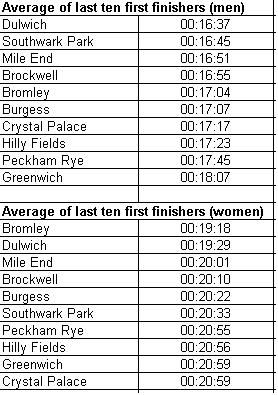
To exclude the 'anomolous super-speedy visitor effect', I've also looked at averaging the last ten fastest finish times at the events. Dulwich and Mile End are in the top three for men and women, Hilly Fields and Greenwich in the bottom three.


Not sure what to conclude from all this - on most measures Hilly Fields and Greenwich are at the slower end, and Dulwich is clearly one of the fastest. But how much difference it makes depends of how you measure it, and of course on the individual. Burgess Park is definitely the fastest for me, my PB there (19:42) is 92 seconds faster than for Hilly Fields PB (21:14), with my fastest times for Dulwich, Southwark Park and Peckham Rye somewhere in between. So I'm surprised that Burgess doesn't figure higher up the speed tables - maybe it just needs some faster runners to run there!

[updated 1 August with median times; all statistics as of 4 July 2015 unless otherwise stated]