Showing posts with label Peckham Rye. Show all posts

Thursday, 7 November 2019

Running the lost river Peck


Secret Rivers, a recent exhibition at the Museum of Docklands, highlighted London’s lost and neglected waterways. As the city spread in the 19th century rivers and streams were increasingly covered up and diverted underground through pipes and sewers. Still for the most part they continue some kind of subterranean existence and we may even find some ghostly traces remaining above ground.

One such 'lost river' is the Peck, which apart from one small section has largely disappeared from view in its South London home. A couple of weeks ago I set out to run its course.

View from One Tree Hill
I started from One Tree Hill at Honor Oak close to the supposed source of the river, always a bracing run up to the summit from Brenchley Gardens. From the top there are great views across London. I paused too to remember the time I played three-sided football there 20 years ago

. There's no sign of the river here or on its route flowing down to Peckham Rye, although running down Kelvington Road/Cheltenham Road towards the Rye you do pass another hidden body of water - the covered Honor Oak Reservoir with its improbable Aquarius Golf Club course on top.

Peckham Rye park is the only place where a section of the Peck can still be seen.
Along with many other runners I have lapped this park many times during Peckham parkrun. The course crosses the narrow stream and its rivulets five times so each parkrunner crosses 15 times every Saturday morning.


The area of the park through which the stream flows was first laid out in the late 19th century with its current course there being the result of human landscaping. It is sometimes little more than a trickle, but at least here the water can be seen and appreciated.


One part of the park is known as the Sexby Gardens, named after horticulturist and first Superintendent of London County Council Parks Department, Lt-Colonel J.J. Sexby who oversaw the development of many London parks. His fascinating 1905 book ‘The municipal parks, gardens, and open spaces of London; their history and associations’ includes a description of the Peckham Rye water features:  'In a secluded hollow delightfully shaded with trees a lake has been made. It has an island in the centre and is fed by a small watercourse running though the grounds, which has been formed into a number of pools by artificial dams. This rivulet has its source in a fountain springing out of the rockwork, and thence meanders through the park, receiving some life when babbling over some miniature waterfalls before its entrance to the lake' (you can read/download the whole book for free at archive.org)

Illustration from Sexby's book

The river now disappears underground with its course following the western edge of the park (Dulwich side) towards Peckham. Greenwood's 1830 Map of London  shows what seems to be a pond fed by the river on the north end of the Common, the triangle now cut off by East Dulwich Road. This was also the location of Peckham Lido which was open from 1923 to 1987 - plans have been put forward to rebuild it, we can only hope.


Peckham Lido

 The map shows the river carrying on down Peckham Rye, past the White Horse (a pub of the same name still stands on the same spot) and then more or less  following the line of what is now Copeland Road, with a footpath alonside it. In the 1830s it seems to have filled a pool in what is marked on the map as a brick field site - this may have been a result of quarrying rather than a natural feature.

1830 map


After that the river is believed to have crossed Queens Road and headed towards the Old Kent Road crossing it at a point somewhere north of the the Ilderton Road junction - I ran down Consort Road, Kings Grove and alongside Brimmington Park to Old Kent Road then crossed over and ran down Ormside Road before joining Ilderton Road. Somewhere in the vicinity of South Bermondsey Station the Peck joined the Earls Sluice, another now buried stream which still flows on to the Thames - but today as part of an underground sewer. I will return to the Earls Sluice another day.


Peckham Lights - from a series of contour maps of the Peck and its environs by artist Loraine Rutt

Here's my River Peck running route - full details on mapmyrun - just under 7k  though I actually ran 12k getting to and from the route. It's an approximation of the course of the river, as there are fences, railways and buildings in the way 


For other people's takes on the route see: London's Lost Rivers, Londonist,  Peckham Society, Diamond Geezer


Tuesday, 28 November 2017

Phyllis Green: 1920s Peckham athlete (plus some Peckham Rye running history)


I did Peckham Rye parkrun again at the weekend, with about  around 250 people doing a 5k in an area that  can claim to be one of the birth places of modern English athletics. Some of the runners were from established local running clubs like Kent AC or Dulwich Runners, some from informal local groups like Runhead AC (who run every Tuesday from the Beer Shop in Nunhead), many just enjoying being part of the parkrun crew. But it is two of the oldest established London clubs, no longer based in the area,  who trace their origins back to Peckham Rye:

'South London Harriers was formed on 27th December, 1871 at a meeting in the Vivian Hotel, at 34 Philip Road (now known as Philip Walk), Peckham Rye, SE15. There was a similar Club close by in Peckham Rye, which was founded at "The King's Arms", as Peckham Hare & Hounds in October 1869, before soon changing its name to Peckham Amateur Athletic Club (PAAC). It later moved to "The Rye House", and in July 1878 moved from the Peckham Rye area to become the Blackheath Harriers' (SLH: A Brief History)
Both clubs moved away from Peckham as it became more urbanised, but are still going strong elsewhere. SLH  has its  clubhouse in Coulsdon, while Blackheath & Bromley Harriers AC is  based at the Norman Road track in Bromley (and with a clubhouse in Hayes).

A notable Peckham athlete was a pioneer women's jumper and the first to clear five feet in the high jump. Phyllis Green (1908-99) was born at 12 Rye Lane where her father Henry Green managed the undertakers. He was a member of Peckham Harriers so no doubt encouraged his daughter who as a 17 year old at Peckham High School for Girls 'set her first world best of 1.51 metres at London's Stamford Bridge in June 1925, and equalled that mark in Brussels a month later. She raised it by half an inch when winning the WAAA title at Stamford Bridge on 11 July 1925, becoming the first woman to clear 5 feet (1.52 metres).  At another London venue, Chiswick, she improved her world best to 1.55 metres (5 ft 1 in) in 1926 and her highest ever jump was 1.58 metres (5 ft 2¼ in) at the 1927 WAAA championships off a grass take-off at Reading’ – the end of a short but successful competitive career . She also held the British long jump record for a while and her personal best of 5.52 metres in 1927 was only 5 cm short of the then world record.  She told a reporter in 1925 that ‘I have always jumped from the time I learned to walk…'I never went round an obstacle—I always jumped over it.' (source:  Mel Watman, Women athletes between the world wars, Oxford Dictionary of National Biography, 2012)
These were the early days of women’s athletics - the Women’s Amateur Athletics Association was only founded in 1922, and Phyllis Green belonged to the London Olympiades Athletics Club, the first women’s club, set up in 1921 in a period when many running clubs only admitted male members.
The only picture I have found of Phyllis Green is an etching by Percy Smith (1882-1948), held in the collection of the Birmingham Museum and Art Gallery

(see Running Past for details of the first WAAA championships, held at Downham in 1923)


Saturday, 2 January 2016

New Year Runs & Resolutions: Register as a Blood Stem Cell Donor

I got off to a good start to 2016 with two 5k parkruns under my belt before breakfast. New Year's Day is the only day in the year that it is possible to record two parkruns on the same day, so  by starting out at Peckham Rye at 9 am (as I did) it was possible to go on to join another run elsewhere in South London immediately afterwards - Hilly Fields and Dulwich parkruns were both scheduled to start at 10 am and Southwark Park at 10:30 am.

At Peckham Rye there were 183 runners including more than 70 experienced parkrunners who had never run at that location before, no doubt many of them looking to do the double and perhaps tick off a couple of locations on the parkrun tourist itinerary for those who try and get round to as many parkruns as possible. In fact I noticed that one of the runners was parkrun uber-tourist Chris Cowell, after whom the unofficial parkrun status of 'Cowell Club' was named for those who have run at least 100 different parkruns (Chris was the first to achieve this feat).

New Year's Day parkrun under way at Peckham Rye  - by Brucie_Baby from flickr group


Chris moved on from Peckham to Southwark Park, I went up to Hilly Fields where the 117 finishers including eight who had never run a parkun anywhere before - evidence perhaps of some New Year resolutions kicking in early.

Blood Stem Cell Donation

I got one of my New Year resolutions out of the way early too by starting the process of registering as a potential blood stem cell/bone marrow donor. I was listening to an interview recently on the Marathon Talk podcast with Melissa Fehr, who does the River Runner blog (she lives on a boat moored on the Thames in London so does plenty of running along the River).  To summarise Melissa's story:

'In 2008 I was running 30km a week, eating healthy, keeping slim, and planning my wedding. Within a fortnight I couldn't walk up a flight of stairs without losing my breath and in July 2009 I had a bone marrow transplant to cure a rare blood disorder.

Unfortunately, my only brother was not a match for me, so the Anthony Nolan Trust put out a worldwide search to find someone with my specific genetics, and a young man from America donated his stem cells to save my life. After a grueling first 6 months, I was able to return to work and exercise, gradually regaining the fitness I'd had before the illness and chemo... and eventually surpassing "the old me"!

In October 2012 I ran my first full marathon in Amsterdam, finishing in 3:48. I ran my second in Copenhagen in May 2013, and after a severe bout of shingles interrupted my training, I still managed to finish in 3:52. In 2014 I ran the Virgin Money London marathon in 3:30 and the Berlin marathon in 3:46'.

Last September Melissa competed for Team GB in the World Transplant Games held in Argentina, and won five gold medals including setting a transplant athlete world record in 1500m

Naturally Mellisa is keen to encourage people to register as potential stem cell/bone marrow donors, as whether somebody can benefit from this life saving treatment depends entirely on finding somebody who is a genetic match for the patient. There are several routes to becoming a donor:

- the NHS British Bone Marrow Registry is open to donors aged 19-49. You must already be a blood donor, and if you wish to join should discuss it next time you give blood

- if you are aged 16-30 you can join the Anthony Nolan register, maintained by the charity.

- Delete Blood Cancer is an international charity, with a UK branch, which maintains a register open to people aged 18 to 55.

I have signed up via the latter, it only takes a couple of minutes to do so online. Next step is that they send a cheek swab which you return to them from which they obtain DNA details. Of course you only get called upon to actually make a donation if there is a patient in need who matches to you. Nowadays most donations are taken via a non surgical outpatient procedure where blood stem cells are collected from the donor’s blood stream, with only a minority requiring extracting cells from bone marrow via a syringe.

Just do it!

You can listen to Melissa at Marathon talk, her interview starts at about 54 minutes 30 seconds.
 

Friday, 31 July 2015

What is the fastest parkrun in SE London? And how much difference does the course make?

All parkruns are equal but some are more equal than others... yes they're all 5k distance (more or less ;-)) but anyone who has run more than one knows that some courses are faster. There are various reasons, such as the terrain (tarmac is generally faster than trail) and how many slowing twists and turns there are, but obviously the main factor is hills. Up hill sections slow most of us down, and even  if we go hard down hill it is rarely enough to make up the time lost on the ascent.

Still, hilly courses are excellent training and for some its enough of a challenge  to just compare times week in week out over the same course. My home parkrun at Hilly Fields is one of the hillier in London, as the name suggests, and I have run it 73 times. But sometimes its good to see how fast you can go on the flat, and if you are chasing a target time it obviously makes sense to seek out a faster course now and then.

But can we quantify how much difference a course makes? Clearly it partly depends on the individual. If you are very strong on hills, then of course you might not notice as much a difference in time when moving on to a flatter course. If, on the other hand,  you can barely keep going up hill you are likely to benefit more when there's less hill to deal with.

Making more general comparisons is more complicated than it seems, as I found when looking at runs in the South East London area (with Mile End across the river also included as it's one of my nearest parkruns as the crow flies). One obvious measure is the average run time which the parkrun website gives for each run. I assume that by average, parkrun refer to the mean. This is calculated from aggregating all the run times from an event and dividing them by the number of runs - in the case of Hilly Fields currently over 15,000.


In my area that makes the flat tarmac course at Dulwich the fastest, more than two minutes faster than the hills of Hilly Fields and Greenwich's Avery Hill Park course.Still I was surprised to see Brockwell Park coming in second fastest when it is certainly much hillier than the pretty flat Southwark, Burgess and Peckham Rye courses. Average times might be affected by various other factors though - perhaps some courses attract more, faster club runners which lift the average while others might have larger, more inclusive fields with a higher proportion of slower runners. Dulwich parkrun has a strong association with Dulwich Runners, Brockwell Park is home to Windrush Tri club, Hilly Fields is close to Kent AC's track, whereas Burgess parkrun has no nearby club - does that affect its times? It's important to recognise that what's being measured here is not how fast the course is as such, but how fast the people running it are. There is a relationship between the two - even the fastest runners run more slowly on tougher courses - but some parkruns seem to have faster fields (i.e. more generally faster runners)

Another way of looking at the average is the median time - that is the time of the runner who finished half way down the field. I would have thought that would ameliorate the 'club runner effect', as the times of the faster runners don't affect the average in the same way. As I don't have access to all the data for parkruns ever, I have just calculated this for all runs last week, that is 25 Jul 2015:


On the median measure, Greenwich still appears to be the toughest course. Southwark Park is now the fastest, with Dulwich slipping into second. Burgess is now faster than Brockwell Park which I would expect. But I certainly don't believe that Hilly Fields is faster than Peckham Rye - there must have just been a faster field at Hilly Fields that day.

Course records

So how do the faster runners compare? What about the course records? Well Bromley comes out fastest for both men and women, with Dulwich and Brockwell Park in the fastest four for both. But course records can sometimes just reflect that a top runner turned up one day. Hilly Fields certainly wouldn't be seen as faster than Burgess Park by most runners, but the fastest male time at the former is 22 seconds ahead of the latter, set on Christmas Day 2014 by team GB mountain runner Shaun Dixon (mind you Burgess record holder Max Nicholls is a junior Team GB mountain runner who could probably also get a good time at Hilly Fields).

More instructive is comparing course records set by individuals at different courses. Kent AC's Amy Clements' has the records at both Dulwich and Hilly Fields, the former 1:18 faster. That's in line with the gap in average times between the two. But  this year's Manchester Marathon winner Paul Martelletti holds records at Mile End and Southwark Park- is the former really faster, or was he just taking it a bit easier in Southwark that day?


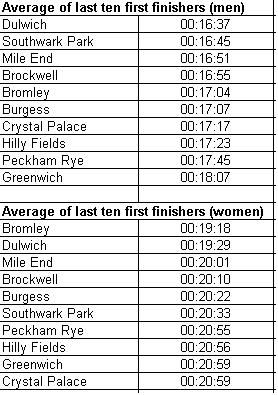
To exclude the 'anomolous super-speedy visitor effect', I've also looked at averaging the last ten fastest finish times at the events. Dulwich and Mile End are in the top three for men and women, Hilly Fields and Greenwich in the bottom three.


Not sure what to conclude from all this - on most measures Hilly Fields and Greenwich are at the slower end, and Dulwich is clearly one of the fastest. But how much difference it makes depends of how you measure it, and of course on the individual. Burgess Park is definitely the fastest for me, my PB there (19:42) is 92 seconds faster than for Hilly Fields PB (21:14), with my fastest times for Dulwich, Southwark Park and Peckham Rye somewhere in between. So I'm surprised that Burgess doesn't figure higher up the speed tables - maybe it just needs some faster runners to run there!

[updated 1 August with median times; all statistics as of 4 July 2015 unless otherwise stated]

Monday, 12 January 2015

Winter running 'traditions': of parkruns, paarlauf and muddy spikes


So Christmas and New Year is well and truly over and for the (barely) gainfully employed it's back to work and marathon training. For the second year running I started Christmas Day at Hilly Fields parkrun. I was slow with a sore ankle but was the first finishing reindeer, so I will take it. It was windy and I had to hold on tight to my antlers on the faster downhill sections of the course. I rarely get lapped at Hilly Fields but on this occasion I was just coming to the top of the hill that marks the end of the second lap when I heard thunderous steps coming up behind me- national Inter Counties Fell Running Champion and GB Mountain Runner Shaun Dixon on his way to break the course record followed closely by Paul Martelletti, who ran for GB in the 100 km World Championships in Doha in August 2014.

Christmas fairy at Hilly Fields parkrun

Is Christmas parkrun becoming a new running 'tradition' over the festive period? Well at Hilly Fields there were 121 runners this Christmas compared with 81 the year before and 20 in 2012. Similarly at Dulwich parkun the numbers have risen from 56 in 2012 and 99 in 2013 to 130 in 2014.  

Then there's New Year's Day, the only day in the year in which you can record two parkruns in one day (for the rest of the year all parkruns everywhere in England start at the same time, 9:00 am). I ran at Peckham Rye at 9:00 am, and then Hilly Fields at 10:00 am, while others went from Peckham to Dulwich Park or Southwark Park. Hilly Fields parkrun ended on a sombre note with a runner collapsing at the finish line and being taken to hospital in an ambulance apparently very seriously ill, but glad to say he seems to be recovering.

As with Christmas Day, there's been a steady growth in runners, at least judging by those South London parkruns that took place on New Years Day. 


Another Christmas tradition amongst many athletics clubs is a paarlauf race. Paarlauf is German for 'pair running' but it can be run with larger teams. Essentially it's a relay race, with the difference being that it is entirely up to each team to decide how it covers the distance - there's no fixed leg. At Kent Athletic Club the pre-Christmas paarlauf at Ladywell track consisted of 13 teams of 3 running 16 laps (6400m) between them. My team ran in consecutive 200m sprints, but as we came last that might not have been the best tactic. Others were taking elaborate short cuts across the middle of the track to enable shorter legs or even having the stronger runners run longer distances. All good fun, though running 11 200m sprints with minimal recovery certainly took it out of me.

The final festive tradition must be the first cross country races of January, where many seasonal pristine presents of nice new running shoes are christened in the mud. Saw some lovely looking spikes before the start of the Surrey League at Streatham Common but they all looked much the same colour afterwards.


Oh yes they used to look like this...